



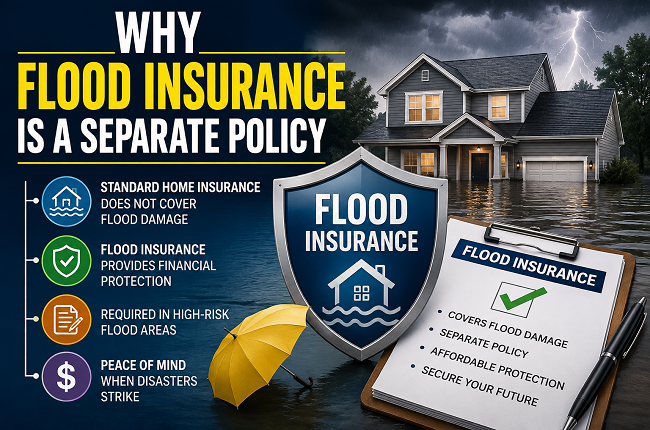
Standard homeowners and renters policies exclude flood. The Washington Office of the Insurance Commissioner states that a typical home insurance policy "does not cover damage caused by flooding. In fact, they specifically exclude damage or losses from flooding." Flood coverage is bought as a separate policy, generally through the National Flood Insurance Program, and it is normally sold by the same agent or insurance company that sells your home policy.
This article explains how flood coverage is structured and where it comes from. It is educational information, not financial, insurance or legal advice. For a question about your own property, speak to a licensed agent or your state Department of Insurance.
Program terms checked August 6, 2026. The coverage limits and rules described here are program terms that can change. FEMA publishes the current figures at FloodSmart.gov, and that is the authority for what applies today.
The exclusion is not an oversight, and four regulators say so
Every state consumer publication reviewed for this article treats flood as outside the standard policy, and the wording is not tentative.
The Washington Office of the Insurance Commissioner states that home policies "specifically exclude damage or losses from flooding." The New York Department of Financial Services states that insurance coverage for losses from floods is not provided in standard homeowners or tenants policies. The North Carolina Department of Insurance states flatly that "Homeowners insurance policies do not cover flood damage." The South Carolina Department of Insurance frames it as the thing consumers most often get wrong: "Most people don't realize that their homeowners insurance doesn't typically cover flood."
So this is not an exclusion that varies much by policy, in the way that some others do. It is a structural boundary between two different contracts. The broader question of what else a home policy leaves out is covered in what a standard home policy never covers.
What "flood" means in this context
The word does a lot of work here, and it is worth noting that not every water event is a flood in the sense the exclusion uses.
The North Carolina Department of Insurance describes the federal program as offering insurance for "direct flood and flood related damage including mudslide and erosion." So the flood contract reaches beyond water alone.
At the same time, the home policy's own exclusions include water events that are not floods. The California Department of Insurance lists water damage caused by seepage or leaks among perils generally not covered, and the Texas Department of Insurance names sewer backups. Those are separate exclusions with separate answers, and a flood policy is not automatically the place they land.
The practical consequence is that "my house had water in it" is not enough information to know which contract, if any, responds. Which one applies depends on the source of the water, and the source is defined in the policy documents rather than by how the damage looks.
Where the coverage comes from instead
Flood coverage is generally available under a separate policy issued through the National Flood Insurance Program, in the New York Department of Financial Services' words. The Washington Office of the Insurance Commissioner describes flood insurance as "widely available through the National Flood Insurance Program."
The important structural point for a reader holding a home policy is that this is a different contract with its own terms, its own limits, its own deductible and its own effective date. It is not an endorsement bolted onto the homeowners policy, and nothing on the homeowners declarations page will tell you whether you have it. If you are still mapping what is on that page, the six coverage parts A through F and how to read an insurance declarations page cover the layout.
A note on this article's sourcing, since it matters for a program page. FEMA's own website and FloodSmart.gov could not be retrieved in this research pass, so every program fact below is sourced to a state insurance regulator publication that was read directly, and the reader is pointed to FEMA for anything current. That is a limitation stated rather than papered over.
Who actually sells you the policy
This is the half of the question most explanations skip, and the answer has two parts that people often collapse into one.
Where you buy it. From your ordinary insurance agent or company. The North Carolina Department of Insurance states that "Your agent or insurance company can assist you with application forms for flood coverage." The Washington Office of the Insurance Commissioner describes buying it from an agent, a broker, or the program itself. The Texas Department of Insurance gives the same route and adds a fallback: "Talk to your home insurance agent about getting a flood policy from your insurance company or the NFIP. If your agent doesn't sell flood insurance, call 877-336-2627."
Who stands behind it. The federal program. That is why the coverage terms do not vary between sellers the way home insurance terms do, and it is why an agent cannot negotiate the coverage the way they might discuss endorsements on a home policy.
The practical implication is that shopping a flood policy is not the same activity as shopping a home policy. There is a market in service and in some cases in private alternatives, but the standard product's terms come from the program.
There is also a private and surplus-lines market alongside the program. The Washington Office of the Insurance Commissioner notes that a household wanting more coverage "can purchase excess flood coverage," and that a policy from a surplus line insurer usually starts immediately. Those are different products with different rules, and a licensed agent is the right person to explain what is available in a given state.
Your community has to be in the program
Here is the eligibility fact almost no consumer page carries, and it is the one that can stop a willing buyer.
The North Carolina Department of Insurance states that the federal program "requires that the community in which you live adopt zoning laws that prohibit future building in flood prone areas." The New York Department of Financial Services tells consumers to "find out if your community participates in the NFIP."
Read together, that means availability is partly a decision your local government made, not one you make. A household can want the coverage, have the money for it, and still be outside the program because of where the property sits and what that jurisdiction has adopted.
This is worth checking before anything else, because it determines whether the rest of the process is even available. Your agent can tell you, and FEMA publishes the participating-community information.
Building and contents are two separate purchases
A household that buys flood insurance and stops after one transaction may have covered the structure and nothing inside it.
The Texas Department of Insurance is explicit about the split. A flood policy "will cover your home up to $250,000," and for belongings "you'll need a separate flood policy for your personal belongings, which provides coverage up to $100,000." The New York Department of Financial Services describes the contents coverage as available for an additional premium, up to the same figure. The Washington Office of the Insurance Commissioner gives the same two residential numbers, and adds the commercial figures of $500,000 on a building and $500,000 for contents.
Those figures are published by the Texas Department of Insurance as updated August 7, 2025 and by Washington's office on a page citing FEMA material dated 09-2024. They are program terms, they can change, and the current version is published by FEMA at FloodSmart.gov. Do not treat the numbers in this article as current on the day you read it.
Two consequences of the structure, neither of which is advice:
Renters have only one of the two to think about. There is no building to insure, so contents coverage is the whole question.
Homeowners can end up with a gap they did not choose. If the building coverage was arranged through a lender requirement and nobody raised the second policy, the contents may simply never have been bought.
The relationship between a limit, a deductible and what a household actually absorbs is the same on this contract as on any other, and is covered in premium, deductible, limit, out-of-pocket.
The 30-day wait, and the two documented exceptions
Flood coverage does not start when you pay for it. This is the single most consequential procedural fact on the page.
The New York Department of Financial Services states that "A flood insurance policy normally will not go into effect until 30 days after you purchase the policy." The North Carolina Department of Insurance describes "a 30-day waiting period before the policy becomes effective; however, there are exceptions," without listing them. The Texas Department of Insurance gives the same rule with the practical warning attached: "Most flood policies have a 30-day waiting period before kicking in so don't wait for an approaching storm."
The Washington Office of the Insurance Commissioner is the one source reviewed here that names an exception. It states that program policies "start covering your building 30 days after the policy is written, unless the policy is required for a mortgage." It separately notes that a policy from a surplus line insurer usually starts immediately, which is a different product rather than an exception to the program rule.
The reason this matters more than it looks is timing. A household that decides to buy when weather is forecast has, in the ordinary case, already missed the window. Whether any exception applies to a specific purchase is a question for the agent writing it, and it should be asked before the policy is bought rather than after.
One more fact worth carrying, because it changes who thinks this page is about them: the Texas Department of Insurance states that 40 percent of program flood insurance claims occur outside the high-risk flood areas. Being outside a mapped high-risk zone is not the same as being outside the risk.
How to find out what applies to you
- Confirm the exclusion in your own policy by reading the exclusions section of the home or renters form. The flood exclusion should be there in writing.
- Check whether your community participates in the program. Your agent can confirm, and FEMA publishes it. This gates everything else.
- Ask your own agent first, since the same agent who wrote the home policy commonly writes this one. If they do not, the Texas Department of Insurance publishes 877-336-2627 as the route to find one who does.
- Establish whether you are buying one coverage or two. Ask specifically about contents as a separate item, not as part of the building conversation.
- Ask when coverage starts, in writing, and whether any exception applies to your purchase.
- Confirm the current limits at FloodSmart.gov rather than from any article, including this one.
Your state Department of Insurance publishes the consumer material this article draws on and handles complaints about how a company administers a policy. The National Association of Insurance Commissioners maintains the directory of state departments.
This site explains documents and contracts. It does not tell anyone whether to buy flood coverage or how much to buy, because that depends on the property, its elevation, its location and the household's own circumstances, and none of those is visible from here. How sources are chosen on this site is set out in our editorial policy.
Frequently asked questions
Can I add flood coverage to my homeowners policy instead?
The state material reviewed here describes flood as a separate policy rather than an addition to the home policy. The New York Department of Financial Services states that flood coverage "is generally available under a separate policy issued through the National Flood Insurance Program." Your agent can confirm what is available in your state.
Do I need flood insurance if I am not in a flood zone?
That is a decision this site does not make for anyone. The relevant fact is that the Texas Department of Insurance states 40 percent of program flood claims occur outside high-risk flood areas, so location outside a mapped zone is not the same as absence of risk. A licensed agent can discuss a specific property.
Why is there a waiting period?
The rule is part of the program's terms. Several regulators state it plainly: coverage normally begins 30 days after purchase. Washington's Office of the Insurance Commissioner names one documented exception, where the policy is required for a mortgage. Whether an exception applies to a particular purchase is a question for the agent writing it.
Does renters insurance cover flood?
The New York Department of Financial Services states that coverage for flood losses is not provided in standard homeowners or tenants policies. Contents flood coverage is bought separately, and it is the only one of the two coverages a renter has to consider, since there is no building to insure.
Sources: Washington State Office of the Insurance Commissioner, "Flood insurance" (page cites FEMA material dated 09-2024). North Carolina Department of Insurance, "Flood Insurance" and "Basic Homeowners Insurance" (no dates shown on the pages). New York Department of Financial Services, "Homeowners Insurance: Flood Insurance" (no date shown on the page). Texas Department of Insurance, "Flood insurance: Why you need a policy," updated August 7, 2025, and "All-risk or named peril home insurance policies," updated September 29, 2025. South Carolina Department of Insurance, "FAQ About Flood Insurance" (no date shown on the page). California Department of Insurance, "Residential Insurance: Homeowners and Renters," Form 401, revised January 2026. All accessed and program terms checked August 6, 2026. FEMA's own pages at FEMA.gov and FloodSmart.gov could not be retrieved during this research and are cited only as the place to confirm current program figures.
