



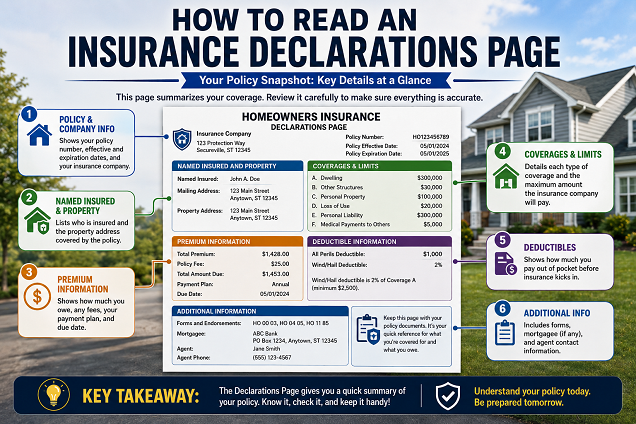
A declarations page is the one- or two-page summary that comes at the front of a home, auto or renters policy. The Maryland Insurance Administration describes it as the document that identifies the kinds and amounts of coverage you have and what it costs. It lists who is covered, for how long, up to what limits, after what deductible, and at what premium. It is a summary of the contract. It is not the contract.
This article explains how a document is laid out. It is educational information, not financial, insurance or legal advice. For a question about your own policy, speak to a licensed agent or your state Department of Insurance.
That last distinction is the one that costs people money, so it is worth stating twice. The declarations page carries the numbers. The policy forms behind it carry the definitions, the exclusions and the conditions that decide whether a given loss is covered at all. Reading the page well means reading the numbers accurately and then knowing exactly which document to ask for next. This guide walks the page block by block, in the order the blocks usually appear, and the walkthrough is the same whether the policy covers a house, a car or an apartment.
What a declarations page is, and what it is not
Insurers call it the "dec page." It is generated for your policy specifically, which is why it carries your name, your address and your numbers, while the rest of the policy is a stack of standard printed forms that thousands of other households receive word for word.
That split is the whole design. The standard forms say what the words in the contract mean. The declarations page says which of those forms apply to you, in what amounts, for what period. Neither half is readable without the other, and only one half arrives in a format most people will actually look at.
So the practical rule is this. Any question of the form "how much" is answered on the declarations page. Any question of the form "is this covered" is answered in the forms, and the declarations page tells you which forms to open. Treating the dec page as the full contract is the most common reading error, and it produces confident wrong answers rather than obvious confusion, which is what makes it expensive.
Where to find yours
A declarations page is issued at least once a year, at renewal, and again any time coverage changes mid-term. Four places to look, in order of speed:
- The insurer's online account. Almost every carrier posts current and prior dec pages under a "documents," "policy" or "ID cards" section.
- The renewal packet. The dec page is the first page inside, usually ahead of a stack of forms with numbers in the corners.
- Your agent. An independent or captive agent can send it the same day.
- Your mortgage servicer or lienholder, if there is one. They are listed on the page and hold a copy, because the escrow account pays the premium.
If none of those produce it, call the insurer's service line and ask for "the current declarations page for policy number X." That is the exact phrase, and it avoids being sent a marketing summary instead.
The identification block: who and what is covered
The top of the page names the parties and the property. On a homeowners policy that means the named insured, the mailing address, and the insured location if it differs. On an auto policy it means the named insured, the listed drivers, and each covered vehicle by year, make, model and VIN. On a renters policy it means the named insured and the rented address.
Two lines in this block do more work than they appear to:
The named insured. Coverage follows this name and, in most standard forms, the relatives who live in the same household. A roommate, an unmarried partner, or an adult child who has moved out is a separate question with a real answer in the policy form, not an assumption to make from the dec page.
The mortgagee, loss payee or lienholder. If a lender is listed here, that lender has an interest in the payout and is usually named on claim checks. On a financed car the lienholder line is also how the insurer knows to tell your lender if the policy lapses.
Check the spelling, the address and the vehicle identifiers. An error here is dull to fix now and serious to discover later.
The policy period, and why two dates carry more weight than they look
The policy period is printed as an effective date and an expiration date, and often with a time of day attached, such as 12:01 a.m. standard time at the insured location. Coverage exists inside that window and does not exist outside it.
Two practical consequences follow. First, the time of day is real. A policy that expires at 12:01 a.m. on the first of the month does not cover a loss that afternoon, and a new policy that starts at 12:01 a.m. begins there, not at midnight and not when you signed. Second, the dates are how you check for a gap when you switch carriers. Lay the outgoing expiration date beside the incoming effective date. If there is a day between them, there is a day with no coverage, and that day is exactly the sort of detail nobody notices until it matters.
The period is also the clock on which a term deductible, a term limit, or an annual aggregate resets, which is why it sits near the top of the page rather than the bottom.
The coverage table: limits and deductibles, read as a pair
The middle of the page is a table. One column names each coverage, one column gives the limit, and one column gives the deductible that applies to it. The limit is the most the insurer will pay for a covered loss under that coverage. The deductible is the amount subtracted before they pay anything.
On a homeowners policy the coverages usually appear as lettered parts. The Iowa Insurance Division, in a consumer guide published on April 4, 2024, sets them out as Coverage A dwelling, Coverage B other structures, Coverage C personal property, Coverage D loss of use, Coverage E personal liability, and Coverage F medical payments to others. Coverage A is the structure itself. Coverage B is what is detached from it, such as a shed or a fence. Coverage C is what would fall out if you turned the house upside down. Coverage D is the additional living expense of being unable to live there. Coverage E responds to a liability claim against you, and Coverage F pays certain medical costs for a guest hurt on your property regardless of fault.
Auto policies use names rather than letters: bodily injury liability, property damage liability, collision, comprehensive, uninsured and underinsured motorist, medical payments or personal injury protection. Renters policies carry a shortened version of the homeowners letters, with no Coverage A because the structure is not yours.
Read each row across, not down. A limit means nothing without the deductible sitting beside it, and a deductible means nothing without knowing which coverage it attaches to.
The deductible line, and where a second deductible hides
Most readers know their deductible as a single number. On a property policy it is often more than one number, and the declarations page is where that shows up.
Two structures appear. A flat deductible is a fixed dollar amount subtracted from a covered loss. A percentage deductible is a share of the insured value rather than a fixed sum. The Insurance Information Institute notes that percentage deductibles generally apply to homeowners policies and are calculated on a percentage of the home's insured value, and that deductibles generally apply to property damage rather than to the liability part of a homeowners or auto policy. The Institute's page carries no visible last-updated date, so it is cited here as a description of structure rather than as a current figure.
The second thing worth knowing is timing. The Institute states that deductibles apply each time you file a claim, with the exception that in Florida and Louisiana hurricane deductibles are applied once per season rather than for each storm. That is a different rhythm from a health plan, where the deductible is an annual figure, and the two get confused constantly.
Look for a separate line naming wind, hail, hurricane, named storm or earthquake. If one is there, that peril has its own deductible and it is frequently the larger of the two. How those percentage deductibles are written and what triggers them is covered in flat vs percentage deductibles.
The valuation words: replacement cost or actual cash value
Somewhere on the page, usually near Coverage A or Coverage C, sits a word or a short code that decides how a payout is calculated. This is the single highest-consequence item on the declarations page and it is often the least visible.
The NAIC, in a consumer article dated January 2, 2025, puts the two definitions this way. Under actual cash value coverage, the policy pays the cost to repair or replace based on the property's value taking account of its age and wear and tear, which is depreciation, and the NAIC adds that this "often does not pay enough to fully replace your property or repair the damage." Under replacement cost value coverage, the policy pays the cost to repair or replace the damaged property using materials of like kind and quality.
The North Carolina Department of Insurance states the same split in plainer terms: actual cash value is the amount needed to fix your home minus the decrease in value from age or use, while replacement cost value is the amount needed to repair at today's prices for building supplies, or to replace belongings at today's cost of a similar item.
A policy can use one basis for the structure and the other for contents, and the declarations page is where that combination is recorded. The full comparison, including the four neighboring terms that are not the same thing, is in actual cash value vs replacement cost.
The form and endorsement numbers, which are the index to the contract
Near the bottom of most declarations pages is a list that looks like clutter: a column of codes such as HO 00 03, HO 04 16, HO 04 90, PP 00 01, or a carrier's own numbering. Readers skip it. It is the most useful block on the page.
Those codes are the actual documents that make up your policy. One of them is the base policy form, which contains the insuring agreement, the definitions, the exclusions and the conditions. The rest are endorsements, each of which adds, removes or modifies something in that base form. Together they are the contract. The declarations page is only the cover sheet that says which ones apply to you and in what amounts.
This gives you a precise request to make. Instead of asking "is water damage covered," which invites a summary, you can ask your insurer or agent to send you the base form and each endorsement by number, then read the exclusions in the base form and check whether any listed endorsement changes them. An insurer is generally able to produce these on request, and the numbers are the reason the request is easy to fulfill.
It also gives you a way to see what changed at renewal. Compare this year's list of form numbers to last year's. A code that disappeared, appeared, or gained a new edition date is a change to your contract, and it will not be announced anywhere else on the page.
Premium, discounts, and the lines that are not coverage
The lower part of the page totals the money. Expect a premium by coverage or by vehicle, a policy total, any fees, and a list of discounts applied.
The discounts list is worth a slow read once a year, because discounts are applied from data the insurer holds about you and that data goes stale. A discount tied to a safety device, a claims-free period, a bundled policy, or a driver who no longer lives in the household is a line you can verify against reality. The Maryland Insurance Administration's consumer material notes that companies may reduce a premium where set conditions are met, such as a good driving record, an antitheft device, or holding auto and homeowners coverage with the same company.
Two things in this area are commonly mistaken for coverage. A fee is an administrative charge and buys nothing. A credit or surcharge adjusts price, not protection. Neither changes a limit, a deductible or what the policy covers, and only the coverage table does that.
What your declarations page will never tell you
This is the boundary worth memorizing, because most disappointment with a policy traces back to a reader who expected the dec page to answer something it structurally cannot.
| The declarations page tells you | Only the policy forms tell you |
|---|---|
| Who is named on the policy | How the policy defines "insured," "residence premises" or "occurrence" |
| The limit for each coverage | Whether your specific loss falls under that coverage at all |
| The deductible for each coverage | What triggers a separate wind, hail or named storm deductible |
| That contents are on an ACV or RCV basis | How depreciation is calculated and whether any of it is recoverable |
| Which endorsements apply, by number | What each of those endorsements actually changes |
| The premium and the discounts | Your duties after a loss, and the deadlines attached to them |
The pattern is consistent. Amounts are on the declarations page. Meanings are in the forms. Anything phrased as "is this covered" is a meaning question.
Five things to check on your own page today
- The names and the property details. Spelling, address, and the VIN of each vehicle.
- The policy period, including the time of day, and whether it butts cleanly against any prior policy.
- Every deductible line, not just the first one. Look specifically for wind, hail, hurricane, named storm or earthquake.
- The valuation basis on the structure and on contents separately. The words to hunt for are "replacement cost" and "actual cash value."
- The form and endorsement list, compared against last year's page.
None of these five requires knowing what the right answer is. They only require noticing what your page says, which is the part you can do without help.
Deep dives on the blocks of this page
Each of these takes one block of the declarations page and works through it in full.
- Premium, deductible, limit, out-of-pocket — the four numbers the coverage table is built from, what each one does, and why three of the four mean something different on a health plan.
- Flat vs percentage deductibles — why a second deductible appears, what the percentage is a percentage of, and what separates a hurricane deductible from a wind and hail deductible.
- Actual cash value vs replacement cost — the valuation words, the depreciation they turn on, and why one policy can use both.
- The six coverage parts, A through F — what each lettered line covers, why three of them are usually a percentage of the first, and why the six are really two different contracts.
- Named perils vs open perils — the two opposite ways a policy can describe what it covers, and the section of your form that settles which one you have.
- What a standard home policy never covers — four state regulator exclusion lists compared, and the three different kinds of exclusion they contain.
- Why flood is a separate policy — where flood coverage comes from instead, who sells it, why your community has to participate, and how the waiting period works.
- Earthquake insurance is a separate policy: the exclusion is written as earth movement rather than earthquake, and the coverage sold against it may not give the whole family back.
- The six coverage parts of a renters policy: what the landlord's policy is actually for, and the four coverages a tenant is buying.
- Loss of use and additional living expense: what Coverage D pays, where its limit comes from, and the two separate ceilings on it.
- Special limits on jewelry, cash and electronics: why a large contents limit does not mean a large jewelry limit, and where your own figures are printed.
- How to build a home inventory: what goes on each line, four ways to organize it, and the storage decision that decides whether it was worth doing.
- Liability, collision and comprehensive: the two questions that separate the three auto coverages, and which of them carry a deductible.
Who to call, and what to have in front of you
For a question about coverage on your own policy, three routes exist and each wants something different from you.
A licensed insurance agent, either your own or an independent one, can explain what a form number does and what an endorsement changes. Have the declarations page and the form list open when you call. Your insurer's own service line can send you the base form and endorsements by number and confirm what is on file. Have the policy number. Your state Department of Insurance is the neutral party. Every state has one, they publish consumer guides, and they take questions and complaints about how a company is handling a policy. The NAIC maintains a directory of state insurance departments, and the state department is the right destination for anything that feels like a dispute rather than a question.
Nothing on this site is a substitute for any of the three. This article explains a document. It does not tell you what coverage to carry, and no page that has never seen your policy honestly could.
Related reading on this site: about us, our editorial policy on how sources are chosen, and the site disclaimer.
Frequently asked questions
Is a declarations page the same as proof of insurance?
Not quite. A declarations page shows coverage, limits and dates, and many parties will accept it. An auto insurance ID card is a separate, smaller document, and some requesters, including some states for vehicle registration purposes, specify one or the other. Ask the requesting party which document they want by name.
Why does my declarations page list coverages I did not ask for?
Some coverages are built into a standard policy form rather than selected, and others are added by endorsement at the carrier's or the lender's request. The form and endorsement numbers at the bottom of the page are what identify them. Your insurer can say which of them are optional on your policy.
My declarations page arrived and nothing looks different from last year. Do I still need to read it?
The two blocks that change most quietly are the deductible lines and the form list. A deductible can move from a flat dollar amount to a percentage at renewal, and an endorsement can be added or dropped, without either change being obvious anywhere else in the packet.
Where do I look to find out whether a specific loss would be covered?
In the base policy form named on the declarations page, and then in each endorsement listed there. The dec page carries no exclusions and no definitions, so it cannot answer a coverage question on its own. Ask your insurer or agent for those documents by their form numbers.
Who regulates my insurance company?
The state you live in. Insurance in the United States is regulated at state level, and your state Department of Insurance is the body that licenses insurers and handles consumer complaints. The National Association of Insurance Commissioners publishes a directory of every state department.
Sources: Maryland Insurance Administration, consumer material on understanding your declarations page. Iowa Insurance Division, "Consumer Connection: Understanding your Homeowners Policy," published April 4, 2024. National Association of Insurance Commissioners, "What's the Difference Between Actual Cash Value Coverage and Replacement Cost Coverage?", January 2, 2025. North Carolina Department of Insurance, "Actual Cash Value vs. Replacement Cost Value." Insurance Information Institute, "Understanding your insurance deductibles" (no publication date shown on the page). All accessed August 5, 2026.
