



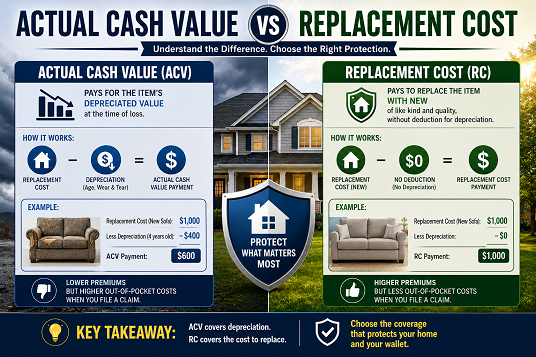
Actual cash value pays based on what the property is worth now, after age and wear are taken into account. Replacement cost pays what it costs to repair or replace with materials of like kind and quality, without that reduction. The NAIC states that actual cash value coverage "often does not pay enough to fully replace your property or repair the damage." The difference between them is depreciation, and which one applies is recorded on your own policy.
This article explains two policy terms. It is educational information, not financial, insurance or legal advice. For a question about your own coverage, speak to a licensed agent or your state Department of Insurance.
Of everything printed on a homeowners or renters declarations page, this is the item with the largest consequence and the smallest font. It is usually a single word or an abbreviation sitting beside a coverage, and it decides how every payout under that coverage is calculated. If you have not located it yet, how to read an insurance declarations page shows where the valuation line normally sits.
The two definitions, as the regulators state them
Two regulators state the distinction plainly, in slightly different words, and having both is more useful than having either.
The NAIC, in a consumer article dated January 2, 2025, puts it this way. Under actual cash value coverage, the policy "will pay the cost to repair or replace your home or personal property based on its value, considering its age and wear and tear (depreciation)," and the NAIC adds directly that this "often does not pay enough to fully replace your property or repair the damage." Under replacement cost value coverage, the policy "will pay the cost to repair or replace your damaged property using materials of a like kind and quality."
The North Carolina Department of Insurance restates the same split in more concrete terms. Actual cash value is "the amount of money needed to fix your home, minus the decrease in value of your property because of age or use." Replacement cost value is "the amount of money needed to repair your home at today's prices of building supplies; or replace your belongings at today's cost of the similar or like item."
| Actual cash value | Replacement cost value | |
|---|---|---|
| Basis of payment | Current depreciated value | Cost to repair or replace with like kind and quality |
| Age and wear | Subtracted | Not subtracted |
| Regulator's caution | NAIC: "often does not pay enough to fully replace your property" | None stated |
| Typical effect on premium | Generally the lower-premium option | Generally the higher-premium option |
| Where it is recorded | Your declarations page and the endorsements it lists | Your declarations page and the endorsements it lists |
Depreciation is the entire difference
Strip away the terminology and there is one variable. Both bases start from the same question, which is what it would take to repair or replace the property. Actual cash value then subtracts an amount for age and use. Replacement cost does not.
The Iowa Insurance Division, in a consumer guide published on April 4, 2024, defines the two in exactly that relationship, describing actual cash value as "replacement cost less depreciation" and replacement cost as reimbursing you to purchase a new item at current market value.
The size of that subtraction depends on the property. A roof covering, a water heater, a laptop and a sofa all lose value with age on different schedules, and a ten-year-old item under an actual cash value policy is valued as a ten-year-old item. That is not a defect in the coverage. It is what the coverage says it will do, which is why the word on the page matters more than any assumption about fairness.
How any withheld depreciation is treated afterward is governed by the policy language and by state rules. That is a settlement question rather than a policy-reading question, and the place to establish it is your own policy form and your state Department of Insurance.
Where these words appear on your own policy
The regulators define the terms. Notably, the NAIC's article does not go on to explain how a policyholder identifies which one applies to their own policy, so that part is worth setting out.
There are three places to look, in order.
The declarations page, beside the coverage. On a homeowners policy the valuation basis usually appears next to Coverage A dwelling and next to Coverage C personal property. It may be spelled out, or abbreviated as RC, RCV or ACV, or expressed as a coverage option code.
The form and endorsement list on the same page. Replacement cost on personal property is often added by an endorsement rather than being part of the base form. If it is there, it appears in that list as a form number, and that number is what you ask your insurer for if you want the exact wording.
The base policy form. The definitions of both terms, and any schedule of property they are applied differently to, live in the form itself rather than on the summary page.
If the words appear nowhere you can find, that is a question for your insurer, and the phrasing that gets a precise answer is "on what valuation basis is Coverage A settled, and on what basis is Coverage C."
A single policy can use both
This is the part most explanations skip. The valuation basis is not one setting for the whole policy. It is set per coverage.
The Iowa Insurance Division makes this explicit for personal property, stating that Coverage C "may be actual cash value (replacement cost less depreciation) or replacement cost." That is a separate determination from the one made for the structure.
The common combination is replacement cost on the dwelling and actual cash value on contents, because contents are where depreciation bites hardest and where the premium difference shows up most. A household can therefore be reading its declarations page correctly, see "replacement cost" next to Coverage A, and still hold actual cash value coverage on everything inside the house.
Some policies also carve out specific categories for different treatment. Roof coverings and certain classes of personal property are the usual examples, and where that is done it is done by endorsement, which means it appears in the form list on your declarations page.
The practical instruction is to read the valuation basis for every coverage separately rather than reading it once.
"Like kind and quality," and what it does not promise
The NAIC's replacement cost definition turns on the phrase "materials of a like kind and quality." It is worth being precise about what that phrase does and does not do.
It sets a comparability standard, not an upgrade. Replacement cost means replacing what was there with something equivalent at today's prices. It does not mean an improvement on what was there, and it does not mean that the exact discontinued item will be found.
It also does not remove the limit. Replacement cost governs how a loss is valued. The coverage limit still governs the maximum payable, and the deductible is still subtracted. A replacement cost policy with a dwelling limit below what rebuilding would actually cost pays up to that limit, and no valuation word changes that. The relationship between limits and deductibles is covered separately in premium, deductible, limit, out-of-pocket.
Four neighboring terms that are not the same thing
Four other phrases appear in the same conversation and none of them is a synonym for either of the two. Worth flagging honestly: unlike actual cash value and replacement cost, these are not defined by a regulator in the sources reviewed here. Carriers define them, and the wording varies, so the only reliable definition is the one in your own policy.
Extended replacement cost. Replacement cost with an additional cushion above the dwelling limit, expressed as a stated percentage. The percentage is a policy term, printed on your own declarations page or endorsement, and there is no standard figure to quote.
Guaranteed replacement cost. Marketed as paying the cost to rebuild without the dwelling limit acting as a cap. Availability and conditions vary by carrier and by state, and the conditions are in the endorsement.
Functional replacement cost. Replacement using contemporary materials that serve the same function rather than matching obsolete construction. It is common on older homes.
Market value. What the property would sell for, which includes land and location. It is not a valuation basis for insurance at all, and it can be far above or far below the cost to rebuild. Confusing rebuild cost with market value is one of the more common misunderstandings in this area.
If any of these four appear on your paperwork, the endorsement number beside it is the document that defines it for you.
What neither term decides
The valuation basis answers one question only: how a covered loss is valued. It does not answer any of the following, and each of them is decided elsewhere in the contract.
- Whether the loss is covered. That is the insuring agreement and the exclusions in the policy form.
- How much can be paid. That is the limit for the applicable coverage.
- What is subtracted first. That is the deductible, and on a homeowners policy there may be more than one. See flat vs percentage deductibles.
- Whether a category is capped separately. Sub-limits on jewelry, cash and similar categories operate independently of valuation.
- What your duties are after a loss. Those are the policy conditions.
A reader who knows their valuation basis and nothing else knows one useful thing. A reader who knows the basis, the limit and the deductible for each coverage can read their whole declarations page.
How to establish which basis your policy uses
- Read the valuation word next to each coverage separately, at minimum for the dwelling and for personal property.
- Check the form and endorsement list for a replacement cost endorsement, and note its number.
- Ask your insurer or agent for the base form and any valuation endorsement by number if you want the exact contract wording rather than a summary.
- Compare against last year's declarations page. A valuation basis can change at renewal.
For questions beyond reading the page, a licensed insurance agent can explain what your endorsement does and what changing it would mean for your premium. Your insurer's service line can confirm what is on file. Your state Department of Insurance is the neutral party, publishes consumer material on exactly this distinction, and handles complaints about how a company administers a policy. The National Association of Insurance Commissioners maintains a directory of state insurance departments.
This site explains documents. It does not tell anyone which valuation basis to carry, and that question genuinely depends on facts about a household that no article can see. How sources are chosen here is set out in our editorial policy.
Frequently asked questions
Which one does a standard homeowners policy use?
There is no single answer, because it is set per coverage and it varies by policy and by carrier. The Iowa Insurance Division notes that personal property may be written on either basis. The only reliable source for your own policy is your declarations page and the endorsements listed on it.
Is replacement cost always the better coverage?
The NAIC states that actual cash value coverage often does not pay enough to fully replace property or repair damage, and replacement cost generally carries a higher premium in exchange. Which trade-off suits a given household depends on facts about that household, and a licensed agent looking at the actual policy is the right person to weigh it.
Does replacement cost mean I get a brand new item for an old one?
It means repair or replacement with materials of like kind and quality, in the NAIC's words, valued at today's cost. It is a comparability standard rather than an upgrade, and the coverage limit and deductible still apply.
Is replacement cost the same as market value?
No. Market value is what a property would sell for and includes land and location. Replacement cost is what it would take to repair or rebuild. The two can differ substantially in either direction, and market value is not a valuation basis for insurance payouts.
Sources: National Association of Insurance Commissioners, "What's the Difference Between Actual Cash Value Coverage and Replacement Cost Coverage?", January 2, 2025. North Carolina Department of Insurance, "Actual Cash Value vs. Replacement Cost Value" (no date shown on the page). Iowa Insurance Division, "Consumer Connection: Understanding your Homeowners Policy," published April 4, 2024. All accessed August 5, 2026.
