



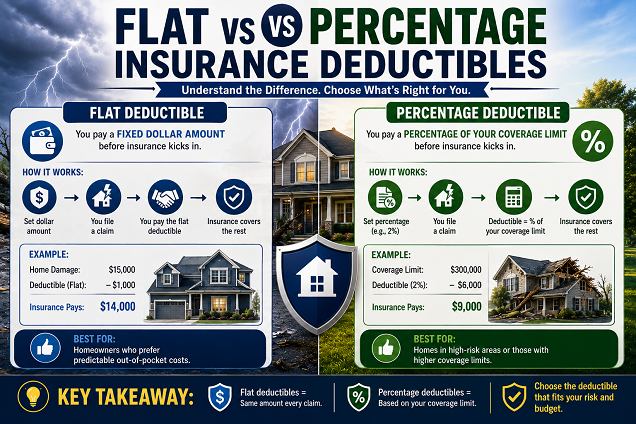
A flat deductible is a fixed dollar amount subtracted from a covered loss. A percentage deductible is a share of the amount your home is insured for, not a share of the loss. The Insurance Information Institute states that percentage deductibles generally apply to homeowners policies and are calculated on a percentage of the home's insured value. That difference is why a percentage deductible does not get smaller when the damage is smaller.
This article explains how a policy clause is structured. It is educational information, not financial, insurance or legal advice. Rules on these deductibles are set state by state, so for your own policy speak to a licensed agent or your state Department of Insurance.
Most homeowners policies carry two deductibles rather than one. There is the everyday figure that applies to most covered losses, and then a separate, usually larger figure that applies only when the cause of loss is wind, hail, a hurricane or a named storm. The second one is frequently written as a percentage, and the percentage is where the confusion starts. If you have not yet located either figure on your paperwork, how to read an insurance declarations page walks through where the deductible column sits.
Flat and percentage: the same line, written two ways
Both structures do the same job. They set the amount that comes out before the insurer pays. They differ only in how that amount is expressed and therefore in what makes it move.
A flat deductible is written as a dollar figure. It stays the same regardless of what your home is insured for and regardless of the size of the loss. It is the structure most people picture when they hear the word.
A percentage deductible is written as a percentage. The Insurance Information Institute describes deductibles as being "either a specific dollar amount or a percentage of the total amount of insurance on a policy," and notes that percentage deductibles generally only apply to homeowners policies. The Institute's page carries no visible publication date, so it is cited here for structure rather than as a current figure.
One further boundary from the same source: deductibles generally apply to property damage rather than to the liability portion of a homeowners or auto policy. The liability coverages usually carry no deductible at all.
What the percentage is a percentage of
This is the point that decides everything else, and it is the one most often misread. The percentage is applied to the insured value of the home, which on a homeowners declarations page is the Coverage A dwelling limit. It is not applied to the amount of the loss.
The arithmetic below uses round numbers because they divide cleanly. They are not presented as typical of any policy, any state or any year.
| Figure | |
|---|---|
| Coverage A dwelling limit | 400,000 |
| Wind and hail deductible, written as 2 percent | 2 percent of 400,000 |
| Deductible in dollars | 8,000 |
| Covered loss of 30,000 | insurer pays 22,000 |
| Covered loss of 9,000 | insurer pays 1,000 |
| Covered loss of 7,500 | insurer pays nothing |
Read the last two rows together. The deductible is 8,000 dollars in all three cases, because it is a function of the dwelling limit, not of the damage. A smaller loss does not produce a smaller deductible, it produces a smaller payment or no payment at all. That is the behavior that catches people, and it is entirely a consequence of what the percentage is measured against.
There is a second-order effect worth noticing. Because the deductible tracks the dwelling limit, it rises whenever the dwelling limit rises. Many policies increase Coverage A automatically at renewal to keep pace with construction costs. A percentage deductible quietly increases with it, and nothing else on the page announces that.
Where a second deductible appears on your policy
Look at the coverage table on your declarations page. The deductible column may hold more than one entry, and the second is usually labeled with the peril it belongs to rather than with a coverage letter.
The labels to search for are wind, windstorm, wind and hail, hail, hurricane, named storm, tropical cyclone and earthquake. Any of these appearing next to a figure or a percentage means that peril has its own deductible.
Two things about that line are worth checking rather than assuming. First, whether it is a percentage or a dollar amount, since some carriers write the wind and hail deductible as a flat figure. Second, whether it changed at renewal. A deductible can move from a flat dollar amount to a percentage between one policy period and the next, and the change is visible only by comparing this year's declarations page against last year's.
The definitions that decide when the special deductible applies are not on the declarations page. They are in the policy form and in whichever endorsement created the deductible, both of which are listed on the page by their form numbers.
Hurricane, named storm, windstorm, wind and hail: four labels, four triggers
These labels are not synonyms, and the difference between them is a difference in what has to happen before the larger deductible applies.
| Label | What triggers it |
|---|---|
| Hurricane deductible | Damage from a hurricane as categorized by the National Weather Service or the National Hurricane Center, per the NAIC |
| Named storm deductible | Broader than the above. The NAIC describes it as covering categorized hurricanes plus other declared weather events such as typhoons, tropical storms and tropical cyclones where a name has been assigned by the National Weather Service or the National Hurricane Center |
| Windstorm deductible | Wind damage generally, per the Insurance Information Institute, which notes windstorm or wind and hail deductibles cover any kind of wind damage including from tornadoes |
| Wind and hail deductible | The same broad wind trigger, extended to hail |
The practical consequence is that a hurricane deductible is the narrowest of the four and a wind and hail deductible is the broadest. A policy with a hurricane deductible applies its ordinary deductible to an ordinary windstorm. A policy with a wind and hail deductible applies the special figure to any wind event at all.
The Insurance Information Institute notes that wind and hail deductibles are common in Midwestern states and in what it calls Tornado Alley, naming Texas, Oklahoma, Kansas and Nebraska.
The published ranges, and why two authorities give different numbers
Two national bodies publish ranges for these percentages, and the numbers do not match. Both are worth having, because they are answering different questions.
The Insurance Information Institute states that wind and hail deductibles "are most commonly paid in percentages, typically from 1 percent to 5 percent." Its background page on hurricane and windstorm deductibles gives the same 1 to 5 percent span for hurricane deductibles, with higher amounts in some coastal areas. Neither Institute page shows a publication or last-updated date, which is stated here rather than glossed over.
The NAIC, on its hurricane deductibles topic page last updated June 2, 2025, gives a wider span: "a percentage of the home's insured value, which can vary from 1% to as high as 15%."
The two are not in conflict. The Institute is describing what is commonly written. The NAIC is describing the span state regulation permits, and it says so directly in the same place: "While there are similarities among the state laws, no two laws are identical; triggers vary from state to state, as well as from insurer to insurer." As of June 2025 the NAIC counted nineteen states plus the District of Columbia permitting some form of hurricane or named storm deductible.
The reason to hold both numbers rather than one is that neither tells you what your policy says. Your own percentage is printed on your declarations page, and that figure is the only one that applies to you.
When a special deductible starts and stops applying
A percentage deductible tied to a named weather event does not apply indefinitely. It applies during a defined window, and the window is set by state regulation and by the policy language.
The Insurance Information Institute states that the duration typically extends from 24 to 72 hours after a warning ends, depending on state regulations. The NAIC's framing of the same point is that triggers vary from state to state and from insurer to insurer.
This matters because the window decides which deductible attaches. The same physical damage can fall inside or outside the trigger period, and the difference between the ordinary deductible and the percentage one is usually large. Since the rule is state-specific and the policy language is carrier-specific, the two places to establish it are your own state Department of Insurance, which publishes the rule for your state, and the endorsement named on your declarations page, which contains the wording your carrier uses.
Earthquake, the other percentage deductible
Wind is not the only peril written this way. The Insurance Information Institute notes that in California, earthquake policies include a 15 percent deductible for main structures.
Earthquake coverage is usually not part of a standard homeowners policy at all. It typically requires a separate policy or an endorsement, which is why its deductible often appears on its own document rather than in the main coverage table. The structure is the same as the wind version: a percentage applied to insured value rather than to the loss.
How to find out which structure your own policy uses
Four steps, none of which requires knowing what the right answer would be.
- Open your declarations page and read the entire deductible column, not the first entry.
- Note whether each entry is a dollar figure or a percentage, and if a percentage, which coverage limit it is measured against. On a homeowners policy that is normally the Coverage A dwelling limit.
- Do the multiplication once so you know the figure in dollars rather than in percent.
- Find the endorsement number attached to the special deductible in the form list, and ask your insurer for that document by number if you want the exact trigger wording.
For anything beyond reading the page, three routes exist. A licensed insurance agent can explain what your specific endorsement does. Your insurer's service line can send the policy form and the endorsement by number. Your state Department of Insurance is the neutral party and the right destination here in particular, because these deductibles are regulated at state level and the rules genuinely differ. The National Association of Insurance Commissioners maintains a directory of state insurance departments.
Two related pages on this site: premium, deductible, limit, out-of-pocket covers what each of the four numbers does, and actual cash value vs replacement cost covers the other line on the declarations page that changes what a payout is worth. Our disclaimer sets out what this site does and does not do.
Frequently asked questions
Is a percentage deductible a percentage of the damage?
No. The Insurance Information Institute states that percentage deductibles are calculated on a percentage of the home's insured value. On a homeowners declarations page that is the Coverage A dwelling limit. The size of the loss does not change the deductible.
Why did my deductible change from a dollar amount to a percentage?
That is a change to the policy at renewal, and it would be recorded on the new declarations page and in the form and endorsement list attached to it. Comparing this year's page against last year's is how the change becomes visible. Your insurer or agent can confirm what was changed and when.
Is a hurricane deductible the same as a wind and hail deductible?
No. The NAIC describes a hurricane deductible as applying solely to damage from a hurricane as categorized by the National Weather Service or the National Hurricane Center. The Insurance Information Institute describes windstorm and wind and hail deductibles as covering any kind of wind damage, including from tornadoes. The wind and hail version is the broader trigger.
Which states have these deductibles?
The NAIC states that as of June 2025, nineteen states plus the District of Columbia permit some form of hurricane or named storm deductible, and that no two state laws are identical. Wind and hail deductibles are separate from that count, and the Insurance Information Institute names Texas, Oklahoma, Kansas and Nebraska among the states where they are common. Your state Department of Insurance publishes the rule that applies where you live.
Sources: National Association of Insurance Commissioners, "Insurance Topics: Hurricane Deductibles," last updated June 2, 2025. Insurance Information Institute, "Understanding your insurance deductibles" and "Background on: hurricane and windstorm deductibles" (neither page shows a publication date). All accessed August 5, 2026.
