



Demo Example
Demo Example
Demo Example
Tag

deductibles

Browsing

Liability pays for losses you cause to other people. Collision pays for damage to your own car from impact with a vehicle or an object. Comprehensive pays for damage to your own car from causes other than a collision. The California Department of Insurance states that "only comprehensive and collision coverage have deductibles," and that liability "does not pay for injuries to you or the people in your household."

This article explains how an auto policy is divided. It is educational information, not financial, insurance or legal advice. For a question about your own policy, speak to a licensed agent or your state Department of Insurance.

Policy structures checked August 10, 2026. Required limits, available coverages and policy forms are set state by state. Your own policy document and your state Department of Insurance are the authorities for your contract.

The one question that separates all three

Auto policies are usually explained as a list of coverages, which is why nobody remembers the list. The three main coverages actually split on two questions asked in order, and once you have the questions the definitions look obvious.

Question one: whose loss is this? If the answer is somebody else's, you are in liability. If the answer is your own car, you are in the other two.

Question two, asked only if the loss is your own car: what caused it? If it was impact, that is collision. If it was anything else, that is comprehensive.

Note what is not on that list. Fault is not the dividing line. Collision responds to impact damage to your car whether or not the impact was your doing. The California Department of Insurance's own description of collision does not mention fault at all. People assume the split is "my fault versus not my fault" and it is not.

Finding these three on your own paperwork is the same exercise as on any other policy, and is covered in how to read an insurance declarations page.

Liability: other people's losses, and not yours

Liability is two coverages that usually appear as one line, and both point outward.

The California Department of Insurance defines them in two short phrases. Bodily injury liability "pays for bodily injury you cause someone else." Property damage liability "pays for property damage you cause someone else."

The North Carolina Department of Insurance gives the fuller version. Bodily injury liability "will pay for damages to other people as a result of an accident caused by you or another covered driver," and its examples include medical and funeral expenses, lost wages, disability, rehabilitation, pain and suffering, lawsuits and legal expenses. Property damage liability "will pay for damages to other people's property as a result of an accident that is caused by you or another covered driver," including the repair or actual cash value of the other person's vehicle or property, and legal expenses.

Then the sentence that corrects the most common misunderstanding in auto insurance. The California Department of Insurance states that liability "does not pay for injuries to you or the people in your household."

So the coverage every state requires is the one that does nothing for you. It exists to make other people whole. Everything that protects you or your car is a separate coverage with a separate price, and a policy carrying liability alone is a complete policy in the legal sense and an empty one from where you are sitting.

Collision: your car, one specific cause

Collision is the narrower of the two coverages on your own vehicle, and its definition is about contact.

The California Department of Insurance: collision "pays for damage to your car caused by physical contact with another vehicle or an object, such as a tree, rock, guardrail, or building." The North Carolina Department of Insurance: "Physical damage to your covered vehicle caused by an impact with another vehicle or object." The Texas Department of Insurance puts it in one line: collision "pays to repair or replace your car after an accident."

Three things follow from the definition.

The other object does not have to be a vehicle. A tree, a guardrail or a building all produce a collision loss on these definitions.

It applies regardless of who caused the accident. Nothing in any of the three definitions conditions the coverage on fault.

It is optional as a matter of law, which is the subject of a later section, and which is why a large number of cars on the road do not carry it.

Comprehensive: your car, everything else

Comprehensive is defined negatively, and that single fact explains why its list of covered causes looks like a miscellany rather than a category.

The California Department of Insurance: comprehensive "pays for damage to your car caused by something other than a collision. For example, comprehensive can cover damage from fire, theft, vandalism, windstorm, flood, falling objects, etc."

Read that list again. Fire, theft, vandalism, windstorm, flood, falling objects. Those things have nothing in common with each other. They are grouped because of what they are not. Comprehensive is the residual category on an auto policy, which is a structure worth recognizing because property insurance uses the opposite approach, listing what is covered rather than what is left over. That contrast is the subject of named perils versus open perils.

Two practical consequences of a residual definition. First, theft of the whole vehicle sits here rather than under collision, which surprises people. Second, weather damage that involves no impact sits here too, which is why the same storm can produce a collision claim for one driver and a comprehensive claim for another.

The Texas Department of Insurance gives the same coverage a plainer name and description: comprehensive, or other than collision, "pays if your car is stolen or damaged by fire, flood, vandalism or something other than a collision."

Only two of the three have a deductible

This is one sentence in a regulator's glossary and it settles a question that confuses almost everyone looking at a quote.

The California Department of Insurance defines a deductible as "the amount of the loss that you must pay before your insurance company pays anything," and then adds: "Only comprehensive and collision coverage have deductibles."

Liability has no deductible. You are not asked to pay the first part of somebody else's loss before your insurer pays the rest of it. The Texas Department of Insurance describes the deductible in exactly the same place, as the amount you pay yourself on a collision or comprehensive claim, which the company subtracts from what it pays.

That is why a quote can show a deductible next to two coverages and not next to the third, and why raising a deductible changes the price of two of your coverages and not the price of the one the state requires. How a deductible interacts with a limit and with what a household actually absorbs is worked through in premium, deductible, limit, out-of-pocket. Property policies structure the same idea differently again, sometimes as a percentage rather than a dollar figure, as covered in flat versus percentage deductibles.

What collision and comprehensive actually pay

Here is the sentence that explains why the same coverage behaves so differently on a new car and an old one.

The North Carolina Department of Insurance states that collision "pays the lesser of the cost of repair or ACV of your automobile," and that comprehensive "pays the cost of repair or ACV of your automobile less any deductible." ACV is actual cash value, the depreciated value of the vehicle at the time of the loss.

Two ceilings apply at once. The repair cost is one. The car's own depreciated value is the other. The payment is capped by whichever is lower, and then the deductible comes off.

On a recent vehicle the repair cost is almost always the binding number. On an older vehicle, the actual cash value can fall low enough that it becomes the binding number instead, at which point the practical value of the coverage has shrunk without anybody changing the policy. What actual cash value means and how it differs from replacement cost is set out in actual cash value versus replacement cost.

The California Department of Insurance's own guidance raises the question of whether to keep these coverages on an older vehicle given its value. This article reports that the question exists and does not answer it, because the answer depends on the specific car, its value and the household's circumstances. That is a conversation for a licensed agent.

Who requires what: the law, and the lender

Two different authorities require two different parts of an auto policy, and confusing them is common.

Liability is required by state law. The limits are set state by state. The Texas Department of Insurance, as one example, states that Texas law requires minimum coverage of 30/60/25. Every state sets its own numbers and its own rules, and your state's Department of Insurance is the place to find yours.

Collision and comprehensive are not required by law. They are required by whoever financed the car. The California Department of Insurance states that "this coverage is required by lenders or leasing companies." The Texas Department of Insurance says the same, describing both as required by lenders if you have an outstanding loan on the vehicle.

The practical consequence arrives the month you pay off a car. The lender requirement ends, quietly, without a notice. Nothing removes the coverage automatically, and nothing tells you the reason it was there has changed. Whether to keep it is a decision, and the point worth making here is only that it becomes a decision at that moment rather than earlier.

Two further coverages sit alongside the three and are worth knowing by name. The North Carolina Department of Insurance describes uninsured motorist coverage as protection when an at-fault uninsured driver injures you or another covered person, including property damage, and underinsured motorist coverage as protection when the at-fault driver's limits are too low, noting that underinsured motorist coverage does not cover property damage. Medical payments coverage, in the same department's words, "pays for reasonable and necessary medical and funeral expenses due to an automobile accident."

What to check on your own declarations page

  1. Find which of the three you actually carry. Liability will be there. Collision and comprehensive may not be.
  2. Read the liability limits, and note that they are set by your state rather than by your insurer.
  3. Check whether there are two deductibles or one. Collision and comprehensive can carry different amounts.
  4. Note your vehicle's age, because on the published definitions the payment is capped at the car's depreciated value.
  5. Know whether a lender still requires anything, and know what changes when the loan ends.
  6. Ask about uninsured and underinsured motorist coverage separately, since the three main coverages do not address a driver with no insurance.

Your state Department of Insurance publishes the consumer material this article draws on and handles complaints about how a company administers a policy. The National Association of Insurance Commissioners maintains the directory of state departments. A licensed agent in your state can tell you what is required and available where you live.

This site explains documents and contracts. It does not tell anyone which coverages to carry, what limits to choose, or which company to buy from, because that depends on the vehicle, the state and the household's own circumstances, and none of that is visible from here. How sources are chosen on this site is set out in our editorial policy.

Frequently asked questions

If someone else hits my car, does my collision coverage or their liability coverage pay?
Both are potentially in play, because they are different contracts doing different jobs. Their liability coverage exists to pay for damage they cause to other people's property. Your collision coverage responds to impact damage to your car without reference to fault. Which one is used in a given situation is a question for the companies involved and for your agent.

Is comprehensive coverage the same as full coverage?
No. "Full coverage" is not a coverage that appears in any of the regulator definitions reviewed here. It is an informal phrase people use for a policy carrying liability plus collision plus comprehensive. Your declarations page will list the actual coverages, and that list is the answer.

Do I have to carry collision and comprehensive?
Not as a matter of law. The California Department of Insurance and the Texas Department of Insurance both describe them as required by lenders or leasing companies rather than by the state. Liability is the coverage state law requires, at limits each state sets.

Why does my policy have two different deductibles?
Because collision and comprehensive are separate coverages and each can carry its own deductible. Liability carries none at all. The California Department of Insurance states that "only comprehensive and collision coverage have deductibles."


Sources: California Department of Insurance, "Automobile Insurance" consumer page (no date shown on the page). North Carolina Department of Insurance, "Basic and Miscellaneous Auto Coverages" (page header carries a July 1, 2025 reference). Texas Department of Insurance, "Auto insurance guide," last updated December 11, 2025. All accessed and checked August 10, 2026. The Wisconsin Office of the Commissioner of Insurance and Washington State Office of the Insurance Commissioner auto guides could not be read during this research and nothing is sourced to them.
Standard homeowners, renters and condominium policies do not cover earthquake damage. The New York Department of Financial Services states it flatly: "Earthquakes are not covered under standard homeowners, renters or condominium policies." The coverage is bought either as an endorsement added to the existing policy or as a separate stand-alone policy, and it carries a percentage deductible rather than a flat dollar one.

This article explains how a policy exclusion and the coverage sold against it are structured. It is educational information, not financial, insurance or legal advice. For a question about your own property, speak to a licensed agent or your state Department of Insurance.

Policy structures checked August 10, 2026. Availability, forms and program rules differ by state and by company, and the authority for what applies to you is your own policy document and your state Department of Insurance.

What the exclusion actually says, and why it is not called "earthquake"

The word on the page is usually broader than the word people search for, and the difference is the whole point of this article.

The California Department of Insurance, in its residential insurance guide, lists what a standard policy leaves out this way: "Earthquake, flood, mold, earth movement, and 'wear and tear' are some of the perils that are usually excluded." Note that earthquake and earth movement appear as two separate items on that list.

That is not redundancy. Earth movement is a family, and earthquake is one member of it. The family also takes in landslide, mudflow, sinkhole collapse, subsidence and the slow settling of ground under a foundation. A policy that excludes earth movement has excluded all of them, and a reader who finds the exclusion, recognizes the word earthquake and buys the obvious product has closed part of the hole rather than all of it.

The rest of what a standard home policy leaves out is set out in what a standard home policy never covers. The exclusion for water from outside is handled separately in why flood is a separate policy.

The two ways the coverage is bought

Flood coverage has essentially one route. Earthquake coverage has two, and which one is available to you is a function of your state and your insurer rather than your preference.

The Washington State Office of the Insurance Commissioner describes both plainly: "You can add it to your homeowner or renter insurance. You can also buy it as separate coverage."

Route one is an endorsement. The coverage is attached to the policy you already have. The declarations page will show it, which means it is visible in the same place as everything else. If you are not sure where to look, how to read an insurance declarations page walks through the layout.

Route two is a stand-alone policy. A separate contract, possibly from a different company, with its own limits, its own deductible and its own effective date. Nothing on the homeowners declarations page will tell you it exists.

The Texas Department of Insurance lists "damage from earthquakes" among the endorsements a Texas homeowner can ask about, which is the first route. The practical consequence of the two-route structure is that "do I have earthquake coverage" is not always answerable from one document.

What an earthquake policy generally covers

The coverage is built to look like a small homeowners policy rather than like a single-purpose add-on, and that surprises people who expect it to pay only for cracks in walls.

The Washington OIC describes coverage for repairs to the home, damage to personal property, debris removal, and additional living expenses during the repair or rebuilding period. It notes that some policies may also reach the cost of meeting current building codes, land stabilization, and other unattached structures.

Two of those are worth pausing on.

Additional living expenses. If the house is not habitable, the same category of cost that a home policy handles after a fire is in play here. What that coverage does and does not pay is covered in loss of use and additional living expense.

Building code costs. Rebuilding to a current code can cost more than rebuilding what was there. Washington's office lists this as something a policy may cover, not something every policy covers, and the difference is in the form you are offered.

What it does not cover, including some earth movement

This is the section the seller-written pages skip, and it is the reason the exclusion and the fix are not the same size.

The Washington OIC's list of what an earthquake policy does not cover includes fire damage, the land itself, vehicles, damage that existed before the earthquake, water damage from outside the home, and then this group: landslides, ground settling, mudflows, earth movement and subsidence.

Read that against the exclusion on the home policy and the shape of the problem appears. The home policy excluded the earth movement family. The earthquake policy, on the description Washington's regulator publishes, does not necessarily take the whole family back. A house damaged by ground settling may sit outside both contracts.

The same page adds a second boundary that matters on a coastline: earthquake coverage "might not cover floods, tidal waves or tsunamis, even when an earthquake causes them." Cause and coverage are not the same question. The peril that responds is the peril the contract names, not the event that started the chain, which is the underlying logic of named perils versus open perils.

None of this means an earthquake policy is a poor product. It means the question worth asking an agent is not "does this cover earthquakes" but "which parts of the earth movement exclusion does this actually give back, and which stay excluded."

The deductible is a percentage, and there may be more than one

Earthquake coverage does not use the flat dollar deductible most homeowners are used to.

Both regulators reviewed here give the same range. The Washington OIC states that earthquake deductibles are "usually 10%-25% of the maximum amount your insurance will pay for your building." The New York Department of Financial Services gives the same 10 to 25 percent range, expressed against replacement value.

Two things follow that a flat deductible never produces.

The dollar amount moves when the coverage amount moves. Raise the building limit and the deductible rises with it, without anybody changing the deductible clause. The mechanics of this are the same as on a wind or hail deductible and are worked through in flat versus percentage deductibles.

There may be more than one. The Washington OIC states that separate deductibles may apply for the building, for contents and for unattached structures. That is unusual. On most property coverage a single loss meets a single deductible. Here, one earthquake can potentially meet three, each calculated against a different limit. Whether that is how a specific policy is built is a question for the form you are offered, and it should be asked before the policy is bought.

Where the insurer gets a say about your house

Earthquake coverage is the one item in this cluster where the physical condition of the building can gate the contract.

The Washington OIC notes that some insurers may require an inspection of the property, and may impose conditions such as bolting the house to its foundation, bracing walls, and strapping fixtures.

That is a different kind of requirement from anything else on a home policy. A deductible or a limit is a term you negotiate on paper. A retrofit condition is work on the building, with a cost and a schedule attached, and it may have to happen before coverage is available rather than after.

For a reader, the useful consequence is one of sequence. If earthquake coverage is something you intend to ask about, ask early enough that an inspection requirement does not arrive as a surprise in the middle of a renewal.

What availability depends on, and the one state rule this article can source

Availability is not uniform across the country, and this article is careful about how far it generalizes.

In California, the regulator states an obligation on the insurer. The California Department of Insurance writes: "When an insurer writes your homeowners coverage, the insurer is legally obligated to offer you earthquake coverage for an additional premium." That is a California statement about California policies, published by California's own regulator.

Outside California, this article makes no claim either way. Whether an insurer in another state must offer earthquake coverage was not something the regulator pages read for this article addressed, and it is not a fact worth guessing at. Your own state Department of Insurance is the authority for your state.

A note on sourcing, because it matters on a topic this state-specific. The California Department of Insurance's dedicated earthquake publication and the Missouri Department of Insurance's earthquake pages could not be retrieved in this research pass. That is why nothing here describes the California Earthquake Authority's own policy terms, and why no figure appears for how common the coverage is anywhere.

How to find out what applies to you

  1. Find the exclusion in your own policy and read the exact words. Look for "earth movement" rather than "earthquake," and note everything the clause sweeps in.
  2. Check the declarations page for an endorsement. If earthquake coverage was added to the policy you already have, it should appear there.
  3. Ask whether a stand-alone policy exists in your name. It will not show on the homeowners declarations page, so the only way to know is to ask, or to look for a separate premium notice.
  4. Ask which parts of the earth movement family the coverage returns, specifically naming landslide, settling and subsidence, and get the answer against the form rather than in general terms.
  5. Ask how many deductibles apply and what each is calculated against.
  6. Ask whether an inspection or a retrofit condition applies before assuming coverage is a paperwork exercise.

Your state Department of Insurance publishes the consumer material this article draws on and handles complaints about how a company administers a policy. The National Association of Insurance Commissioners maintains the directory of state departments. A licensed agent in your state is the right person to tell you what forms are actually available where you live.

This site explains documents and contracts. It does not tell anyone whether to buy earthquake coverage or how much, because that depends on the building, the ground under it, its location and the household's own circumstances, and none of those is visible from here. How sources are chosen on this site is set out in our editorial policy.

Frequently asked questions

Is earthquake coverage part of a standard homeowners policy anywhere?
The regulator publications reviewed here treat it as outside the standard policy. The New York Department of Financial Services states that earthquakes "are not covered under standard homeowners, renters or condominium policies," and the California Department of Insurance lists earthquake among the perils "usually excluded." Your own policy's exclusions section is the authority for your contract.

Why is the deductible a percentage instead of a dollar amount?
That is how the coverage is written. The Washington Office of the Insurance Commissioner describes deductibles of "10%-25% of the maximum amount your insurance will pay for your building," and New York's department gives the same range. The practical effect is that the deductible is tied to the coverage amount rather than fixed, so it moves when the limit does.

Does renters insurance ever include earthquake coverage?
The New York Department of Financial Services names renters policies among those that do not cover earthquakes. The Washington OIC describes earthquake coverage as something that can be added to a renter policy as well as a homeowner policy. So it is an addition rather than something included, and what is available depends on the state and the company.

If an earthquake causes a landslide, which policy pays?
That is exactly the gap this article is about, and the honest answer is that it depends on the wording of both contracts. The Washington OIC lists landslides, ground settling, mudflows and subsidence among what an earthquake policy does not cover, and the home policy has already excluded earth movement. Ask the agent to answer it against the specific forms before you need the answer.


Sources: California Department of Insurance, "Residential Insurance: Homeowners and Renters," Form 401, revised January 2026. New York Department of Financial Services, "Homeowners Insurance: Basic Coverage and Adding Coverage" (no date shown on the page). Washington State Office of the Insurance Commissioner, "Earthquake insurance" (no date shown on the page). Texas Department of Insurance, "Home insurance guide," last updated June 1, 2026. All accessed and policy structures checked August 10, 2026. The California Department of Insurance's dedicated earthquake publication and the Missouri Department of Insurance's earthquake pages could not be retrieved during this research and nothing is sourced to them.

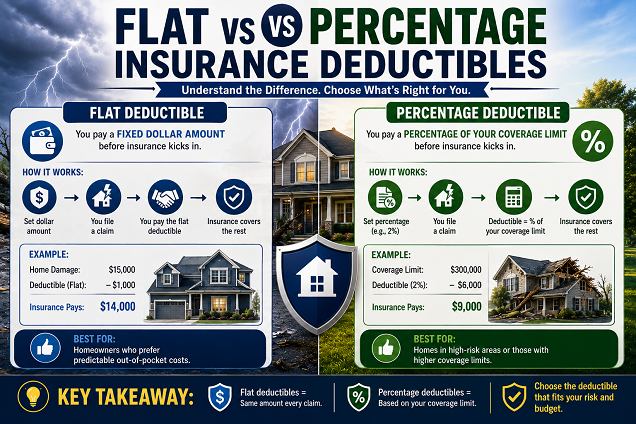
A flat deductible is a fixed dollar amount subtracted from a covered loss. A percentage deductible is a share of the amount your home is insured for, not a share of the loss. The Insurance Information Institute states that percentage deductibles generally apply to homeowners policies and are calculated on a percentage of the home's insured value. That difference is why a percentage deductible does not get smaller when the damage is smaller.

This article explains how a policy clause is structured. It is educational information, not financial, insurance or legal advice. Rules on these deductibles are set state by state, so for your own policy speak to a licensed agent or your state Department of Insurance.

Most homeowners policies carry two deductibles rather than one. There is the everyday figure that applies to most covered losses, and then a separate, usually larger figure that applies only when the cause of loss is wind, hail, a hurricane or a named storm. The second one is frequently written as a percentage, and the percentage is where the confusion starts. If you have not yet located either figure on your paperwork, how to read an insurance declarations page walks through where the deductible column sits.

Flat and percentage: the same line, written two ways

Both structures do the same job. They set the amount that comes out before the insurer pays. They differ only in how that amount is expressed and therefore in what makes it move.

A flat deductible is written as a dollar figure. It stays the same regardless of what your home is insured for and regardless of the size of the loss. It is the structure most people picture when they hear the word.

A percentage deductible is written as a percentage. The Insurance Information Institute describes deductibles as being "either a specific dollar amount or a percentage of the total amount of insurance on a policy," and notes that percentage deductibles generally only apply to homeowners policies. The Institute's page carries no visible publication date, so it is cited here for structure rather than as a current figure.

One further boundary from the same source: deductibles generally apply to property damage rather than to the liability portion of a homeowners or auto policy. The liability coverages usually carry no deductible at all.

What the percentage is a percentage of

This is the point that decides everything else, and it is the one most often misread. The percentage is applied to the insured value of the home, which on a homeowners declarations page is the Coverage A dwelling limit. It is not applied to the amount of the loss.

The arithmetic below uses round numbers because they divide cleanly. They are not presented as typical of any policy, any state or any year.

Figure
Coverage A dwelling limit 400,000
Wind and hail deductible, written as 2 percent 2 percent of 400,000
Deductible in dollars 8,000
Covered loss of 30,000 insurer pays 22,000
Covered loss of 9,000 insurer pays 1,000
Covered loss of 7,500 insurer pays nothing

Read the last two rows together. The deductible is 8,000 dollars in all three cases, because it is a function of the dwelling limit, not of the damage. A smaller loss does not produce a smaller deductible, it produces a smaller payment or no payment at all. That is the behavior that catches people, and it is entirely a consequence of what the percentage is measured against.

There is a second-order effect worth noticing. Because the deductible tracks the dwelling limit, it rises whenever the dwelling limit rises. Many policies increase Coverage A automatically at renewal to keep pace with construction costs. A percentage deductible quietly increases with it, and nothing else on the page announces that.

Where a second deductible appears on your policy

Look at the coverage table on your declarations page. The deductible column may hold more than one entry, and the second is usually labeled with the peril it belongs to rather than with a coverage letter.

The labels to search for are wind, windstorm, wind and hail, hail, hurricane, named storm, tropical cyclone and earthquake. Any of these appearing next to a figure or a percentage means that peril has its own deductible.

Two things about that line are worth checking rather than assuming. First, whether it is a percentage or a dollar amount, since some carriers write the wind and hail deductible as a flat figure. Second, whether it changed at renewal. A deductible can move from a flat dollar amount to a percentage between one policy period and the next, and the change is visible only by comparing this year's declarations page against last year's.

The definitions that decide when the special deductible applies are not on the declarations page. They are in the policy form and in whichever endorsement created the deductible, both of which are listed on the page by their form numbers.

Hurricane, named storm, windstorm, wind and hail: four labels, four triggers

These labels are not synonyms, and the difference between them is a difference in what has to happen before the larger deductible applies.

Label What triggers it
Hurricane deductible Damage from a hurricane as categorized by the National Weather Service or the National Hurricane Center, per the NAIC
Named storm deductible Broader than the above. The NAIC describes it as covering categorized hurricanes plus other declared weather events such as typhoons, tropical storms and tropical cyclones where a name has been assigned by the National Weather Service or the National Hurricane Center
Windstorm deductible Wind damage generally, per the Insurance Information Institute, which notes windstorm or wind and hail deductibles cover any kind of wind damage including from tornadoes
Wind and hail deductible The same broad wind trigger, extended to hail

The practical consequence is that a hurricane deductible is the narrowest of the four and a wind and hail deductible is the broadest. A policy with a hurricane deductible applies its ordinary deductible to an ordinary windstorm. A policy with a wind and hail deductible applies the special figure to any wind event at all.

The Insurance Information Institute notes that wind and hail deductibles are common in Midwestern states and in what it calls Tornado Alley, naming Texas, Oklahoma, Kansas and Nebraska.

The published ranges, and why two authorities give different numbers

Two national bodies publish ranges for these percentages, and the numbers do not match. Both are worth having, because they are answering different questions.

The Insurance Information Institute states that wind and hail deductibles "are most commonly paid in percentages, typically from 1 percent to 5 percent." Its background page on hurricane and windstorm deductibles gives the same 1 to 5 percent span for hurricane deductibles, with higher amounts in some coastal areas. Neither Institute page shows a publication or last-updated date, which is stated here rather than glossed over.

The NAIC, on its hurricane deductibles topic page last updated June 2, 2025, gives a wider span: "a percentage of the home's insured value, which can vary from 1% to as high as 15%."

The two are not in conflict. The Institute is describing what is commonly written. The NAIC is describing the span state regulation permits, and it says so directly in the same place: "While there are similarities among the state laws, no two laws are identical; triggers vary from state to state, as well as from insurer to insurer." As of June 2025 the NAIC counted nineteen states plus the District of Columbia permitting some form of hurricane or named storm deductible.

The reason to hold both numbers rather than one is that neither tells you what your policy says. Your own percentage is printed on your declarations page, and that figure is the only one that applies to you.

When a special deductible starts and stops applying

A percentage deductible tied to a named weather event does not apply indefinitely. It applies during a defined window, and the window is set by state regulation and by the policy language.

The Insurance Information Institute states that the duration typically extends from 24 to 72 hours after a warning ends, depending on state regulations. The NAIC's framing of the same point is that triggers vary from state to state and from insurer to insurer.

This matters because the window decides which deductible attaches. The same physical damage can fall inside or outside the trigger period, and the difference between the ordinary deductible and the percentage one is usually large. Since the rule is state-specific and the policy language is carrier-specific, the two places to establish it are your own state Department of Insurance, which publishes the rule for your state, and the endorsement named on your declarations page, which contains the wording your carrier uses.

Earthquake, the other percentage deductible

Wind is not the only peril written this way. The Insurance Information Institute notes that in California, earthquake policies include a 15 percent deductible for main structures.

Earthquake coverage is usually not part of a standard homeowners policy at all. It typically requires a separate policy or an endorsement, which is why its deductible often appears on its own document rather than in the main coverage table. The structure is the same as the wind version: a percentage applied to insured value rather than to the loss.

How to find out which structure your own policy uses

Four steps, none of which requires knowing what the right answer would be.

  1. Open your declarations page and read the entire deductible column, not the first entry.
  2. Note whether each entry is a dollar figure or a percentage, and if a percentage, which coverage limit it is measured against. On a homeowners policy that is normally the Coverage A dwelling limit.
  3. Do the multiplication once so you know the figure in dollars rather than in percent.
  4. Find the endorsement number attached to the special deductible in the form list, and ask your insurer for that document by number if you want the exact trigger wording.

For anything beyond reading the page, three routes exist. A licensed insurance agent can explain what your specific endorsement does. Your insurer's service line can send the policy form and the endorsement by number. Your state Department of Insurance is the neutral party and the right destination here in particular, because these deductibles are regulated at state level and the rules genuinely differ. The National Association of Insurance Commissioners maintains a directory of state insurance departments.

Two related pages on this site: premium, deductible, limit, out-of-pocket covers what each of the four numbers does, and actual cash value vs replacement cost covers the other line on the declarations page that changes what a payout is worth. Our disclaimer sets out what this site does and does not do.

Frequently asked questions

Is a percentage deductible a percentage of the damage?
No. The Insurance Information Institute states that percentage deductibles are calculated on a percentage of the home's insured value. On a homeowners declarations page that is the Coverage A dwelling limit. The size of the loss does not change the deductible.

Why did my deductible change from a dollar amount to a percentage?
That is a change to the policy at renewal, and it would be recorded on the new declarations page and in the form and endorsement list attached to it. Comparing this year's page against last year's is how the change becomes visible. Your insurer or agent can confirm what was changed and when.

Is a hurricane deductible the same as a wind and hail deductible?
No. The NAIC describes a hurricane deductible as applying solely to damage from a hurricane as categorized by the National Weather Service or the National Hurricane Center. The Insurance Information Institute describes windstorm and wind and hail deductibles as covering any kind of wind damage, including from tornadoes. The wind and hail version is the broader trigger.

Which states have these deductibles?
The NAIC states that as of June 2025, nineteen states plus the District of Columbia permit some form of hurricane or named storm deductible, and that no two state laws are identical. Wind and hail deductibles are separate from that count, and the Insurance Information Institute names Texas, Oklahoma, Kansas and Nebraska among the states where they are common. Your state Department of Insurance publishes the rule that applies where you live.


Sources: National Association of Insurance Commissioners, "Insurance Topics: Hurricane Deductibles," last updated June 2, 2025. Insurance Information Institute, "Understanding your insurance deductibles" and "Background on: hurricane and windstorm deductibles" (neither page shows a publication date). All accessed August 5, 2026.

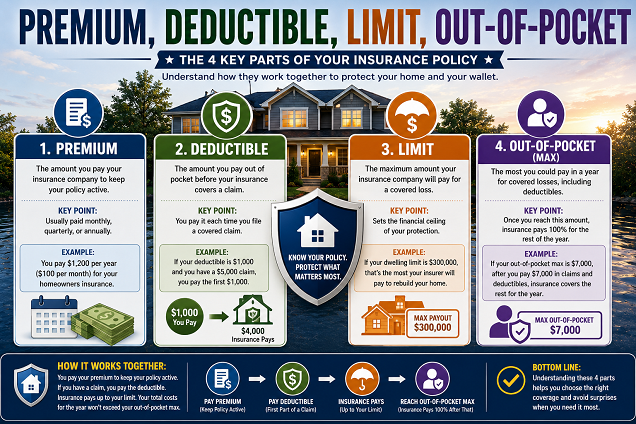
Premium is what you pay to hold the policy. Deductible is what is subtracted from a covered loss before the insurer pays. Limit is the most the insurer will pay for that coverage. Out-of-pocket is what ends up coming from you, which is the deductible plus anything above the limit or outside the coverage. Three of the four are printed on your declarations page. The fourth is arithmetic.

This article explains how policy terms work. It is educational information, not financial, insurance or legal advice. For a question about your own policy, speak to a licensed agent or your state Department of Insurance.

These four words are the vocabulary the rest of a policy is written in, and they are the four most commonly mixed up. Part of the reason is that the same words are used by health plans to mean something meaningfully different, and search results for them are dominated by the health-plan version. This page covers the property and casualty version first, on a homeowners, renters or auto policy, and then says exactly where the health-plan meanings diverge. If you want the page-by-page tour of the document these numbers sit on, start with how to read an insurance declarations page.

Premium: the price of the contract, and what it does not buy

The premium is the amount you pay the insurer to keep the policy in force for the policy period. It is billed monthly, quarterly, semiannually or annually, and on a home with a mortgage it is often paid out of an escrow account rather than by you directly.

Two things follow that people frequently expect and that are not true.

The premium does not accumulate. Paying premium for ten claim-free years does not build a balance, reduce a future deductible, or entitle you to anything at renewal. A property and casualty policy is a term contract for a defined period, and when the period ends the contract ends.

The premium is not part of your loss arithmetic. When a covered loss happens, the deductible and the limit decide what is paid. Premium paid does not enter that calculation in any way.

What the premium does reflect is the rest of the page. A lower deductible or a higher limit generally costs more premium, and the declarations page usually shows the discounts applied to arrive at the final figure. Which combination is right for a given household is a question for a licensed agent who can see the whole picture, not something a general article can answer.

Deductible: the amount subtracted, and how often it comes back

The deductible is the amount removed from a covered loss before the insurer pays anything. If a covered loss is smaller than the deductible, the policy pays nothing, which is the ordinary and intended result rather than a failure of the coverage.

The timing is the part that surprises people. The Insurance Information Institute states that deductibles apply each time you file a claim, with the exception that in Florida and Louisiana hurricane deductibles are applied once per season rather than for each storm. So a property deductible is not an annual allowance you work through. It resets to full for every separate covered loss.

A single policy also frequently carries more than one deductible. A homeowners policy commonly has one figure for most covered losses and a separate, larger one for wind, hail, hurricane or named storm, and the second is often written as a percentage rather than a dollar amount. That structure is the subject of its own page here: flat vs percentage deductibles.

One more boundary worth knowing. The Institute notes that deductibles generally apply to property damage rather than to the liability portion of a homeowners or auto policy. The liability coverages usually have no deductible at all.

Limit: the ceiling, and why a policy has several

The limit is the maximum the insurer will pay under a given coverage for a covered loss. Anything above it is yours.

The important structural point is the plural. A property policy does not have "a limit." It has one for each coverage. The Iowa Insurance Division, in a consumer guide published on April 4, 2024, sets out the standard homeowners coverages as Coverage A dwelling, Coverage B other structures, Coverage C personal property, Coverage D loss of use, Coverage E personal liability, and Coverage F medical payments to others. Each of those carries its own limit, and they are not interchangeable. Money left unused under Coverage A does not become available under Coverage C.

Beneath those headline limits sit sub-limits, which cap particular categories inside a coverage. Jewelry, cash, firearms and business property are the usual examples: they are covered under personal property, but only up to a smaller figure of their own.

Auto policies express limits differently, often as a pair or a trio of numbers for liability, with separate limits for collision, comprehensive and the various medical and uninsured motorist coverages. Same principle, different notation.

Out-of-pocket: the word that means two different things

On a property or auto policy, "out of pocket" is not a defined term with a line on your declarations page. It is a description of the total you end up paying, and it is made of three parts: the deductible, anything above the applicable limit, and anything the policy does not cover at all.

That total has no ceiling. A homeowners policy has no out-of-pocket maximum, because the concept does not exist in the property forms. If a loss exceeds the limit, the excess is simply yours.

This is exactly where the health-plan version of the vocabulary diverges, and where most of the confusion comes from. On a health plan, "out-of-pocket maximum" is a defined term with a specific figure, and it functions as a genuine annual ceiling on covered, in-network costs. On a homeowners policy there is no such number, and looking for one is looking for something the contract does not contain.

The four numbers working together in one covered loss

The numbers below are chosen because they divide cleanly. They are not presented as typical, and no figure here is a statement about what any policy costs or should be set at.

Say a policy carries a personal property limit of 100,000 dollars and a deductible of 1,000 dollars, and a covered loss damages property with a settled value of 12,000 dollars.

Step Figure Where it comes from
Settled value of the covered loss 12,000 the claim settlement
Less the deductible 1,000 the deductible column on the declarations page
Insurer pays 11,000 arithmetic, provided the limit is not reached
Applicable limit 100,000 the limit column for that coverage
Your out-of-pocket 1,000 the deductible only, in this case

Change one thing and the shape changes. If the settled value were 140,000 dollars against the same 100,000 dollar limit, the insurer would pay 100,000 minus the deductible, and your out-of-pocket would be the deductible plus the 40,000 above the limit. Change it again: if the loss is a peril the policy excludes, none of these numbers apply, because the deductible and the limit only operate on covered losses.

That last line is the one worth carrying away. The four numbers describe how much. Whether a loss is covered at all is decided by the policy form, not by any of them.

Where the health-plan version diverges

Health plans use three of these four words and add several of their own. The same word does a different job in each system.

Term On a homeowners, renters or auto policy On a health plan
Premium Price of the policy for the term. Not part of loss arithmetic Price of the plan, usually monthly. Generally does not count toward the out-of-pocket maximum
Deductible Subtracted per claim. Resets for every separate covered loss An annual amount, met across the plan year
Limit Many limits, one per coverage, plus sub-limits inside them Coverage limits exist but the more prominent ceiling is the out-of-pocket maximum
Out-of-pocket A description, not a defined term. No maximum exists A defined term with a stated maximum on covered in-network costs
Coinsurance Uncommon on a standard homeowners policy Central: a percentage share after the deductible
Copay Does not appear A flat fee per service

For the health-plan versions, the authoritative starting points are HealthCare.gov, which publishes a federal glossary of these terms, and your own plan's Summary of Benefits and Coverage, which is the standardized document every plan must provide. This site does not restate their definitions secondhand.

Where to check your own four numbers

All three of the printed numbers appear on your declarations page. The premium is usually at the bottom or in its own block. The limits and deductibles appear in the coverage table, side by side, one row per coverage. Read each row across rather than reading a column down, because a limit and a deductible only mean something as a pair.

Two further items on that page change what the numbers are worth. One is whether a coverage is written on a replacement cost or actual cash value basis, which is covered here in actual cash value vs replacement cost. The other is the list of form and endorsement numbers, which is where the definitions and exclusions live.

For a question about your own limits or deductibles, a licensed insurance agent can explain what your page says and what changing it would do. Your insurer's service line can confirm what is on file and send you the policy forms by number. Your state Department of Insurance is the neutral party, publishes consumer guides, and handles complaints about how a company is administering a policy. Have your declarations page and policy number in front of you for any of the three. Our disclaimer sets out what this site does and does not do.

Frequently asked questions

Does paying my deductible on one claim mean I do not pay it again that year?
On a property policy, no. The Insurance Information Institute states that deductibles apply each time you file a claim. The exception it names is that Florida and Louisiana apply hurricane deductibles once per season rather than per storm. A health plan works the opposite way, with an annual deductible met once across the plan year.

Why does my policy list several different limits?
Because a homeowners policy is several coverages in one contract. The Iowa Insurance Division lists Coverage A through Coverage F, each protecting something different, and each carries its own limit. Unused limit under one coverage is not available under another.

Is there a maximum I can be out of pocket on a homeowners claim?
No. There is no out-of-pocket maximum in a standard homeowners policy. That term belongs to health plans. On a property policy your exposure is the deductible plus anything above the limit plus anything the policy does not cover.

Does a lower deductible always cost more premium?
Generally the two move in opposite directions, which is why they are shown together on the declarations page. What that trade-off is worth depends on facts about your own situation, and a licensed agent looking at your actual policy is the right person to price it.


Sources: Insurance Information Institute, "Understanding your insurance deductibles" (no publication date shown on the page). Iowa Insurance Division, "Consumer Connection: Understanding your Homeowners Policy," published April 4, 2024. Maryland Insurance Administration, consumer material on understanding your declarations page. All accessed August 5, 2026.