



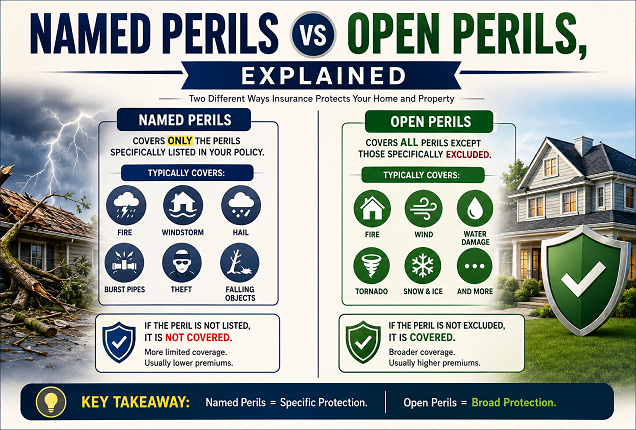
A named peril policy covers only the causes of loss it lists by name. An open peril policy covers any cause of loss it does not specifically exclude. The Texas Department of Insurance puts it in one line each: "Named perils policies cover only the events listed in the policy," and "All-risk policies cover any event that the policy doesn't specifically exclude." The section of your policy that settles which one you have is titled "Perils Insured Against."
This article explains two ways a policy can be written. It is educational information, not financial, insurance or legal advice. For a question about your own coverage, speak to a licensed agent or your state Department of Insurance.
The difference is not a matter of degree. The two are opposite ways of writing the same promise, and everything else about how a policy behaves follows from which one is used. If you are still locating the parts of your paperwork, how to read an insurance declarations page covers the layout, and the six coverage parts A through F covers what the lettered lines mean.
The two definitions, and the one sentence that separates them
The Texas Department of Insurance, in a consumer tip page updated September 29, 2025, gives both definitions plainly. Named perils policies "cover only the events listed in the policy." All-risk policies "cover any event that the policy doesn't specifically exclude." TDI notes that all-risk policies are "also called open perils policies," so the two phrases refer to the same thing.
| Named perils | Open perils (all-risk) | |
|---|---|---|
| How coverage is described | A list of covered causes | A list of excluded causes |
| A cause not mentioned anywhere | Not covered | Covered |
| Where to read it | The list of perils in the policy | The exclusions in the policy |
| Typical examples given by regulators | Fire, lightning, explosion, theft, vandalism | Any cause except the stated exclusions |
| Relative cost, as regulators describe it | The lower-cost option, with narrower coverage | The broader option |
TDI states that named perils policies "cost less but provide limited coverage." That is a statement about the structure, not a recommendation, and no regulator source reviewed here publishes a figure for how much less.
Where the burden sits changes
The practical consequence of the two structures is where the question lands when something happens.
Under a named peril policy, a covered cause has to match something written on the list. If a cause of damage is not on the list, it does not matter that it also is not excluded, because there is no exclusion list doing that work. Silence means no coverage.
Under an open peril policy, the starting position is reversed. The cause does not need to be found on a list, because there is no list to be found on. The question becomes whether the cause matches something in the exclusions. Silence means coverage.
That is why the exclusions section is a much bigger deal on an open peril policy than on a named peril one, and why the two documents look so different when you open them. On one, the important pages are the covered perils. On the other, the important pages are the carve-outs. What those carve-outs typically are is covered in what a standard home policy never covers.
"All risk" is a name, not a description
The phrase all-risk reads like a guarantee, and it is not one. The best evidence for that is the regulator's own list of what an all-risk policy still leaves out.
TDI states that coverage on an all-risk policy typically excludes termites, wear and tear, sewer backups, floods, earthquakes, mold removal and foundation repairs. Every one of those is a cause of loss to a home, and every one of them can sit outside a policy sold under a name that appears to promise everything.
The New York Department of Financial Services describes the HO-3 form as covering "your home for all risks of physical loss, except those that are specifically excluded in the policy, such as flood, earthquake, war, nuclear accident, etc." The qualifier is doing the work in that sentence, not the phrase in front of it.
So the honest reading of open perils is: broader than a list, and still bounded. A household that treats the phrase as a promise of complete coverage has misread it, and that misreading is common enough that both regulators write the exception into the same sentence as the rule.
The words are not standardized, including among regulators
Here is something worth knowing before you go looking for these phrases in your own paperwork: they may not be there.
Three state insurance regulators describe the same product in three different vocabularies.
- The Texas Department of Insurance uses "all-risk" and "open perils" as interchangeable terms, and uses "named perils" for the other.
- The California Department of Insurance, in its residential insurance guide issued as Form 401 and revised January 2026, uses neither phrase. It sets out two lists instead, one of perils generally covered and one of perils generally not covered, and leaves the reader to draw the structural conclusion.
- The North Carolina Department of Insurance describes a homeowners policy as a "multi-peril policy" and does not draw the named-versus-open comparison at all in its basic homeowners material.
None of them is wrong. They are consumer publications written by different offices for different audiences. But it means a reader who learns the terminology from an article and then searches their own policy or their own state's guide for the words may come up empty, and conclude something has gone missing. Nothing has. The structure is there either way, and it is identified by how the policy describes coverage rather than by which label it uses.
The basis can differ between your home and your belongings
This is the point most explanations flatten. The peril basis is not necessarily one setting for the entire policy.
The New York Department of Financial Services describes the HO-3 Special Form as covering "your home for all risks of physical loss, except those that are specifically excluded." It then describes the HO-5 Comprehensive Form as the one under which "your personal possessions typically would also be covered" on that basis. The word doing the work there is "also." If extending the basis to possessions is what distinguishes one form from another, then on the first form the possessions are not on the same basis as the house.
That is the same structural pattern seen with valuation, where a single policy can use one basis for the structure and another for the contents. The reading instruction is identical: check each coverage separately rather than reading the answer once and assuming it applies down the page. The valuation version of the same problem is covered in actual cash value vs replacement cost.
Form numbers do not settle it, and two regulators show why
The obvious shortcut is to find your form number and look up what that form does. It is a reasonable instinct and it is not reliable, and the cleanest demonstration of why is that two state regulators describe the same form differently.
The New York Department of Financial Services describes the HO-3 as covering the home on an all-risk basis, and reserves the extension to personal possessions for the HO-5 Comprehensive Form.
The South Carolina Department of Insurance describes the HO-3 Special Form as offering "broad coverage for your dwelling and personal belongings against all perils unless specifically excluded in the policy."
Both are official state consumer material. The point is not that one office made an error. It is that form numbers describe a family of policies, insurers file their own versions of them, wording is approved state by state, and a summary written for one state's market will not describe every policy sold under that number. Your own policy form is the document that governs your coverage, and no article, including this one, is a substitute for it.
For completeness, the South Carolina Department of Insurance also describes the HO-1 Basic Form as covering "a specific list of perils, such as fire, lightning, hail, theft, and vandalism," and the HO-2 Broad Form as protecting the dwelling "against a wider range of perils," including falling objects, water damage from plumbing issues and electrical damage. The New York Department of Financial Services lists the HO-1 perils as "fire, lightning and smoke damage; windstorm and hail; burglary and theft; explosion; glass breakage; vehicle or aircraft damage; riot and civil commotion; vandalism and malicious mischief." Those lists are what a named peril policy looks like in practice.
How to find out which basis your policy uses
- Open the policy form, not the declarations page. The declarations page carries the limits and the form numbers. The perils live in the form.
- Find the section titled "Perils Insured Against." That is the Texas Department of Insurance's instruction, and it is the fastest route to the answer.
- Read what that section does. If it names causes of loss one by one, the coverage is named peril. If it says the policy covers loss unless excluded and then points you to an exclusions section, the coverage is open peril.
- Do it separately for the structure and for the contents, since the two can be written on different bases.
- Then read the exclusions, because on an open peril policy that section is where the actual boundary of the coverage is drawn.
- If the form is not in hand, ask your insurer for it by the form number printed on your declarations page. That is a document request, not a coverage question, and the service line can handle it.
A licensed insurance agent can explain what your specific form does and what a different one would change. Your state Department of Insurance publishes consumer material on policy types and handles complaints about how a company administers a policy. The National Association of Insurance Commissioners maintains the directory of those state departments.
What this does not decide
Knowing your peril basis answers one question: how the policy decides whether a cause of loss is inside or outside the coverage. Four things sit elsewhere.
- How much can be paid. That is the limit for the applicable coverage.
- What is subtracted first. That is the deductible, and a homeowners policy can carry more than one. See flat vs percentage deductibles.
- How a covered loss is valued. That is actual cash value or replacement cost, set per coverage.
- The causes that are outside any homeowners policy. Flood is the clearest example, and it is not an exclusion you can argue about, it is a separate contract. See why flood is a separate policy.
This site explains documents. It does not tell anyone which policy form to buy, because that depends on the property, the household and what is available in that state.
Frequently asked questions
Is open perils the same as all-risk?
Yes. The Texas Department of Insurance states that all-risk policies are "also called open perils policies." Different insurers and different state guides favor different labels for the same structure.
Does an open peril policy cover everything?
No. TDI states that coverage on an all-risk policy typically excludes termites, wear and tear, sewer backups, floods, earthquakes, mold removal and foundation repairs. The New York Department of Financial Services describes the HO-3 as covering all risks "except those that are specifically excluded in the policy, such as flood, earthquake, war, nuclear accident, etc."
How do I tell which one I have?
Read the section of your policy titled "Perils Insured Against," which is the Texas Department of Insurance's instruction. A list of named causes means named peril. A statement of coverage plus an exclusions section means open peril.
Can one policy use both?
It can. The New York Department of Financial Services distinguishes the HO-3, which it describes as covering the home on an all-risk basis, from the HO-5, which it describes as the form under which personal possessions are also covered that way. Since form wording varies by insurer and by state, the only reliable answer for your policy is in your own form.
Sources: Texas Department of Insurance, "All-risk or named peril home insurance policies," updated September 29, 2025. New York Department of Financial Services, "Homeowners Insurance: Choosing a Policy" (no date shown on the page). South Carolina Department of Insurance, "Understanding the Types of Homeowner Insurance Policies for Your Dwelling" (no date shown on the page). California Department of Insurance, "Residential Insurance: Homeowners and Renters," Form 401, revised January 2026. North Carolina Department of Insurance, "Basic Homeowners Insurance" (no date shown on the page). All accessed August 6, 2026.
