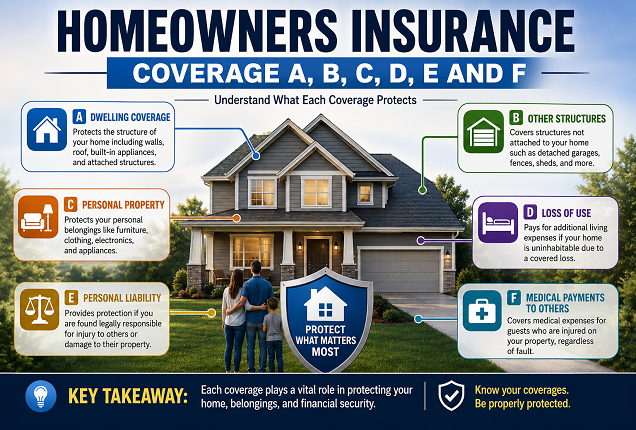
A standard homeowners policy is organized into six lettered coverages. Coverage A is the dwelling, Coverage B other structures, Coverage C personal property, Coverage D loss of use, Coverage E personal liability, and Coverage F medical payments to others. The first four pay for damage to your own property. The last two respond when someone else is injured or their property is damaged. Each carries its own separate limit, printed on your declarations page.
This article explains how a policy is organized. It is educational information, not financial, insurance or legal advice. For a question about your own coverage, speak to a licensed agent or your state Department of Insurance.
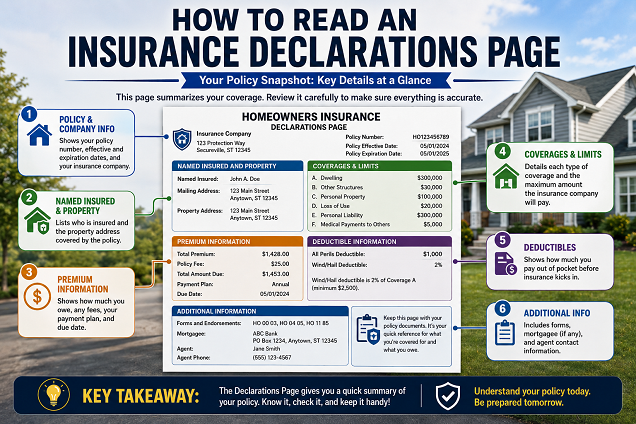
The letters are not a ranking and they are not sizes of the same thing. They are six different promises, and the reason they look like a list is that they are printed as one. If you have not found where they sit on your paperwork, how to read an insurance declarations page covers the layout.
The six letters, in one table
Three state insurance regulators publish plain-language descriptions of these coverages. The wording below is theirs.
| Letter | Name | What it covers | Usual relationship to Coverage A |
|---|---|---|---|
| A | Dwelling | The house itself and attached structures | The base figure everything else is set from |
| B | Other structures | Structures on the premises not attached to the dwelling | Normally 10 percent of Coverage A |
| C | Personal property | The contents of the home and personal belongings | Typically 50 percent of Coverage A |
| D | Loss of use | Additional living expenses when the home cannot be lived in | Normally 20 percent of Coverage A |
| E | Personal liability | Injury to others for which you are legally responsible | Set as its own limit, not a percentage |
| F | Medical payments to others | Medical expenses of people accidentally injured on your property | Set as its own limit, not a percentage |
The North Carolina Department of Insurance publishes the 10 percent, 50 percent and 20 percent relationships. The California Department of Insurance, in its residential insurance guide issued as Form 401 and revised January 2026, gives the same figure for Coverage B and states that Coverage D is "normally limited to 20 percent of Coverage A."
The most useful thing to understand about that column is covered further down: those are defaults, not rules.
Section I and Section II: two contracts on one page
The six letters do not form a single scale. They divide in two, and the divide is the most important structural fact on the page.
Coverages A, B, C and D answer one question: my own property was damaged or made unusable, what does the policy pay. The North Carolina Department of Insurance describes Coverage A as protection for "your house and attached structures if it is damaged by a covered loss," and Coverage D as "additional living expenses if your home is damaged by a peril insured against to the extent that you cannot live in your home."
Coverages E and F answer a different question: someone other than me suffered a loss connected to my household. NC DOI describes Coverage E as coverage "in the event you or a resident of your household are legally responsible for injury to others," and Coverage F as "reasonable medical expenses for persons accidentally injured on your property."
That is why a reader cannot compare the limits down the column and conclude anything. A Coverage E limit and a Coverage C limit are not larger and smaller versions of the same protection. They are two unrelated promises that happen to be printed under one heading.
Coverage A: the dwelling, and why every other number depends on it
Coverage A is the anchor. The Iowa Insurance Division, in a consumer guide published April 4, 2024, calls it "the cornerstone of your homeowners policy, protecting the physical structure of your home against perils or causes of loss such as fire, windstorms, hail, lightning, and vandalism." The California Department of Insurance describes it as the "major property coverage that protects your house and attached structures."
Two practical consequences follow from that position.
The first is arithmetic. Because B, C and D are commonly written as a percentage of A, the Coverage A limit is not only the dwelling limit. It is the input that generates three other limits on the same page. A household that revises Coverage A and does not look further down the page has changed four numbers, not one.
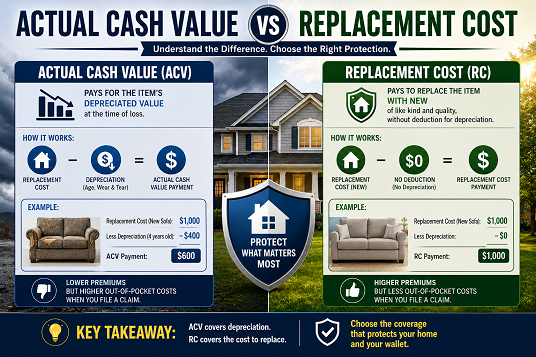
The second is that Coverage A is a rebuilding figure rather than a market figure. The North Carolina Department of Insurance frames adequacy in terms of replacement cost rather than sale price. What a property would sell for includes land and location, and neither of those burns. The distinction between valuation bases, and where it is recorded on your own page, is set out in actual cash value vs replacement cost.
Coverages B, C and D: the three that are usually a percentage of A
Coverage B, other structures. NC DOI describes it as protection "to other structures on the residence premises that are not attached to the dwelling," and puts the default at 10 percent of Coverage A. The Iowa Insurance Division gives examples: "detached garages, sheds, fences, or guest houses." Whether a given structure is attached is a question about the structure, not about how it is used.
Coverage C, personal property. NC DOI describes it as protection "for the contents of your home and other personal belongings owned by you or family members," typically at 50 percent of Coverage A. Iowa lists "furniture, clothing, electronics, and appliances."
Coverage D, loss of use. NC DOI puts this at 20 percent of Coverage A and adds a procedural point most summaries skip: it is paid on documentation. Iowa's phrasing is that when a home "becomes uninhabitable due to a covered loss, loss of use coverage helps cover additional living expenses."
Now the correction. These percentages are published defaults, not the shape of every policy. They are the settings a policy commonly starts from, and what governs your coverage is the dollar limit printed beside each letter on your own declarations page. If your Coverage B limit is not 10 percent of your Coverage A limit, your policy is not wrong. It is simply not on the default, and the page is the authority.
That is also why the standard advice to "check your Coverage B" is not a matter of doing the multiplication. The multiplication tells you whether you are on the default. It tells you nothing about whether the default suits a property with a detached workshop on it, and that second question is one for a licensed agent looking at the actual property.
Coverage C is where the sub-limits live
Coverage C has a feature the other five do not, and it is the most common source of surprise on the page.
The overall Coverage C limit is not the maximum payable for every category of belonging. The North Carolina Department of Insurance states that the coverage carries limited coverage on categories including cash, jewelry, furs, manuscripts and collections. The California Department of Insurance likewise notes that personal property is subject to special limits on categories such as jewelry, firearms and fine arts.
In other words, a household can hold a large Coverage C limit and still find a category capped at a small figure well below it. The category caps are set inside the policy form rather than on the summary page, and the amounts vary by policy, so the only reliable figures are the ones in your own form.
What that means for reading the page: the Coverage C number tells you the ceiling for personal property as a whole. It does not tell you the ceiling for any one category, and the two are separate questions.
Coverage E and Coverage F have different triggers
These two sit side by side, are both about other people, and are commonly read as one large version and one small version of the same thing. They are not.
Coverage E responds to legal responsibility. NC DOI describes it as applying where you or a household resident "are legally responsible for injury to others," and notes that intentional acts are excluded.
Coverage F responds without it. The Iowa Insurance Division states that medical payments coverage "focuses specifically on covering medical expenses for guests injured on your property, regardless of fault."
That phrase is the whole distinction. Coverage F is a small, no-fault payment for a guest's medical expenses. Coverage E is the coverage that engages when responsibility is actually at issue. They can apply to the same incident, they can apply to different incidents, and neither one is a fraction of the other.
Coverage F also has boundaries worth knowing while the page is open. NC DOI states that it does not cover injuries to members of the household, and does not cover business activities. Injuries to the people who live in the house are not what this line is for.
What the letters do not tell you
The six letters describe what a policy is organized to cover. Four things are decided elsewhere in the contract, and none of them appears in the letter itself.
- Whether a given cause of damage is covered at all. That is the perils section, and it depends on whether the coverage is written on a named peril or an open peril basis. See named perils vs open perils.
- What is carved out regardless. That is the exclusions section, and it is separate from the perils section. See what a standard home policy never covers.
- How a covered loss is valued. That is the valuation basis, set per coverage.
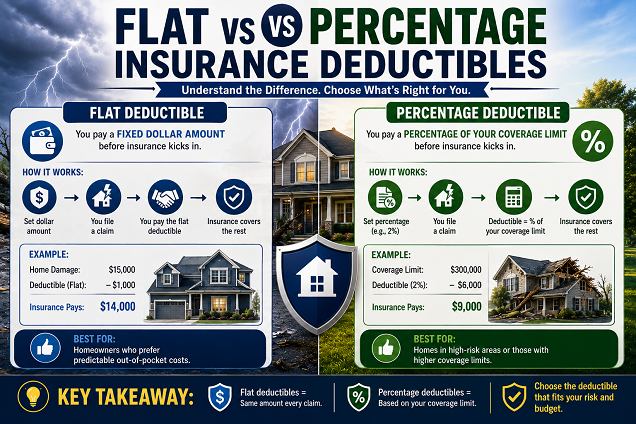
- What is subtracted before payment, and what the ceiling is. That is the deductible and the limit, and the relationship between those numbers is set out in premium, deductible, limit, out-of-pocket.
A reader who knows the six letters can navigate the page. A reader who knows the letters, the perils basis, the exclusions and the deductible can read the policy.
How to read your own six lines
- Find the coverage table on the declarations page and write down the letter, the name and the dollar limit for each of the six.
- Check whether B, C and D sit on the published defaults of 10, 50 and 20 percent of Coverage A. Being off the default is information, not an error.
- Note which limits are property and which are liability. A through D on one side, E and F on the other, and do not compare across the line.
- Look for the special limits on Coverage C, which will be in the policy form rather than on the declarations page. Ask your insurer for the form by number if it is not in hand.
- Read the valuation word next to each property coverage separately, since it can differ between the dwelling and the contents.
For questions past that point, a licensed insurance agent can explain what a given limit does and what changing it would mean. Your insurer's service line can confirm what is on file. Your state Department of Insurance publishes consumer material on exactly this structure and handles complaints about how a company administers a policy, and the National Association of Insurance Commissioners maintains the directory of those state departments.
This site explains documents. It does not tell anyone what limits to carry, because that depends on the property, the household and the assets involved, and no article can see any of them. How sources are chosen here is set out in our editorial policy.
Frequently asked questions
Does every homeowners policy use these six letters?
The lettered structure is the common convention in the United States and is what North Carolina, California and Iowa regulators all describe. Layout and wording vary between insurers and between policy forms, and some pages list the coverages by name rather than by letter. Your own declarations page is the authority for your policy.
Is Coverage B always 10 percent of Coverage A?
No. Ten percent is the default that the North Carolina Department of Insurance publishes, and the California Department of Insurance gives the same figure. It is a common starting point, not a rule. The dollar limit printed on your declarations page is what applies.
What is the difference between Coverage E and Coverage F?
The trigger. Coverage E applies where you or a household resident are legally responsible for injury to others, in NC DOI's wording. Coverage F pays reasonable medical expenses for people accidentally injured on your property, and the Iowa Insurance Division states it applies regardless of fault.
Why is my jewelry capped below my Coverage C limit?
Because personal property coverage carries separate special limits on certain categories. The North Carolina Department of Insurance names cash, jewelry, furs, manuscripts and collections among them, and California names jewelry, firearms and fine arts. Those caps live in the policy form, and the amounts vary, so the form is where to read yours.
Sources: North Carolina Department of Insurance, "Basic Homeowners Insurance" (no date shown on the page). California Department of Insurance, "Residential Insurance: Homeowners and Renters," Form 401, revised January 2026. Iowa Insurance Division, "Consumer Connection: Understanding your Homeowners Policy," published April 4, 2024. All accessed August 6, 2026.