



Demo Example
Demo Example
Demo Example
Tag

insurance terms

Browsing

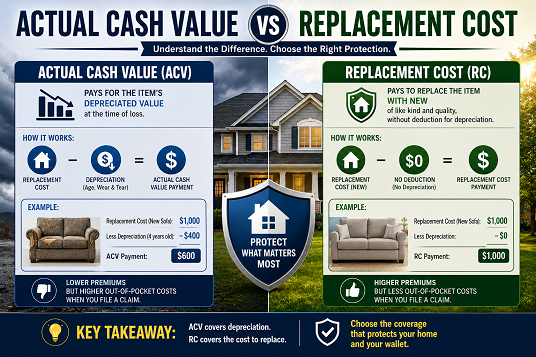
Actual cash value pays based on what the property is worth now, after age and wear are taken into account. Replacement cost pays what it costs to repair or replace with materials of like kind and quality, without that reduction. The NAIC states that actual cash value coverage "often does not pay enough to fully replace your property or repair the damage." The difference between them is depreciation, and which one applies is recorded on your own policy.

This article explains two policy terms. It is educational information, not financial, insurance or legal advice. For a question about your own coverage, speak to a licensed agent or your state Department of Insurance.

Of everything printed on a homeowners or renters declarations page, this is the item with the largest consequence and the smallest font. It is usually a single word or an abbreviation sitting beside a coverage, and it decides how every payout under that coverage is calculated. If you have not located it yet, how to read an insurance declarations page shows where the valuation line normally sits.

The two definitions, as the regulators state them

Two regulators state the distinction plainly, in slightly different words, and having both is more useful than having either.

The NAIC, in a consumer article dated January 2, 2025, puts it this way. Under actual cash value coverage, the policy "will pay the cost to repair or replace your home or personal property based on its value, considering its age and wear and tear (depreciation)," and the NAIC adds directly that this "often does not pay enough to fully replace your property or repair the damage." Under replacement cost value coverage, the policy "will pay the cost to repair or replace your damaged property using materials of a like kind and quality."

The North Carolina Department of Insurance restates the same split in more concrete terms. Actual cash value is "the amount of money needed to fix your home, minus the decrease in value of your property because of age or use." Replacement cost value is "the amount of money needed to repair your home at today's prices of building supplies; or replace your belongings at today's cost of the similar or like item."

Actual cash value Replacement cost value
Basis of payment Current depreciated value Cost to repair or replace with like kind and quality
Age and wear Subtracted Not subtracted
Regulator's caution NAIC: "often does not pay enough to fully replace your property" None stated
Typical effect on premium Generally the lower-premium option Generally the higher-premium option
Where it is recorded Your declarations page and the endorsements it lists Your declarations page and the endorsements it lists

Depreciation is the entire difference

Strip away the terminology and there is one variable. Both bases start from the same question, which is what it would take to repair or replace the property. Actual cash value then subtracts an amount for age and use. Replacement cost does not.

The Iowa Insurance Division, in a consumer guide published on April 4, 2024, defines the two in exactly that relationship, describing actual cash value as "replacement cost less depreciation" and replacement cost as reimbursing you to purchase a new item at current market value.

The size of that subtraction depends on the property. A roof covering, a water heater, a laptop and a sofa all lose value with age on different schedules, and a ten-year-old item under an actual cash value policy is valued as a ten-year-old item. That is not a defect in the coverage. It is what the coverage says it will do, which is why the word on the page matters more than any assumption about fairness.

How any withheld depreciation is treated afterward is governed by the policy language and by state rules. That is a settlement question rather than a policy-reading question, and the place to establish it is your own policy form and your state Department of Insurance.

Where these words appear on your own policy

The regulators define the terms. Notably, the NAIC's article does not go on to explain how a policyholder identifies which one applies to their own policy, so that part is worth setting out.

There are three places to look, in order.

The declarations page, beside the coverage. On a homeowners policy the valuation basis usually appears next to Coverage A dwelling and next to Coverage C personal property. It may be spelled out, or abbreviated as RC, RCV or ACV, or expressed as a coverage option code.

The form and endorsement list on the same page. Replacement cost on personal property is often added by an endorsement rather than being part of the base form. If it is there, it appears in that list as a form number, and that number is what you ask your insurer for if you want the exact wording.

The base policy form. The definitions of both terms, and any schedule of property they are applied differently to, live in the form itself rather than on the summary page.

If the words appear nowhere you can find, that is a question for your insurer, and the phrasing that gets a precise answer is "on what valuation basis is Coverage A settled, and on what basis is Coverage C."

A single policy can use both

This is the part most explanations skip. The valuation basis is not one setting for the whole policy. It is set per coverage.

The Iowa Insurance Division makes this explicit for personal property, stating that Coverage C "may be actual cash value (replacement cost less depreciation) or replacement cost." That is a separate determination from the one made for the structure.

The common combination is replacement cost on the dwelling and actual cash value on contents, because contents are where depreciation bites hardest and where the premium difference shows up most. A household can therefore be reading its declarations page correctly, see "replacement cost" next to Coverage A, and still hold actual cash value coverage on everything inside the house.

Some policies also carve out specific categories for different treatment. Roof coverings and certain classes of personal property are the usual examples, and where that is done it is done by endorsement, which means it appears in the form list on your declarations page.

The practical instruction is to read the valuation basis for every coverage separately rather than reading it once.

"Like kind and quality," and what it does not promise

The NAIC's replacement cost definition turns on the phrase "materials of a like kind and quality." It is worth being precise about what that phrase does and does not do.

It sets a comparability standard, not an upgrade. Replacement cost means replacing what was there with something equivalent at today's prices. It does not mean an improvement on what was there, and it does not mean that the exact discontinued item will be found.

It also does not remove the limit. Replacement cost governs how a loss is valued. The coverage limit still governs the maximum payable, and the deductible is still subtracted. A replacement cost policy with a dwelling limit below what rebuilding would actually cost pays up to that limit, and no valuation word changes that. The relationship between limits and deductibles is covered separately in premium, deductible, limit, out-of-pocket.

Four neighboring terms that are not the same thing

Four other phrases appear in the same conversation and none of them is a synonym for either of the two. Worth flagging honestly: unlike actual cash value and replacement cost, these are not defined by a regulator in the sources reviewed here. Carriers define them, and the wording varies, so the only reliable definition is the one in your own policy.

Extended replacement cost. Replacement cost with an additional cushion above the dwelling limit, expressed as a stated percentage. The percentage is a policy term, printed on your own declarations page or endorsement, and there is no standard figure to quote.

Guaranteed replacement cost. Marketed as paying the cost to rebuild without the dwelling limit acting as a cap. Availability and conditions vary by carrier and by state, and the conditions are in the endorsement.

Functional replacement cost. Replacement using contemporary materials that serve the same function rather than matching obsolete construction. It is common on older homes.

Market value. What the property would sell for, which includes land and location. It is not a valuation basis for insurance at all, and it can be far above or far below the cost to rebuild. Confusing rebuild cost with market value is one of the more common misunderstandings in this area.

If any of these four appear on your paperwork, the endorsement number beside it is the document that defines it for you.

What neither term decides

The valuation basis answers one question only: how a covered loss is valued. It does not answer any of the following, and each of them is decided elsewhere in the contract.

  • Whether the loss is covered. That is the insuring agreement and the exclusions in the policy form.
  • How much can be paid. That is the limit for the applicable coverage.
  • What is subtracted first. That is the deductible, and on a homeowners policy there may be more than one. See flat vs percentage deductibles.
  • Whether a category is capped separately. Sub-limits on jewelry, cash and similar categories operate independently of valuation.
  • What your duties are after a loss. Those are the policy conditions.

A reader who knows their valuation basis and nothing else knows one useful thing. A reader who knows the basis, the limit and the deductible for each coverage can read their whole declarations page.

How to establish which basis your policy uses

  1. Read the valuation word next to each coverage separately, at minimum for the dwelling and for personal property.
  2. Check the form and endorsement list for a replacement cost endorsement, and note its number.
  3. Ask your insurer or agent for the base form and any valuation endorsement by number if you want the exact contract wording rather than a summary.
  4. Compare against last year's declarations page. A valuation basis can change at renewal.

For questions beyond reading the page, a licensed insurance agent can explain what your endorsement does and what changing it would mean for your premium. Your insurer's service line can confirm what is on file. Your state Department of Insurance is the neutral party, publishes consumer material on exactly this distinction, and handles complaints about how a company administers a policy. The National Association of Insurance Commissioners maintains a directory of state insurance departments.

This site explains documents. It does not tell anyone which valuation basis to carry, and that question genuinely depends on facts about a household that no article can see. How sources are chosen here is set out in our editorial policy.

Frequently asked questions

Which one does a standard homeowners policy use?
There is no single answer, because it is set per coverage and it varies by policy and by carrier. The Iowa Insurance Division notes that personal property may be written on either basis. The only reliable source for your own policy is your declarations page and the endorsements listed on it.

Is replacement cost always the better coverage?
The NAIC states that actual cash value coverage often does not pay enough to fully replace property or repair damage, and replacement cost generally carries a higher premium in exchange. Which trade-off suits a given household depends on facts about that household, and a licensed agent looking at the actual policy is the right person to weigh it.

Does replacement cost mean I get a brand new item for an old one?
It means repair or replacement with materials of like kind and quality, in the NAIC's words, valued at today's cost. It is a comparability standard rather than an upgrade, and the coverage limit and deductible still apply.

Is replacement cost the same as market value?
No. Market value is what a property would sell for and includes land and location. Replacement cost is what it would take to repair or rebuild. The two can differ substantially in either direction, and market value is not a valuation basis for insurance payouts.


Sources: National Association of Insurance Commissioners, "What's the Difference Between Actual Cash Value Coverage and Replacement Cost Coverage?", January 2, 2025. North Carolina Department of Insurance, "Actual Cash Value vs. Replacement Cost Value" (no date shown on the page). Iowa Insurance Division, "Consumer Connection: Understanding your Homeowners Policy," published April 4, 2024. All accessed August 5, 2026.
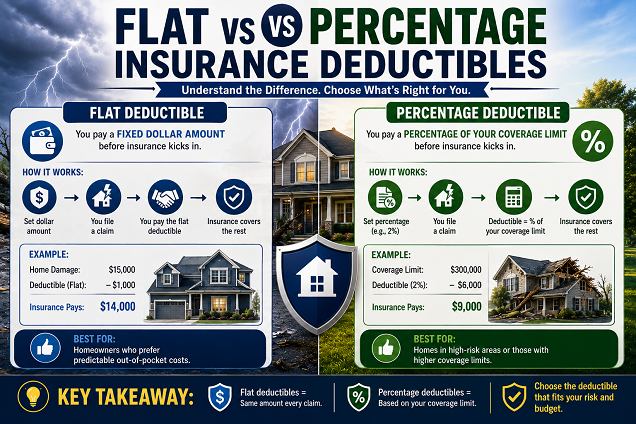
A flat deductible is a fixed dollar amount subtracted from a covered loss. A percentage deductible is a share of the amount your home is insured for, not a share of the loss. The Insurance Information Institute states that percentage deductibles generally apply to homeowners policies and are calculated on a percentage of the home's insured value. That difference is why a percentage deductible does not get smaller when the damage is smaller.

This article explains how a policy clause is structured. It is educational information, not financial, insurance or legal advice. Rules on these deductibles are set state by state, so for your own policy speak to a licensed agent or your state Department of Insurance.

Most homeowners policies carry two deductibles rather than one. There is the everyday figure that applies to most covered losses, and then a separate, usually larger figure that applies only when the cause of loss is wind, hail, a hurricane or a named storm. The second one is frequently written as a percentage, and the percentage is where the confusion starts. If you have not yet located either figure on your paperwork, how to read an insurance declarations page walks through where the deductible column sits.

Flat and percentage: the same line, written two ways

Both structures do the same job. They set the amount that comes out before the insurer pays. They differ only in how that amount is expressed and therefore in what makes it move.

A flat deductible is written as a dollar figure. It stays the same regardless of what your home is insured for and regardless of the size of the loss. It is the structure most people picture when they hear the word.

A percentage deductible is written as a percentage. The Insurance Information Institute describes deductibles as being "either a specific dollar amount or a percentage of the total amount of insurance on a policy," and notes that percentage deductibles generally only apply to homeowners policies. The Institute's page carries no visible publication date, so it is cited here for structure rather than as a current figure.

One further boundary from the same source: deductibles generally apply to property damage rather than to the liability portion of a homeowners or auto policy. The liability coverages usually carry no deductible at all.

What the percentage is a percentage of

This is the point that decides everything else, and it is the one most often misread. The percentage is applied to the insured value of the home, which on a homeowners declarations page is the Coverage A dwelling limit. It is not applied to the amount of the loss.

The arithmetic below uses round numbers because they divide cleanly. They are not presented as typical of any policy, any state or any year.

Figure
Coverage A dwelling limit 400,000
Wind and hail deductible, written as 2 percent 2 percent of 400,000
Deductible in dollars 8,000
Covered loss of 30,000 insurer pays 22,000
Covered loss of 9,000 insurer pays 1,000
Covered loss of 7,500 insurer pays nothing

Read the last two rows together. The deductible is 8,000 dollars in all three cases, because it is a function of the dwelling limit, not of the damage. A smaller loss does not produce a smaller deductible, it produces a smaller payment or no payment at all. That is the behavior that catches people, and it is entirely a consequence of what the percentage is measured against.

There is a second-order effect worth noticing. Because the deductible tracks the dwelling limit, it rises whenever the dwelling limit rises. Many policies increase Coverage A automatically at renewal to keep pace with construction costs. A percentage deductible quietly increases with it, and nothing else on the page announces that.

Where a second deductible appears on your policy

Look at the coverage table on your declarations page. The deductible column may hold more than one entry, and the second is usually labeled with the peril it belongs to rather than with a coverage letter.

The labels to search for are wind, windstorm, wind and hail, hail, hurricane, named storm, tropical cyclone and earthquake. Any of these appearing next to a figure or a percentage means that peril has its own deductible.

Two things about that line are worth checking rather than assuming. First, whether it is a percentage or a dollar amount, since some carriers write the wind and hail deductible as a flat figure. Second, whether it changed at renewal. A deductible can move from a flat dollar amount to a percentage between one policy period and the next, and the change is visible only by comparing this year's declarations page against last year's.

The definitions that decide when the special deductible applies are not on the declarations page. They are in the policy form and in whichever endorsement created the deductible, both of which are listed on the page by their form numbers.

Hurricane, named storm, windstorm, wind and hail: four labels, four triggers

These labels are not synonyms, and the difference between them is a difference in what has to happen before the larger deductible applies.

Label What triggers it
Hurricane deductible Damage from a hurricane as categorized by the National Weather Service or the National Hurricane Center, per the NAIC
Named storm deductible Broader than the above. The NAIC describes it as covering categorized hurricanes plus other declared weather events such as typhoons, tropical storms and tropical cyclones where a name has been assigned by the National Weather Service or the National Hurricane Center
Windstorm deductible Wind damage generally, per the Insurance Information Institute, which notes windstorm or wind and hail deductibles cover any kind of wind damage including from tornadoes
Wind and hail deductible The same broad wind trigger, extended to hail

The practical consequence is that a hurricane deductible is the narrowest of the four and a wind and hail deductible is the broadest. A policy with a hurricane deductible applies its ordinary deductible to an ordinary windstorm. A policy with a wind and hail deductible applies the special figure to any wind event at all.

The Insurance Information Institute notes that wind and hail deductibles are common in Midwestern states and in what it calls Tornado Alley, naming Texas, Oklahoma, Kansas and Nebraska.

The published ranges, and why two authorities give different numbers

Two national bodies publish ranges for these percentages, and the numbers do not match. Both are worth having, because they are answering different questions.

The Insurance Information Institute states that wind and hail deductibles "are most commonly paid in percentages, typically from 1 percent to 5 percent." Its background page on hurricane and windstorm deductibles gives the same 1 to 5 percent span for hurricane deductibles, with higher amounts in some coastal areas. Neither Institute page shows a publication or last-updated date, which is stated here rather than glossed over.

The NAIC, on its hurricane deductibles topic page last updated June 2, 2025, gives a wider span: "a percentage of the home's insured value, which can vary from 1% to as high as 15%."

The two are not in conflict. The Institute is describing what is commonly written. The NAIC is describing the span state regulation permits, and it says so directly in the same place: "While there are similarities among the state laws, no two laws are identical; triggers vary from state to state, as well as from insurer to insurer." As of June 2025 the NAIC counted nineteen states plus the District of Columbia permitting some form of hurricane or named storm deductible.

The reason to hold both numbers rather than one is that neither tells you what your policy says. Your own percentage is printed on your declarations page, and that figure is the only one that applies to you.

When a special deductible starts and stops applying

A percentage deductible tied to a named weather event does not apply indefinitely. It applies during a defined window, and the window is set by state regulation and by the policy language.

The Insurance Information Institute states that the duration typically extends from 24 to 72 hours after a warning ends, depending on state regulations. The NAIC's framing of the same point is that triggers vary from state to state and from insurer to insurer.

This matters because the window decides which deductible attaches. The same physical damage can fall inside or outside the trigger period, and the difference between the ordinary deductible and the percentage one is usually large. Since the rule is state-specific and the policy language is carrier-specific, the two places to establish it are your own state Department of Insurance, which publishes the rule for your state, and the endorsement named on your declarations page, which contains the wording your carrier uses.

Earthquake, the other percentage deductible

Wind is not the only peril written this way. The Insurance Information Institute notes that in California, earthquake policies include a 15 percent deductible for main structures.

Earthquake coverage is usually not part of a standard homeowners policy at all. It typically requires a separate policy or an endorsement, which is why its deductible often appears on its own document rather than in the main coverage table. The structure is the same as the wind version: a percentage applied to insured value rather than to the loss.

How to find out which structure your own policy uses

Four steps, none of which requires knowing what the right answer would be.

  1. Open your declarations page and read the entire deductible column, not the first entry.
  2. Note whether each entry is a dollar figure or a percentage, and if a percentage, which coverage limit it is measured against. On a homeowners policy that is normally the Coverage A dwelling limit.
  3. Do the multiplication once so you know the figure in dollars rather than in percent.
  4. Find the endorsement number attached to the special deductible in the form list, and ask your insurer for that document by number if you want the exact trigger wording.

For anything beyond reading the page, three routes exist. A licensed insurance agent can explain what your specific endorsement does. Your insurer's service line can send the policy form and the endorsement by number. Your state Department of Insurance is the neutral party and the right destination here in particular, because these deductibles are regulated at state level and the rules genuinely differ. The National Association of Insurance Commissioners maintains a directory of state insurance departments.

Two related pages on this site: premium, deductible, limit, out-of-pocket covers what each of the four numbers does, and actual cash value vs replacement cost covers the other line on the declarations page that changes what a payout is worth. Our disclaimer sets out what this site does and does not do.

Frequently asked questions

Is a percentage deductible a percentage of the damage?
No. The Insurance Information Institute states that percentage deductibles are calculated on a percentage of the home's insured value. On a homeowners declarations page that is the Coverage A dwelling limit. The size of the loss does not change the deductible.

Why did my deductible change from a dollar amount to a percentage?
That is a change to the policy at renewal, and it would be recorded on the new declarations page and in the form and endorsement list attached to it. Comparing this year's page against last year's is how the change becomes visible. Your insurer or agent can confirm what was changed and when.

Is a hurricane deductible the same as a wind and hail deductible?
No. The NAIC describes a hurricane deductible as applying solely to damage from a hurricane as categorized by the National Weather Service or the National Hurricane Center. The Insurance Information Institute describes windstorm and wind and hail deductibles as covering any kind of wind damage, including from tornadoes. The wind and hail version is the broader trigger.

Which states have these deductibles?
The NAIC states that as of June 2025, nineteen states plus the District of Columbia permit some form of hurricane or named storm deductible, and that no two state laws are identical. Wind and hail deductibles are separate from that count, and the Insurance Information Institute names Texas, Oklahoma, Kansas and Nebraska among the states where they are common. Your state Department of Insurance publishes the rule that applies where you live.


Sources: National Association of Insurance Commissioners, "Insurance Topics: Hurricane Deductibles," last updated June 2, 2025. Insurance Information Institute, "Understanding your insurance deductibles" and "Background on: hurricane and windstorm deductibles" (neither page shows a publication date). All accessed August 5, 2026.

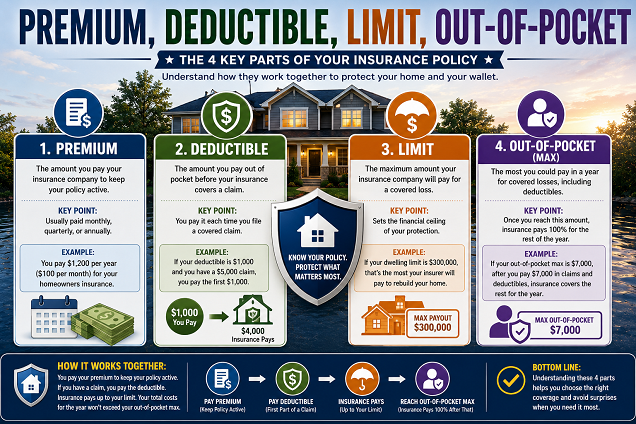
Premium is what you pay to hold the policy. Deductible is what is subtracted from a covered loss before the insurer pays. Limit is the most the insurer will pay for that coverage. Out-of-pocket is what ends up coming from you, which is the deductible plus anything above the limit or outside the coverage. Three of the four are printed on your declarations page. The fourth is arithmetic.

This article explains how policy terms work. It is educational information, not financial, insurance or legal advice. For a question about your own policy, speak to a licensed agent or your state Department of Insurance.

These four words are the vocabulary the rest of a policy is written in, and they are the four most commonly mixed up. Part of the reason is that the same words are used by health plans to mean something meaningfully different, and search results for them are dominated by the health-plan version. This page covers the property and casualty version first, on a homeowners, renters or auto policy, and then says exactly where the health-plan meanings diverge. If you want the page-by-page tour of the document these numbers sit on, start with how to read an insurance declarations page.

Premium: the price of the contract, and what it does not buy

The premium is the amount you pay the insurer to keep the policy in force for the policy period. It is billed monthly, quarterly, semiannually or annually, and on a home with a mortgage it is often paid out of an escrow account rather than by you directly.

Two things follow that people frequently expect and that are not true.

The premium does not accumulate. Paying premium for ten claim-free years does not build a balance, reduce a future deductible, or entitle you to anything at renewal. A property and casualty policy is a term contract for a defined period, and when the period ends the contract ends.

The premium is not part of your loss arithmetic. When a covered loss happens, the deductible and the limit decide what is paid. Premium paid does not enter that calculation in any way.

What the premium does reflect is the rest of the page. A lower deductible or a higher limit generally costs more premium, and the declarations page usually shows the discounts applied to arrive at the final figure. Which combination is right for a given household is a question for a licensed agent who can see the whole picture, not something a general article can answer.

Deductible: the amount subtracted, and how often it comes back

The deductible is the amount removed from a covered loss before the insurer pays anything. If a covered loss is smaller than the deductible, the policy pays nothing, which is the ordinary and intended result rather than a failure of the coverage.

The timing is the part that surprises people. The Insurance Information Institute states that deductibles apply each time you file a claim, with the exception that in Florida and Louisiana hurricane deductibles are applied once per season rather than for each storm. So a property deductible is not an annual allowance you work through. It resets to full for every separate covered loss.

A single policy also frequently carries more than one deductible. A homeowners policy commonly has one figure for most covered losses and a separate, larger one for wind, hail, hurricane or named storm, and the second is often written as a percentage rather than a dollar amount. That structure is the subject of its own page here: flat vs percentage deductibles.

One more boundary worth knowing. The Institute notes that deductibles generally apply to property damage rather than to the liability portion of a homeowners or auto policy. The liability coverages usually have no deductible at all.

Limit: the ceiling, and why a policy has several

The limit is the maximum the insurer will pay under a given coverage for a covered loss. Anything above it is yours.

The important structural point is the plural. A property policy does not have "a limit." It has one for each coverage. The Iowa Insurance Division, in a consumer guide published on April 4, 2024, sets out the standard homeowners coverages as Coverage A dwelling, Coverage B other structures, Coverage C personal property, Coverage D loss of use, Coverage E personal liability, and Coverage F medical payments to others. Each of those carries its own limit, and they are not interchangeable. Money left unused under Coverage A does not become available under Coverage C.

Beneath those headline limits sit sub-limits, which cap particular categories inside a coverage. Jewelry, cash, firearms and business property are the usual examples: they are covered under personal property, but only up to a smaller figure of their own.

Auto policies express limits differently, often as a pair or a trio of numbers for liability, with separate limits for collision, comprehensive and the various medical and uninsured motorist coverages. Same principle, different notation.

Out-of-pocket: the word that means two different things

On a property or auto policy, "out of pocket" is not a defined term with a line on your declarations page. It is a description of the total you end up paying, and it is made of three parts: the deductible, anything above the applicable limit, and anything the policy does not cover at all.

That total has no ceiling. A homeowners policy has no out-of-pocket maximum, because the concept does not exist in the property forms. If a loss exceeds the limit, the excess is simply yours.

This is exactly where the health-plan version of the vocabulary diverges, and where most of the confusion comes from. On a health plan, "out-of-pocket maximum" is a defined term with a specific figure, and it functions as a genuine annual ceiling on covered, in-network costs. On a homeowners policy there is no such number, and looking for one is looking for something the contract does not contain.

The four numbers working together in one covered loss

The numbers below are chosen because they divide cleanly. They are not presented as typical, and no figure here is a statement about what any policy costs or should be set at.

Say a policy carries a personal property limit of 100,000 dollars and a deductible of 1,000 dollars, and a covered loss damages property with a settled value of 12,000 dollars.

Step Figure Where it comes from
Settled value of the covered loss 12,000 the claim settlement
Less the deductible 1,000 the deductible column on the declarations page
Insurer pays 11,000 arithmetic, provided the limit is not reached
Applicable limit 100,000 the limit column for that coverage
Your out-of-pocket 1,000 the deductible only, in this case

Change one thing and the shape changes. If the settled value were 140,000 dollars against the same 100,000 dollar limit, the insurer would pay 100,000 minus the deductible, and your out-of-pocket would be the deductible plus the 40,000 above the limit. Change it again: if the loss is a peril the policy excludes, none of these numbers apply, because the deductible and the limit only operate on covered losses.

That last line is the one worth carrying away. The four numbers describe how much. Whether a loss is covered at all is decided by the policy form, not by any of them.

Where the health-plan version diverges

Health plans use three of these four words and add several of their own. The same word does a different job in each system.

Term On a homeowners, renters or auto policy On a health plan
Premium Price of the policy for the term. Not part of loss arithmetic Price of the plan, usually monthly. Generally does not count toward the out-of-pocket maximum
Deductible Subtracted per claim. Resets for every separate covered loss An annual amount, met across the plan year
Limit Many limits, one per coverage, plus sub-limits inside them Coverage limits exist but the more prominent ceiling is the out-of-pocket maximum
Out-of-pocket A description, not a defined term. No maximum exists A defined term with a stated maximum on covered in-network costs
Coinsurance Uncommon on a standard homeowners policy Central: a percentage share after the deductible
Copay Does not appear A flat fee per service

For the health-plan versions, the authoritative starting points are HealthCare.gov, which publishes a federal glossary of these terms, and your own plan's Summary of Benefits and Coverage, which is the standardized document every plan must provide. This site does not restate their definitions secondhand.

Where to check your own four numbers

All three of the printed numbers appear on your declarations page. The premium is usually at the bottom or in its own block. The limits and deductibles appear in the coverage table, side by side, one row per coverage. Read each row across rather than reading a column down, because a limit and a deductible only mean something as a pair.

Two further items on that page change what the numbers are worth. One is whether a coverage is written on a replacement cost or actual cash value basis, which is covered here in actual cash value vs replacement cost. The other is the list of form and endorsement numbers, which is where the definitions and exclusions live.

For a question about your own limits or deductibles, a licensed insurance agent can explain what your page says and what changing it would do. Your insurer's service line can confirm what is on file and send you the policy forms by number. Your state Department of Insurance is the neutral party, publishes consumer guides, and handles complaints about how a company is administering a policy. Have your declarations page and policy number in front of you for any of the three. Our disclaimer sets out what this site does and does not do.

Frequently asked questions

Does paying my deductible on one claim mean I do not pay it again that year?
On a property policy, no. The Insurance Information Institute states that deductibles apply each time you file a claim. The exception it names is that Florida and Louisiana apply hurricane deductibles once per season rather than per storm. A health plan works the opposite way, with an annual deductible met once across the plan year.

Why does my policy list several different limits?
Because a homeowners policy is several coverages in one contract. The Iowa Insurance Division lists Coverage A through Coverage F, each protecting something different, and each carries its own limit. Unused limit under one coverage is not available under another.

Is there a maximum I can be out of pocket on a homeowners claim?
No. There is no out-of-pocket maximum in a standard homeowners policy. That term belongs to health plans. On a property policy your exposure is the deductible plus anything above the limit plus anything the policy does not cover.

Does a lower deductible always cost more premium?
Generally the two move in opposite directions, which is why they are shown together on the declarations page. What that trade-off is worth depends on facts about your own situation, and a licensed agent looking at your actual policy is the right person to price it.


Sources: Insurance Information Institute, "Understanding your insurance deductibles" (no publication date shown on the page). Iowa Insurance Division, "Consumer Connection: Understanding your Homeowners Policy," published April 4, 2024. Maryland Insurance Administration, consumer material on understanding your declarations page. All accessed August 5, 2026.