Demo Example
Demo Example
Demo Example
Tag

auto insurance

Browsing

A state minimum auto liability limit is the least liability coverage a state allows you to buy and still register or drive a car there. It is written as three numbers: bodily injury per person, bodily injury per accident, and property damage per accident. Texas, in the Texas Department of Insurance's auto insurance guide last updated December 11, 2025, requires "at least $30,000 of coverage for injuries per person, up to a total of $60,000 per accident, and $25,000 of coverage for property damage." Every state sets its own figures, and those figures are a limit on what the insurer pays, not a limit on what you can be held to owe.

This article explains how a policy limit is structured. It is educational information, not financial, insurance or legal advice. For a question about your own coverage, speak to a licensed agent or your state Department of Insurance.

Figures checked August 10, 2026 and attributed to the state that publishes them. Minimum limits are set by state law and change by legislation. Only your own state's current published figures apply to you.

The three numbers, and what each one is counting

The notation is compact and unexplained almost everywhere it appears, which is why the middle number is so widely misread.

The first number is per injured person. It is the most the policy pays for bodily injury to any one person.

The second number is per accident, for bodily injury. It is the most the policy pays for all bodily injury in a single event, regardless of how many people were hurt.

The third number is property damage, per accident. It is the most the policy pays for damage to other people's property in a single event.

Texas's figures make the arithmetic visible. The Texas Department of Insurance writes them as "30/60/25," and explains them as $30,000 per person, "up to a total of $60,000 per accident," and $25,000 for property damage.

The second number is an aggregate, and this is the part people miss. It is not a second, larger allowance for each person. It is the shared ceiling that everyone injured in the event draws from. One person injured cannot reach it, because the per-person number stops them first. Several people injured share it, and the sharing is decided by the values of their claims rather than by dividing it evenly.

None of the three does anything for you or your own car. The California Department of Insurance states it directly: liability coverage "does not pay for injuries to you or the people in your household." Everything that responds to your own injuries or your own vehicle is a different coverage with a different price, as set out in liability, collision and comprehensive.

The limit binds the insurer, not you

This is the sentence to take away from the whole article, and it is published by a regulator rather than inferred here.

The Texas Department of Insurance: "If you don't have enough liability coverage to pay for the damages and injuries you cause, you might have to pay the rest out of your own pocket."

A policy limit is a promise about how much a company will pay. It is not a settlement of what you owe. If a claim against you is valued above your limits, the insurer's obligation ends at the limit and the remainder does not disappear. Where it goes after that is a legal question, decided under your state's law, and it is a question for an attorney rather than for an insurance article.

That is the gap that excess liability coverage exists to address, and how a second contract stacks above the first is explained in personal umbrella policy explained.

It also explains why the phrase "state minimum" describes a legal floor and nothing else. A minimum is the number below which the state will not let you drive. It is not a statement by anyone that the number is sufficient for any particular accident.

Two states can share a number and still be different

Here is the practical reason you cannot borrow a figure from a neighbor, an old article, or a national summary.

Texas: $30,000 per person, $60,000 per accident, $25,000 property damage, per the Texas Department of Insurance's auto insurance guide, last updated December 11, 2025.

California: $30,000 per person, $60,000 per accident, $15,000 property damage. The California Department of Insurance states these amounts in its automobile insurance guide, Form 101, revised February 5, 2025, and the California Department of Motor Vehicles publishes the same three figures, citing California Insurance Code section 11580.1b.

The first two numbers are identical. The third is not, and the difference is not small in proportional terms. A driver who assumes the property damage figure is standard because the injury figures matched would be wrong about the one number most likely to be reached in an ordinary collision.

Minimums also move. They are set in statute, and statutes are amended. California's published property damage minimum today differs from figures that still appear in older consumer material about the same state. Any article that hands you a table of fifty numbers is only as current as the day it was compiled, and it will not tell you which row changed last week.

What "minimum" does not include

The three liability numbers are not always the whole of what a state requires, and the extras vary more than the liability figures do.

Some states require or mandate the offer of additional coverages. Texas is a documented example: the Texas Department of Insurance states, in guidance last updated October 14, 2024, that "insurance companies must offer uninsured motorist coverage when you buy auto insurance. If you don't want it, you have to turn it down in writing." That is not a coverage requirement, it is an offer requirement, and the difference matters. What that coverage does is covered in uninsured and underinsured motorist coverage, explained.

Other states attach different requirements again, including medical or injury protection coverages that respond regardless of fault. There is no national list that is correct for everyone, and this article deliberately does not print one. What exists in every state is an official page that is correct for that state, and finding it is the subject of the next section.

How to find your own state's number, in five minutes

This is the durable skill, and it survives every future change in the law.

  1. Go to your state's Department of Insurance website, not a comparison site. The National Association of Insurance Commissioners maintains the directory of state departments, which is the neutral way to find the right one.
  2. Look for the auto insurance consumer guide. Most states publish one, and most of them state the minimum limits in the first few pages.
  3. Check the date on the page. Regulator pages usually carry a "last updated" line. If there is not one, treat the figure with more caution and cross-check.
  4. Cross-check with your state's motor vehicle agency. Registration and financial responsibility rules sit there, and the two agencies publishing the same three numbers is a good confirmation.
  5. Compare the published minimum with the limits on your own declarations page. Your limits may be higher; the minimum is a floor, not a description of what you bought. If you are unsure where to look, how to read an insurance declarations page walks through it.

Write down the date you checked. A figure without a date is a figure you will have to check again anyway.

What the minimum has to do with your premium

Very little, in the direction most people assume, and it is worth saying because the assumption drives real decisions.

Liability limits are one input into what a policy costs. They sit alongside the deductibles on your other coverages, which are a separate structure entirely, explained in premium, deductible, limit, out-of-pocket. Carrying the state minimum does not make a policy cheap, and carrying more than the minimum does not make it proportionally expensive, because the relationship between limits and price is not linear and is set by each insurer's own rating.

This site does not tell anyone what limits to carry. That decision depends on the household's assets, its state's law and its own circumstances, and it is a conversation for a licensed agent who can see all three. What this article can say is that the number on the page is the insurer's ceiling, that it is set by your state rather than by your company, and that it changes.

Your state Department of Insurance publishes the consumer material this article draws on and handles complaints about how a company administers a policy. The National Association of Insurance Commissioners maintains the directory of state departments. Questions about what happens when a claim exceeds a policy limit are legal questions and belong with an attorney.

This site explains documents and contracts. It does not recommend limits, coverages or companies, because none of that can be judged from here. How sources are chosen on this site is set out in our editorial policy.

Frequently asked questions

What does 30/60/25 mean?
It is the shorthand for three liability limits: $30,000 for bodily injury per person, $60,000 for bodily injury per accident, and $25,000 for property damage per accident. The Texas Department of Insurance uses exactly this notation for Texas's requirement in its auto insurance guide, last updated December 11, 2025. Other states use the same notation with their own numbers.

Is the second number extra money on top of the first?
No. It is the total available for all bodily injury in one accident. The per-person figure caps any single person's recovery from the policy, and the per-accident figure caps everyone's combined. One injured person cannot reach the larger number.

If a claim is bigger than my limits, who pays the rest?
Not your insurer, beyond the limit. The Texas Department of Insurance states that if you do not have enough liability coverage for the damages you cause, "you might have to pay the rest out of your own pocket." What follows from that is governed by your state's law and is a question for an attorney.

Why do different websites list different minimums for my state?
Usually because they were compiled at different times. Minimum limits are set in statute and changed by legislation, and a table compiled before a change will show the old figure. Your state Department of Insurance and your state motor vehicle agency publish the current numbers.

Does the state minimum cover my own car?
No. Liability coverage pays for injury and damage you cause to other people. The California Department of Insurance states that it "does not pay for injuries to you or the people in your household." Coverage for your own vehicle is purchased separately.


Sources: Texas Department of Insurance, "Auto insurance guide," last updated December 11, 2025, and "What is uninsured motorist coverage, and do I really need it?", last updated October 14, 2024. California Department of Insurance, "Automobile Insurance," Form 101, revised February 5, 2025. California Department of Motor Vehicles, insurance requirements page, citing California Insurance Code section 11580.1b, accessed 2026. All accessed and checked August 10, 2026. Only Texas and California figures are stated in this article, each attributed to the agency that publishes it. No national or representative minimum is given, because none exists.

Liability pays for losses you cause to other people. Collision pays for damage to your own car from impact with a vehicle or an object. Comprehensive pays for damage to your own car from causes other than a collision. The California Department of Insurance states that "only comprehensive and collision coverage have deductibles," and that liability "does not pay for injuries to you or the people in your household."

This article explains how an auto policy is divided. It is educational information, not financial, insurance or legal advice. For a question about your own policy, speak to a licensed agent or your state Department of Insurance.

Policy structures checked August 10, 2026. Required limits, available coverages and policy forms are set state by state. Your own policy document and your state Department of Insurance are the authorities for your contract.

The one question that separates all three

Auto policies are usually explained as a list of coverages, which is why nobody remembers the list. The three main coverages actually split on two questions asked in order, and once you have the questions the definitions look obvious.

Question one: whose loss is this? If the answer is somebody else's, you are in liability. If the answer is your own car, you are in the other two.

Question two, asked only if the loss is your own car: what caused it? If it was impact, that is collision. If it was anything else, that is comprehensive.

Note what is not on that list. Fault is not the dividing line. Collision responds to impact damage to your car whether or not the impact was your doing. The California Department of Insurance's own description of collision does not mention fault at all. People assume the split is "my fault versus not my fault" and it is not.

Finding these three on your own paperwork is the same exercise as on any other policy, and is covered in how to read an insurance declarations page.

Liability: other people's losses, and not yours

Liability is two coverages that usually appear as one line, and both point outward.

The California Department of Insurance defines them in two short phrases. Bodily injury liability "pays for bodily injury you cause someone else." Property damage liability "pays for property damage you cause someone else."

The North Carolina Department of Insurance gives the fuller version. Bodily injury liability "will pay for damages to other people as a result of an accident caused by you or another covered driver," and its examples include medical and funeral expenses, lost wages, disability, rehabilitation, pain and suffering, lawsuits and legal expenses. Property damage liability "will pay for damages to other people's property as a result of an accident that is caused by you or another covered driver," including the repair or actual cash value of the other person's vehicle or property, and legal expenses.

Then the sentence that corrects the most common misunderstanding in auto insurance. The California Department of Insurance states that liability "does not pay for injuries to you or the people in your household."

So the coverage every state requires is the one that does nothing for you. It exists to make other people whole. Everything that protects you or your car is a separate coverage with a separate price, and a policy carrying liability alone is a complete policy in the legal sense and an empty one from where you are sitting.

Collision: your car, one specific cause

Collision is the narrower of the two coverages on your own vehicle, and its definition is about contact.

The California Department of Insurance: collision "pays for damage to your car caused by physical contact with another vehicle or an object, such as a tree, rock, guardrail, or building." The North Carolina Department of Insurance: "Physical damage to your covered vehicle caused by an impact with another vehicle or object." The Texas Department of Insurance puts it in one line: collision "pays to repair or replace your car after an accident."

Three things follow from the definition.

The other object does not have to be a vehicle. A tree, a guardrail or a building all produce a collision loss on these definitions.

It applies regardless of who caused the accident. Nothing in any of the three definitions conditions the coverage on fault.

It is optional as a matter of law, which is the subject of a later section, and which is why a large number of cars on the road do not carry it.

Comprehensive: your car, everything else

Comprehensive is defined negatively, and that single fact explains why its list of covered causes looks like a miscellany rather than a category.

The California Department of Insurance: comprehensive "pays for damage to your car caused by something other than a collision. For example, comprehensive can cover damage from fire, theft, vandalism, windstorm, flood, falling objects, etc."

Read that list again. Fire, theft, vandalism, windstorm, flood, falling objects. Those things have nothing in common with each other. They are grouped because of what they are not. Comprehensive is the residual category on an auto policy, which is a structure worth recognizing because property insurance uses the opposite approach, listing what is covered rather than what is left over. That contrast is the subject of named perils versus open perils.

Two practical consequences of a residual definition. First, theft of the whole vehicle sits here rather than under collision, which surprises people. Second, weather damage that involves no impact sits here too, which is why the same storm can produce a collision claim for one driver and a comprehensive claim for another.

The Texas Department of Insurance gives the same coverage a plainer name and description: comprehensive, or other than collision, "pays if your car is stolen or damaged by fire, flood, vandalism or something other than a collision."

Only two of the three have a deductible

This is one sentence in a regulator's glossary and it settles a question that confuses almost everyone looking at a quote.

The California Department of Insurance defines a deductible as "the amount of the loss that you must pay before your insurance company pays anything," and then adds: "Only comprehensive and collision coverage have deductibles."

Liability has no deductible. You are not asked to pay the first part of somebody else's loss before your insurer pays the rest of it. The Texas Department of Insurance describes the deductible in exactly the same place, as the amount you pay yourself on a collision or comprehensive claim, which the company subtracts from what it pays.

That is why a quote can show a deductible next to two coverages and not next to the third, and why raising a deductible changes the price of two of your coverages and not the price of the one the state requires. How a deductible interacts with a limit and with what a household actually absorbs is worked through in premium, deductible, limit, out-of-pocket. Property policies structure the same idea differently again, sometimes as a percentage rather than a dollar figure, as covered in flat versus percentage deductibles.

What collision and comprehensive actually pay

Here is the sentence that explains why the same coverage behaves so differently on a new car and an old one.

The North Carolina Department of Insurance states that collision "pays the lesser of the cost of repair or ACV of your automobile," and that comprehensive "pays the cost of repair or ACV of your automobile less any deductible." ACV is actual cash value, the depreciated value of the vehicle at the time of the loss.

Two ceilings apply at once. The repair cost is one. The car's own depreciated value is the other. The payment is capped by whichever is lower, and then the deductible comes off.

On a recent vehicle the repair cost is almost always the binding number. On an older vehicle, the actual cash value can fall low enough that it becomes the binding number instead, at which point the practical value of the coverage has shrunk without anybody changing the policy. What actual cash value means and how it differs from replacement cost is set out in actual cash value versus replacement cost.

The California Department of Insurance's own guidance raises the question of whether to keep these coverages on an older vehicle given its value. This article reports that the question exists and does not answer it, because the answer depends on the specific car, its value and the household's circumstances. That is a conversation for a licensed agent.

Who requires what: the law, and the lender

Two different authorities require two different parts of an auto policy, and confusing them is common.

Liability is required by state law. The limits are set state by state. The Texas Department of Insurance, as one example, states that Texas law requires minimum coverage of 30/60/25. Every state sets its own numbers and its own rules, and your state's Department of Insurance is the place to find yours.

Collision and comprehensive are not required by law. They are required by whoever financed the car. The California Department of Insurance states that "this coverage is required by lenders or leasing companies." The Texas Department of Insurance says the same, describing both as required by lenders if you have an outstanding loan on the vehicle.

The practical consequence arrives the month you pay off a car. The lender requirement ends, quietly, without a notice. Nothing removes the coverage automatically, and nothing tells you the reason it was there has changed. Whether to keep it is a decision, and the point worth making here is only that it becomes a decision at that moment rather than earlier.

Two further coverages sit alongside the three and are worth knowing by name. The North Carolina Department of Insurance describes uninsured motorist coverage as protection when an at-fault uninsured driver injures you or another covered person, including property damage, and underinsured motorist coverage as protection when the at-fault driver's limits are too low, noting that underinsured motorist coverage does not cover property damage. Medical payments coverage, in the same department's words, "pays for reasonable and necessary medical and funeral expenses due to an automobile accident."

What to check on your own declarations page

  1. Find which of the three you actually carry. Liability will be there. Collision and comprehensive may not be.
  2. Read the liability limits, and note that they are set by your state rather than by your insurer.
  3. Check whether there are two deductibles or one. Collision and comprehensive can carry different amounts.
  4. Note your vehicle's age, because on the published definitions the payment is capped at the car's depreciated value.
  5. Know whether a lender still requires anything, and know what changes when the loan ends.
  6. Ask about uninsured and underinsured motorist coverage separately, since the three main coverages do not address a driver with no insurance.

Your state Department of Insurance publishes the consumer material this article draws on and handles complaints about how a company administers a policy. The National Association of Insurance Commissioners maintains the directory of state departments. A licensed agent in your state can tell you what is required and available where you live.

This site explains documents and contracts. It does not tell anyone which coverages to carry, what limits to choose, or which company to buy from, because that depends on the vehicle, the state and the household's own circumstances, and none of that is visible from here. How sources are chosen on this site is set out in our editorial policy.

Frequently asked questions

If someone else hits my car, does my collision coverage or their liability coverage pay?
Both are potentially in play, because they are different contracts doing different jobs. Their liability coverage exists to pay for damage they cause to other people's property. Your collision coverage responds to impact damage to your car without reference to fault. Which one is used in a given situation is a question for the companies involved and for your agent.

Is comprehensive coverage the same as full coverage?
No. "Full coverage" is not a coverage that appears in any of the regulator definitions reviewed here. It is an informal phrase people use for a policy carrying liability plus collision plus comprehensive. Your declarations page will list the actual coverages, and that list is the answer.

Do I have to carry collision and comprehensive?
Not as a matter of law. The California Department of Insurance and the Texas Department of Insurance both describe them as required by lenders or leasing companies rather than by the state. Liability is the coverage state law requires, at limits each state sets.

Why does my policy have two different deductibles?
Because collision and comprehensive are separate coverages and each can carry its own deductible. Liability carries none at all. The California Department of Insurance states that "only comprehensive and collision coverage have deductibles."


Sources: California Department of Insurance, "Automobile Insurance" consumer page (no date shown on the page). North Carolina Department of Insurance, "Basic and Miscellaneous Auto Coverages" (page header carries a July 1, 2025 reference). Texas Department of Insurance, "Auto insurance guide," last updated December 11, 2025. All accessed and checked August 10, 2026. The Wisconsin Office of the Commissioner of Insurance and Washington State Office of the Insurance Commissioner auto guides could not be read during this research and nothing is sourced to them.

A personal umbrella policy is a separate liability contract that pays above the limits of your auto, homeowners or renters policies. The National Association of Insurance Commissioners describes it as coverage "for liability and defense costs your primary insurance, such as auto, homeowners, and renters insurance policies, do not cover." The New Jersey Department of Banking and Insurance describes it as covering liability "in excess of underlying insurance limits." It is liability only. The NAIC states plainly that it does not cover damage to your own home or your own vehicle.

This article explains how two liability contracts stack. It is educational information, not financial, insurance or legal advice. For a question about your own coverage, speak to a licensed agent or your state Department of Insurance.

Sources checked August 10, 2026. Availability, required underlying limits and policy wording vary by state and by company. Your own policy documents are the authority for your contracts.

What the liability coverage you already have is doing

Before anything sits above it, it is worth being precise about the layer underneath.

The Texas Department of Insurance, in its home insurance guide last updated June 1, 2026, describes personal liability coverage on a home policy as coverage that "pays medical bills, lost wages, and other costs for people that you're legally responsible for injuring," and that covers court costs if you are sued. The California Department of Insurance describes Coverage E, personal liability, as coverage "in the event you or a resident of your household are legally responsible for injury to others," and notes that on renters policies it is "generally subject to a minimum of $100,000."

Note the direction of all of that. Liability coverage points outward, at other people. Where it sits on a homeowners policy, and how it relates to the coverage parts around it, is set out in the six coverage parts of a homeowners policy. The auto policy has its own outward-facing coverage, described in liability, collision and comprehensive.

Every one of these has a number on it. That number is the most the insurer pays. It is not a cap on what a court can decide you owe. The Texas Department of Insurance says the auto version of this out loud in its auto insurance guide, last updated December 11, 2025: "If you don't have enough liability coverage to pay for the damages and injuries you cause, you might have to pay the rest out of your own pocket."

An umbrella policy exists because of the gap in that sentence.

How the stacking actually works

The New Jersey Department of Banking and Insurance, in a consumer release dated July 8, 2015, gives the clearest worked example published by a regulator. A driver carrying $500,000 in auto liability is found responsible for $750,000 in damages. The primary policy pays $500,000. The umbrella pays the remaining $250,000.

Three things are visible in that example and each one matters.

The umbrella did not replace the auto policy. The auto policy paid first, to its full limit, and the umbrella took what was left. Two contracts responded to one event, in order.

The umbrella's limit is stated separately. It is not an adjustment to the auto limit. It is its own number on its own policy.

The order is fixed. The underlying policy exhausts, then the umbrella responds. This is why an umbrella is described as excess coverage rather than as additional coverage.

The Texas Department of Insurance frames the purchase decision the same way in its home insurance guide: "If you want more coverage than your policy provides, you can buy a separate umbrella liability policy." Separate is the operative word. It is a second contract with its own declarations page, its own limit and its own conditions, which means it needs to be read the same way as any other, using the method in how to read an insurance declarations page.

The requirement almost nobody explains: underlying limits

Here is the structural fact that changes what an umbrella actually costs a household to hold, and it is missing from most explanations of the product.

An umbrella does not sit on top of whatever limits you happen to have. It sits on top of limits the umbrella insurer requires you to maintain.

The New Jersey Department of Banking and Insurance's release describes common policies as providing $1 million or more above "underlying limits of $300,000 to $500,000." That figure is not a description of what you have. It is a description of what the layer beneath is expected to be before the layer above will attach.

Two consequences follow, and both are practical.

Buying the upper layer can require raising the lower one first. If your existing auto or home liability limits sit below what the umbrella insurer requires, the requirement is met by changing those policies, not by the umbrella.

If the underlying layer drops, the household holds the difference. An umbrella attaches at a stated point. If the policy beneath it is later written with a lower limit, or lapses, the space between the two is not automatically filled by the umbrella. It is a gap, and it belongs to whoever is standing under it.

This is the part to ask about in writing. Ask what underlying limits the umbrella requires, on which policies, and what happens if one of them changes at renewal. Those answers are specific to the company and the state, and no general article can supply them.

The figures in the New Jersey release are from 2015 and are quoted here as an illustration of the structure, not as current market practice. Required underlying limits are set by the insurer offering the umbrella. Ask yours.

It is not purely excess, and that is the second surprise

If an umbrella only ever paid after an underlying policy exhausted, it would be a simple thing. It is not quite that.

The New Jersey Department of Banking and Insurance's release says umbrella policies may cover "claims possibly not provided for in underlying policies like libel, slander or defamation of character," plus legal defense costs and worldwide coverage. The NAIC lists personal injury alongside bodily injury and property damage among the situations an umbrella addresses.

So there are two different jobs in one contract. For most claims, the umbrella is the second payer above a policy that pays first. For a category the underlying policy never covered at all, there is nothing underneath to exhaust.

That second case raises a question the marketing never raises: when the umbrella is responding to something no underlying policy covers, what does the household pay before the umbrella starts? The answer is in the umbrella's own wording, and the terms used for it vary. It is a fair and specific question to put to a licensed agent, and it is one of the few questions that meaningfully separates one umbrella form from another.

What an umbrella does not do

The honest section, and it is short.

It does not pay for your own property. The NAIC states that umbrella policies do not cover damage to the policyholder's own home or vehicle, and gives hail damage to your own car as the example. Damage to your own things is the job of the property coverages, which is a different half of the insurance world entirely.

It does not pay punitive damages. The NAIC states this and explains the reasoning with an example: drunk driving, "because a person consciously chooses to drink, knowing this could injure someone."

It does not repair the limits underneath it. An umbrella attaching above a thin underlying layer leaves that thin layer exactly as thin as it was. The first dollars of any claim still come from the policy below.

It is not required by any state. Liability limits on an auto policy are set by state law, and what those numbers mean is covered in what a state minimum auto liability limit actually means. No state requires a personal umbrella. Where a requirement to carry one appears, it comes from a private agreement rather than from a statute.

This site does not publish prices for it. Cost figures for umbrella coverage circulate widely and date quickly; the most recent regulator figure found in this research was published in 2015. What an umbrella costs a specific household depends on the underlying policies, the state and the insurer, and the only reliable number is a quoted one from a licensed agent.

Reading the two policies together

An umbrella only makes sense read alongside the policies it attaches to, which means three documents on one table.

  1. Your auto declarations page. Find the liability limits. They are usually written as three numbers.
  2. Your home or renters declarations page. Find personal liability, often labeled Coverage E, and note its limit. Renters carry this coverage too, as set out in what renters insurance covers.
  3. The umbrella declarations page, if one exists. Find its limit and find the attachment point.
  4. Compare the attachment point with the limits on the other two. They should meet. If there is daylight between them, that daylight is uninsured.
  5. Ask what happens at renewal if any underlying limit changes.
  6. Ask which claims the umbrella covers that the underlying policies do not, and what the household pays first in that case.

Your state Department of Insurance publishes consumer material on liability coverage and handles complaints about how a company administers a policy. The National Association of Insurance Commissioners maintains the directory of state departments. A licensed agent in your state can tell you what is available where you live and what underlying limits a given umbrella requires.

This site explains documents and contracts. It does not tell anyone whether to buy an umbrella policy, what limit to carry, or which company to buy from, because that depends on the household's assets, its state and its existing policies, and none of that is visible from here. How sources are chosen on this site is set out in our editorial policy.

Frequently asked questions

Does an umbrella policy cover damage to my own house or car?
No. The National Association of Insurance Commissioners states that umbrella policies do not cover damage to your own home or vehicle, using hail damage to your car as the example. An umbrella is a liability contract. Damage to your own property is covered, if at all, by the property coverages on your home and auto policies.

Do I have to keep certain limits on my other policies to have an umbrella?
Generally yes, and the amounts are set by the umbrella insurer. The New Jersey Department of Banking and Insurance's consumer release describes umbrella coverage as sitting above underlying limits, and names $300,000 to $500,000 as common underlying figures in 2015. What your insurer requires today is a question for your agent, and it is worth asking in writing.

Is an umbrella policy the same as raising my auto liability limit?
No. Raising an auto limit changes one policy. An umbrella is a separate contract that responds above several underlying policies, and the New Jersey department notes it may also cover claims such as libel, slander or defamation that underlying policies may not provide for at all.

Does an umbrella cover punitive damages?
The NAIC states that umbrella policies exclude punitive damages, and explains the reasoning with the example of drunk driving. How punitive damages are treated is also affected by state law, which is a question for an attorney rather than for a general article.

Is a personal umbrella policy required anywhere?
Not by any state as a condition of driving or of owning a home. State law sets minimum auto liability limits; it does not require excess liability coverage. A requirement to carry an umbrella, where one appears, comes from a contract someone has signed rather than from a statute.


Sources: National Association of Insurance Commissioners, "What's an Umbrella Policy?", published December 15, 2022. New Jersey Department of Banking and Insurance, consumer release on umbrella insurance, dated July 8, 2015. Texas Department of Insurance, "Home insurance guide," last updated June 1, 2026, and "Auto insurance guide," last updated December 11, 2025. California Department of Insurance, "Residential Insurance: Homeowners and Renters," Form 401, revised January 2026. All accessed and checked August 10, 2026. The underlying-limit figures quoted from the 2015 New Jersey release are identified as 2015 figures in the text and are not presented as current.

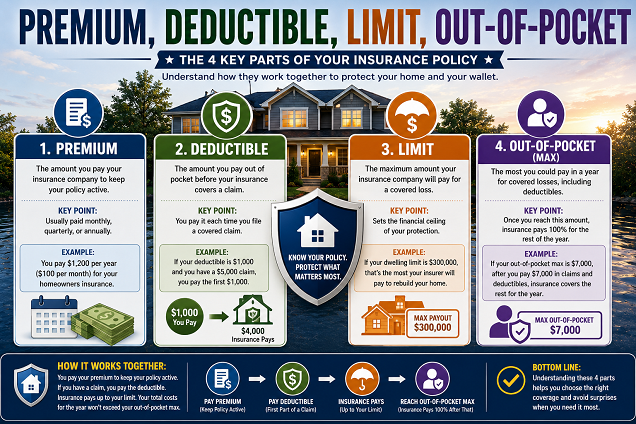
Premium is what you pay to hold the policy. Deductible is what is subtracted from a covered loss before the insurer pays. Limit is the most the insurer will pay for that coverage. Out-of-pocket is what ends up coming from you, which is the deductible plus anything above the limit or outside the coverage. Three of the four are printed on your declarations page. The fourth is arithmetic.

This article explains how policy terms work. It is educational information, not financial, insurance or legal advice. For a question about your own policy, speak to a licensed agent or your state Department of Insurance.

These four words are the vocabulary the rest of a policy is written in, and they are the four most commonly mixed up. Part of the reason is that the same words are used by health plans to mean something meaningfully different, and search results for them are dominated by the health-plan version. This page covers the property and casualty version first, on a homeowners, renters or auto policy, and then says exactly where the health-plan meanings diverge. If you want the page-by-page tour of the document these numbers sit on, start with how to read an insurance declarations page.

Premium: the price of the contract, and what it does not buy

The premium is the amount you pay the insurer to keep the policy in force for the policy period. It is billed monthly, quarterly, semiannually or annually, and on a home with a mortgage it is often paid out of an escrow account rather than by you directly.

Two things follow that people frequently expect and that are not true.

The premium does not accumulate. Paying premium for ten claim-free years does not build a balance, reduce a future deductible, or entitle you to anything at renewal. A property and casualty policy is a term contract for a defined period, and when the period ends the contract ends.

The premium is not part of your loss arithmetic. When a covered loss happens, the deductible and the limit decide what is paid. Premium paid does not enter that calculation in any way.

What the premium does reflect is the rest of the page. A lower deductible or a higher limit generally costs more premium, and the declarations page usually shows the discounts applied to arrive at the final figure. Which combination is right for a given household is a question for a licensed agent who can see the whole picture, not something a general article can answer.

Deductible: the amount subtracted, and how often it comes back

The deductible is the amount removed from a covered loss before the insurer pays anything. If a covered loss is smaller than the deductible, the policy pays nothing, which is the ordinary and intended result rather than a failure of the coverage.

The timing is the part that surprises people. The Insurance Information Institute states that deductibles apply each time you file a claim, with the exception that in Florida and Louisiana hurricane deductibles are applied once per season rather than for each storm. So a property deductible is not an annual allowance you work through. It resets to full for every separate covered loss.

A single policy also frequently carries more than one deductible. A homeowners policy commonly has one figure for most covered losses and a separate, larger one for wind, hail, hurricane or named storm, and the second is often written as a percentage rather than a dollar amount. That structure is the subject of its own page here: flat vs percentage deductibles.

One more boundary worth knowing. The Institute notes that deductibles generally apply to property damage rather than to the liability portion of a homeowners or auto policy. The liability coverages usually have no deductible at all.

Limit: the ceiling, and why a policy has several

The limit is the maximum the insurer will pay under a given coverage for a covered loss. Anything above it is yours.

The important structural point is the plural. A property policy does not have "a limit." It has one for each coverage. The Iowa Insurance Division, in a consumer guide published on April 4, 2024, sets out the standard homeowners coverages as Coverage A dwelling, Coverage B other structures, Coverage C personal property, Coverage D loss of use, Coverage E personal liability, and Coverage F medical payments to others. Each of those carries its own limit, and they are not interchangeable. Money left unused under Coverage A does not become available under Coverage C.

Beneath those headline limits sit sub-limits, which cap particular categories inside a coverage. Jewelry, cash, firearms and business property are the usual examples: they are covered under personal property, but only up to a smaller figure of their own.

Auto policies express limits differently, often as a pair or a trio of numbers for liability, with separate limits for collision, comprehensive and the various medical and uninsured motorist coverages. Same principle, different notation.

Out-of-pocket: the word that means two different things

On a property or auto policy, "out of pocket" is not a defined term with a line on your declarations page. It is a description of the total you end up paying, and it is made of three parts: the deductible, anything above the applicable limit, and anything the policy does not cover at all.

That total has no ceiling. A homeowners policy has no out-of-pocket maximum, because the concept does not exist in the property forms. If a loss exceeds the limit, the excess is simply yours.

This is exactly where the health-plan version of the vocabulary diverges, and where most of the confusion comes from. On a health plan, "out-of-pocket maximum" is a defined term with a specific figure, and it functions as a genuine annual ceiling on covered, in-network costs. On a homeowners policy there is no such number, and looking for one is looking for something the contract does not contain.

The four numbers working together in one covered loss

The numbers below are chosen because they divide cleanly. They are not presented as typical, and no figure here is a statement about what any policy costs or should be set at.

Say a policy carries a personal property limit of 100,000 dollars and a deductible of 1,000 dollars, and a covered loss damages property with a settled value of 12,000 dollars.

Step Figure Where it comes from
Settled value of the covered loss 12,000 the claim settlement
Less the deductible 1,000 the deductible column on the declarations page
Insurer pays 11,000 arithmetic, provided the limit is not reached
Applicable limit 100,000 the limit column for that coverage
Your out-of-pocket 1,000 the deductible only, in this case

Change one thing and the shape changes. If the settled value were 140,000 dollars against the same 100,000 dollar limit, the insurer would pay 100,000 minus the deductible, and your out-of-pocket would be the deductible plus the 40,000 above the limit. Change it again: if the loss is a peril the policy excludes, none of these numbers apply, because the deductible and the limit only operate on covered losses.

That last line is the one worth carrying away. The four numbers describe how much. Whether a loss is covered at all is decided by the policy form, not by any of them.

Where the health-plan version diverges

Health plans use three of these four words and add several of their own. The same word does a different job in each system.

Term On a homeowners, renters or auto policy On a health plan
Premium Price of the policy for the term. Not part of loss arithmetic Price of the plan, usually monthly. Generally does not count toward the out-of-pocket maximum
Deductible Subtracted per claim. Resets for every separate covered loss An annual amount, met across the plan year
Limit Many limits, one per coverage, plus sub-limits inside them Coverage limits exist but the more prominent ceiling is the out-of-pocket maximum
Out-of-pocket A description, not a defined term. No maximum exists A defined term with a stated maximum on covered in-network costs
Coinsurance Uncommon on a standard homeowners policy Central: a percentage share after the deductible
Copay Does not appear A flat fee per service

For the health-plan versions, the authoritative starting points are HealthCare.gov, which publishes a federal glossary of these terms, and your own plan's Summary of Benefits and Coverage, which is the standardized document every plan must provide. This site does not restate their definitions secondhand.

Where to check your own four numbers

All three of the printed numbers appear on your declarations page. The premium is usually at the bottom or in its own block. The limits and deductibles appear in the coverage table, side by side, one row per coverage. Read each row across rather than reading a column down, because a limit and a deductible only mean something as a pair.

Two further items on that page change what the numbers are worth. One is whether a coverage is written on a replacement cost or actual cash value basis, which is covered here in actual cash value vs replacement cost. The other is the list of form and endorsement numbers, which is where the definitions and exclusions live.

For a question about your own limits or deductibles, a licensed insurance agent can explain what your page says and what changing it would do. Your insurer's service line can confirm what is on file and send you the policy forms by number. Your state Department of Insurance is the neutral party, publishes consumer guides, and handles complaints about how a company is administering a policy. Have your declarations page and policy number in front of you for any of the three. Our disclaimer sets out what this site does and does not do.

Frequently asked questions

Does paying my deductible on one claim mean I do not pay it again that year?
On a property policy, no. The Insurance Information Institute states that deductibles apply each time you file a claim. The exception it names is that Florida and Louisiana apply hurricane deductibles once per season rather than per storm. A health plan works the opposite way, with an annual deductible met once across the plan year.

Why does my policy list several different limits?
Because a homeowners policy is several coverages in one contract. The Iowa Insurance Division lists Coverage A through Coverage F, each protecting something different, and each carries its own limit. Unused limit under one coverage is not available under another.

Is there a maximum I can be out of pocket on a homeowners claim?
No. There is no out-of-pocket maximum in a standard homeowners policy. That term belongs to health plans. On a property policy your exposure is the deductible plus anything above the limit plus anything the policy does not cover.

Does a lower deductible always cost more premium?
Generally the two move in opposite directions, which is why they are shown together on the declarations page. What that trade-off is worth depends on facts about your own situation, and a licensed agent looking at your actual policy is the right person to price it.


Sources: Insurance Information Institute, "Understanding your insurance deductibles" (no publication date shown on the page). Iowa Insurance Division, "Consumer Connection: Understanding your Homeowners Policy," published April 4, 2024. Maryland Insurance Administration, consumer material on understanding your declarations page. All accessed August 5, 2026.

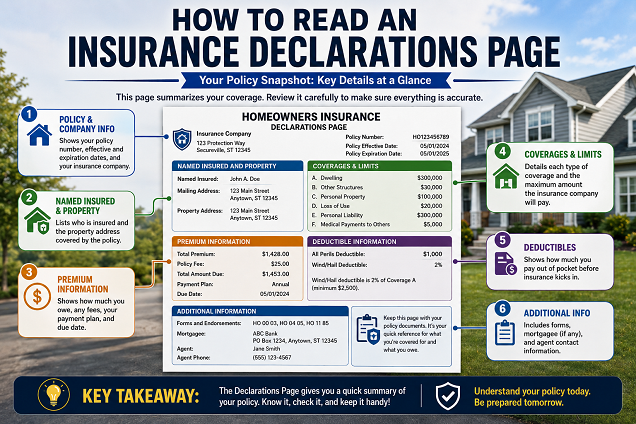
A declarations page is the one- or two-page summary that comes at the front of a home, auto or renters policy. The Maryland Insurance Administration describes it as the document that identifies the kinds and amounts of coverage you have and what it costs. It lists who is covered, for how long, up to what limits, after what deductible, and at what premium. It is a summary of the contract. It is not the contract.

This article explains how a document is laid out. It is educational information, not financial, insurance or legal advice. For a question about your own policy, speak to a licensed agent or your state Department of Insurance.

That last distinction is the one that costs people money, so it is worth stating twice. The declarations page carries the numbers. The policy forms behind it carry the definitions, the exclusions and the conditions that decide whether a given loss is covered at all. Reading the page well means reading the numbers accurately and then knowing exactly which document to ask for next. This guide walks the page block by block, in the order the blocks usually appear, and the walkthrough is the same whether the policy covers a house, a car or an apartment.

What a declarations page is, and what it is not

Insurers call it the "dec page." It is generated for your policy specifically, which is why it carries your name, your address and your numbers, while the rest of the policy is a stack of standard printed forms that thousands of other households receive word for word.

That split is the whole design. The standard forms say what the words in the contract mean. The declarations page says which of those forms apply to you, in what amounts, for what period. Neither half is readable without the other, and only one half arrives in a format most people will actually look at.

So the practical rule is this. Any question of the form "how much" is answered on the declarations page. Any question of the form "is this covered" is answered in the forms, and the declarations page tells you which forms to open. Treating the dec page as the full contract is the most common reading error, and it produces confident wrong answers rather than obvious confusion, which is what makes it expensive.

Where to find yours

A declarations page is issued at least once a year, at renewal, and again any time coverage changes mid-term. Four places to look, in order of speed:

  • The insurer's online account. Almost every carrier posts current and prior dec pages under a "documents," "policy" or "ID cards" section.
  • The renewal packet. The dec page is the first page inside, usually ahead of a stack of forms with numbers in the corners.
  • Your agent. An independent or captive agent can send it the same day.
  • Your mortgage servicer or lienholder, if there is one. They are listed on the page and hold a copy, because the escrow account pays the premium.

If none of those produce it, call the insurer's service line and ask for "the current declarations page for policy number X." That is the exact phrase, and it avoids being sent a marketing summary instead.

The identification block: who and what is covered

The top of the page names the parties and the property. On a homeowners policy that means the named insured, the mailing address, and the insured location if it differs. On an auto policy it means the named insured, the listed drivers, and each covered vehicle by year, make, model and VIN. On a renters policy it means the named insured and the rented address.

Two lines in this block do more work than they appear to:

The named insured. Coverage follows this name and, in most standard forms, the relatives who live in the same household. A roommate, an unmarried partner, or an adult child who has moved out is a separate question with a real answer in the policy form, not an assumption to make from the dec page.

The mortgagee, loss payee or lienholder. If a lender is listed here, that lender has an interest in the payout and is usually named on claim checks. On a financed car the lienholder line is also how the insurer knows to tell your lender if the policy lapses.

Check the spelling, the address and the vehicle identifiers. An error here is dull to fix now and serious to discover later.

The policy period, and why two dates carry more weight than they look

The policy period is printed as an effective date and an expiration date, and often with a time of day attached, such as 12:01 a.m. standard time at the insured location. Coverage exists inside that window and does not exist outside it.

Two practical consequences follow. First, the time of day is real. A policy that expires at 12:01 a.m. on the first of the month does not cover a loss that afternoon, and a new policy that starts at 12:01 a.m. begins there, not at midnight and not when you signed. Second, the dates are how you check for a gap when you switch carriers. Lay the outgoing expiration date beside the incoming effective date. If there is a day between them, there is a day with no coverage, and that day is exactly the sort of detail nobody notices until it matters.

The period is also the clock on which a term deductible, a term limit, or an annual aggregate resets, which is why it sits near the top of the page rather than the bottom.

The coverage table: limits and deductibles, read as a pair

The middle of the page is a table. One column names each coverage, one column gives the limit, and one column gives the deductible that applies to it. The limit is the most the insurer will pay for a covered loss under that coverage. The deductible is the amount subtracted before they pay anything.

On a homeowners policy the coverages usually appear as lettered parts. The Iowa Insurance Division, in a consumer guide published on April 4, 2024, sets them out as Coverage A dwelling, Coverage B other structures, Coverage C personal property, Coverage D loss of use, Coverage E personal liability, and Coverage F medical payments to others. Coverage A is the structure itself. Coverage B is what is detached from it, such as a shed or a fence. Coverage C is what would fall out if you turned the house upside down. Coverage D is the additional living expense of being unable to live there. Coverage E responds to a liability claim against you, and Coverage F pays certain medical costs for a guest hurt on your property regardless of fault.

Auto policies use names rather than letters: bodily injury liability, property damage liability, collision, comprehensive, uninsured and underinsured motorist, medical payments or personal injury protection. Renters policies carry a shortened version of the homeowners letters, with no Coverage A because the structure is not yours.

Read each row across, not down. A limit means nothing without the deductible sitting beside it, and a deductible means nothing without knowing which coverage it attaches to.

The deductible line, and where a second deductible hides

Most readers know their deductible as a single number. On a property policy it is often more than one number, and the declarations page is where that shows up.

Two structures appear. A flat deductible is a fixed dollar amount subtracted from a covered loss. A percentage deductible is a share of the insured value rather than a fixed sum. The Insurance Information Institute notes that percentage deductibles generally apply to homeowners policies and are calculated on a percentage of the home's insured value, and that deductibles generally apply to property damage rather than to the liability part of a homeowners or auto policy. The Institute's page carries no visible last-updated date, so it is cited here as a description of structure rather than as a current figure.

The second thing worth knowing is timing. The Institute states that deductibles apply each time you file a claim, with the exception that in Florida and Louisiana hurricane deductibles are applied once per season rather than for each storm. That is a different rhythm from a health plan, where the deductible is an annual figure, and the two get confused constantly.

Look for a separate line naming wind, hail, hurricane, named storm or earthquake. If one is there, that peril has its own deductible and it is frequently the larger of the two. How those percentage deductibles are written and what triggers them is covered in flat vs percentage deductibles.

The valuation words: replacement cost or actual cash value

Somewhere on the page, usually near Coverage A or Coverage C, sits a word or a short code that decides how a payout is calculated. This is the single highest-consequence item on the declarations page and it is often the least visible.

The NAIC, in a consumer article dated January 2, 2025, puts the two definitions this way. Under actual cash value coverage, the policy pays the cost to repair or replace based on the property's value taking account of its age and wear and tear, which is depreciation, and the NAIC adds that this "often does not pay enough to fully replace your property or repair the damage." Under replacement cost value coverage, the policy pays the cost to repair or replace the damaged property using materials of like kind and quality.

The North Carolina Department of Insurance states the same split in plainer terms: actual cash value is the amount needed to fix your home minus the decrease in value from age or use, while replacement cost value is the amount needed to repair at today's prices for building supplies, or to replace belongings at today's cost of a similar item.

A policy can use one basis for the structure and the other for contents, and the declarations page is where that combination is recorded. The full comparison, including the four neighboring terms that are not the same thing, is in actual cash value vs replacement cost.

The form and endorsement numbers, which are the index to the contract

Near the bottom of most declarations pages is a list that looks like clutter: a column of codes such as HO 00 03, HO 04 16, HO 04 90, PP 00 01, or a carrier's own numbering. Readers skip it. It is the most useful block on the page.

Those codes are the actual documents that make up your policy. One of them is the base policy form, which contains the insuring agreement, the definitions, the exclusions and the conditions. The rest are endorsements, each of which adds, removes or modifies something in that base form. Together they are the contract. The declarations page is only the cover sheet that says which ones apply to you and in what amounts.

This gives you a precise request to make. Instead of asking "is water damage covered," which invites a summary, you can ask your insurer or agent to send you the base form and each endorsement by number, then read the exclusions in the base form and check whether any listed endorsement changes them. An insurer is generally able to produce these on request, and the numbers are the reason the request is easy to fulfill.

It also gives you a way to see what changed at renewal. Compare this year's list of form numbers to last year's. A code that disappeared, appeared, or gained a new edition date is a change to your contract, and it will not be announced anywhere else on the page.

Premium, discounts, and the lines that are not coverage

The lower part of the page totals the money. Expect a premium by coverage or by vehicle, a policy total, any fees, and a list of discounts applied.

The discounts list is worth a slow read once a year, because discounts are applied from data the insurer holds about you and that data goes stale. A discount tied to a safety device, a claims-free period, a bundled policy, or a driver who no longer lives in the household is a line you can verify against reality. The Maryland Insurance Administration's consumer material notes that companies may reduce a premium where set conditions are met, such as a good driving record, an antitheft device, or holding auto and homeowners coverage with the same company.

Two things in this area are commonly mistaken for coverage. A fee is an administrative charge and buys nothing. A credit or surcharge adjusts price, not protection. Neither changes a limit, a deductible or what the policy covers, and only the coverage table does that.

What your declarations page will never tell you

This is the boundary worth memorizing, because most disappointment with a policy traces back to a reader who expected the dec page to answer something it structurally cannot.

The declarations page tells you Only the policy forms tell you
Who is named on the policy How the policy defines "insured," "residence premises" or "occurrence"
The limit for each coverage Whether your specific loss falls under that coverage at all
The deductible for each coverage What triggers a separate wind, hail or named storm deductible
That contents are on an ACV or RCV basis How depreciation is calculated and whether any of it is recoverable
Which endorsements apply, by number What each of those endorsements actually changes
The premium and the discounts Your duties after a loss, and the deadlines attached to them

The pattern is consistent. Amounts are on the declarations page. Meanings are in the forms. Anything phrased as "is this covered" is a meaning question.

Five things to check on your own page today

  1. The names and the property details. Spelling, address, and the VIN of each vehicle.
  2. The policy period, including the time of day, and whether it butts cleanly against any prior policy.
  3. Every deductible line, not just the first one. Look specifically for wind, hail, hurricane, named storm or earthquake.
  4. The valuation basis on the structure and on contents separately. The words to hunt for are "replacement cost" and "actual cash value."
  5. The form and endorsement list, compared against last year's page.

None of these five requires knowing what the right answer is. They only require noticing what your page says, which is the part you can do without help.

Deep dives on the blocks of this page

Each of these takes one block of the declarations page and works through it in full.

Who to call, and what to have in front of you

For a question about coverage on your own policy, three routes exist and each wants something different from you.

A licensed insurance agent, either your own or an independent one, can explain what a form number does and what an endorsement changes. Have the declarations page and the form list open when you call. Your insurer's own service line can send you the base form and endorsements by number and confirm what is on file. Have the policy number. Your state Department of Insurance is the neutral party. Every state has one, they publish consumer guides, and they take questions and complaints about how a company is handling a policy. The NAIC maintains a directory of state insurance departments, and the state department is the right destination for anything that feels like a dispute rather than a question.

Nothing on this site is a substitute for any of the three. This article explains a document. It does not tell you what coverage to carry, and no page that has never seen your policy honestly could.

Related reading on this site: about us, our editorial policy on how sources are chosen, and the site disclaimer.

Frequently asked questions

Is a declarations page the same as proof of insurance?
Not quite. A declarations page shows coverage, limits and dates, and many parties will accept it. An auto insurance ID card is a separate, smaller document, and some requesters, including some states for vehicle registration purposes, specify one or the other. Ask the requesting party which document they want by name.

Why does my declarations page list coverages I did not ask for?
Some coverages are built into a standard policy form rather than selected, and others are added by endorsement at the carrier's or the lender's request. The form and endorsement numbers at the bottom of the page are what identify them. Your insurer can say which of them are optional on your policy.

My declarations page arrived and nothing looks different from last year. Do I still need to read it?
The two blocks that change most quietly are the deductible lines and the form list. A deductible can move from a flat dollar amount to a percentage at renewal, and an endorsement can be added or dropped, without either change being obvious anywhere else in the packet.

Where do I look to find out whether a specific loss would be covered?
In the base policy form named on the declarations page, and then in each endorsement listed there. The dec page carries no exclusions and no definitions, so it cannot answer a coverage question on its own. Ask your insurer or agent for those documents by their form numbers.

Who regulates my insurance company?
The state you live in. Insurance in the United States is regulated at state level, and your state Department of Insurance is the body that licenses insurers and handles consumer complaints. The National Association of Insurance Commissioners publishes a directory of every state department.


Sources: Maryland Insurance Administration, consumer material on understanding your declarations page. Iowa Insurance Division, "Consumer Connection: Understanding your Homeowners Policy," published April 4, 2024. National Association of Insurance Commissioners, "What's the Difference Between Actual Cash Value Coverage and Replacement Cost Coverage?", January 2, 2025. North Carolina Department of Insurance, "Actual Cash Value vs. Replacement Cost Value." Insurance Information Institute, "Understanding your insurance deductibles" (no publication date shown on the page). All accessed August 5, 2026.