



Demo Example
Demo Example
Demo Example
Tag

personal property

Browsing

A home inventory is a written record of what you own, what it is worth, and when you bought it. The Texas Department of Insurance describes it as a list that "will help you decide how much coverage you need." Each line carries the purchase date, the value and the serial number, backed by photographs or video of each room, and the finished record is stored somewhere other than the house it describes.

This article explains a document-keeping practice that supports a residential insurance policy. It is educational information, not financial, insurance or legal advice. For a question about your own coverage, speak to a licensed agent or your state Department of Insurance.

Regulator guidance checked August 10, 2026. Recommendations differ slightly between state departments and none of them is a rule. Your own policy and your own insurer's instructions govern your contract.

What a home inventory is, in the regulators' own words

Three state departments describe the same object in three slightly different ways, and putting them side by side gives a fuller definition than any one of them alone.

The California Department of Insurance: "A home inventory should be completed to keep track of your belongings and valuable items." The Oklahoma Insurance Department: "A home inventory assures you know exactly what you own and what it is worth before you ever need to make a claim." The Texas Department of Insurance: "A complete list of your property will help you decide how much coverage you need and will make filing claims easier."

Read together, an inventory is three things at once. It is a record of what exists, a record of what it is worth, and a document that lives outside your memory. The last of those is the whole reason it works. Nobody can reconstruct the contents of a closet, a garage or a kitchen drawer from memory, and the moment when the attempt would be needed is the worst possible moment to be attempting it.

Why it is a coverage question before it is anything else

Most articles on this subject treat the inventory as something you produce after a loss. Two of the three regulators quoted above frame it the other way around, and their framing is the more useful one.

The Texas Department of Insurance says the list "will help you decide how much coverage you need." Its renters guidance repeats the point: "Fill out a home inventory to know the value of your belongings to be sure you have enough coverage." The California Department of Insurance ties it directly to keeping the policy right: home inventories "should be updated at least once per year, and your insurance company should be notified of new purchases so that you are adequately insured."

That is a pre-loss function, and it is the one that changes decisions. The contents limit on your policy, Coverage C, is a number somebody picked. Usually it was picked as a percentage of the dwelling amount rather than by counting anything. An inventory is the only way to find out whether that number bears any relationship to what is actually in the house. Where Coverage C sits among the other coverages is set out in the six coverage parts A through F, and if you rent, the same limit does the same job in a renters policy.

What goes on each line

The Texas Department of Insurance gives the shortest complete specification of a line item: record "the date you bought each item, its value, and its serial number. This is especially important for expensive items."

Each of those three fields is doing a specific job.

The purchase date is what makes a valuation conversation possible at all. Whether a policy settles on depreciated value or on replacement cost, age is an input, and the difference between those two settlement bases is explained in actual cash value versus replacement cost.

The value is what the item was worth, which is not always what you paid or what it would cost today. Recording the price paid and the date is more durable than recording an opinion about current worth.

The serial number identifies the specific object rather than the category. The California Department of Insurance similarly asks for descriptions, serial numbers and purchase receipts.

Texas's qualifier is the practical one: this matters most for expensive items. A record listing "sofa" is fine. A record listing a laptop without its serial number is a weaker record than the same line with one.

How to organize it, and the four schemes that work

Nearly every published template is organized room by room, which is a reasonable default and not the only option.

The Oklahoma Insurance Department suggests organizing an inventory by room, by category such as furniture or electronics, by price range, or by age. Four schemes, each with a different strength.

By room is the easiest to complete without missing anything, because the house itself tells you where you have and have not been.

By category makes the list easier to compare against a policy, since a policy caps categories rather than rooms. That comparison is the subject of special limits on jewelry, cash and electronics, and it is far easier to do when the inventory is already grouped the way the policy is.

By price range puts the items that matter at the top, which is useful if the exercise is going to be abandoned halfway through, and many are.

By age is the most useful scheme if the settlement basis is depreciated value, because it groups the items where age is doing the most work.

There is no reason to pick only one. A room-by-room walk that tags each entry with a category produces both views from one pass.

Photographs and video, and what they are for

Every regulator reviewed here asks for images alongside the list, and one of them explains why.

The Texas Department of Insurance instructs readers to "photograph or videotape each room." Washington's Office of the Insurance Commissioner advises keeping "an inventory of your property and its value" and recording video of each room periodically. The Oklahoma Insurance Department offers photographs or videos as an alternative organizing method in their own right.

The California Department of Insurance gives the reason: "Photographs of household goods are especially helpful when an item is hard to describe on paper."

That is the honest limit of a written list. A list is precise about identity and vague about condition, quantity and the things you would never think to write down. A slow walk through each room with a camera captures the second category almost for free. The two records answer different questions and the regulators ask for both because neither is sufficient alone.

Where to keep it, which is where most inventories fail

This is the part that decides whether the whole exercise was worth anything, and it gets one line in most published guidance.

The Oklahoma Insurance Department: "Please keep your Home Inventory List in a safety deposit box or another safe place outside your home." The California Department of Insurance: a copy of the inventory and supporting documentation "should be stored in a safe place, such as a safe-deposit box, work office, or a relative's house." The Texas Department of Insurance: "Keep the list and receipts for major items in a fireproof safe or at another location."

Three departments, three phrasings, one instruction. The record has to survive the event it describes. An inventory of a house, kept in that house, is a record with the same risk profile as the property it documents. That is not a subtle point but it is an easy one to miss, because making the list feels like the work and putting it somewhere feels like tidying up.

Oklahoma adds a useful placement idea: keep it with the documents you already treat as irreplaceable, alongside birth certificates and deeds. Whatever system already protects those is a system you have already built.

Keeping it current, and the instruction almost nobody follows

The California Department of Insurance gives a two-part maintenance rule, and the second part is the one that gets skipped.

Part one: home inventories "should be updated at least once per year."

Part two: "your insurance company should be notified of new purchases so that you are adequately insured."

The first is housekeeping. The second is the part that actually changes your contract. An inventory that records a significant purchase and stays in a drawer has improved your records. Telling the insurer is what can change the coverage, and on the capped categories it may be the difference between a category cap applying and an item being handled some other way. What options exist is a conversation for a licensed agent against your specific form.

An annual review is easier than it sounds if it is attached to something that already happens once a year, such as the policy renewal. The renewal notice arrives, the declarations page is already in your hand, and comparing it against a list you already have takes minutes rather than an afternoon. Reading that page is covered in how to read an insurance declarations page.

A method you can start this weekend

  1. Pick one room and finish it before starting a second. A complete record of one room beats a partial record of five.
  2. Walk the room with a camera first, then write the list from the footage. It is faster than writing and looking at the same time.
  3. Write purchase date, value and serial number for anything expensive, per the Texas Department of Insurance's specification. For everything else, a description and a rough value is enough.
  4. Tag each line with a category as you go, so the list can later be read against the policy's capped categories.
  5. Gather receipts for major items and store them with the list, as both Texas and California advise.
  6. Put a copy somewhere that is not the house. A safe-deposit box, a workplace, or a relative's home, in the departments' own words.
  7. Book the annual review against your renewal date, and tell your insurer about significant purchases when they happen rather than at review time.

Your state Department of Insurance publishes the consumer material this article draws on, and several of them publish free inventory forms. The National Association of Insurance Commissioners maintains the directory of state departments. A licensed agent in your state can tell you what your own policy expects.

This site explains documents and contracts. It does not recommend any product, service or tool for keeping records, and it does not tell anyone how much coverage to carry, because that depends on what you own and your own circumstances. How sources are chosen on this site is set out in our editorial policy.

Frequently asked questions

How detailed does a home inventory need to be?
The published guidance scales with value. The Texas Department of Insurance asks for purchase date, value and serial number and notes this is "especially important for expensive items." A short description is generally enough for ordinary household goods, and the detail is spent where it does work.

Do I need a home inventory if I rent?
The Texas Department of Insurance addresses renters directly: "Fill out a home inventory to know the value of your belongings to be sure you have enough coverage." The reasoning is the same as for a homeowner, since the contents limit on a renters policy is chosen the same way.

How often should I update it?
The California Department of Insurance states that inventories "should be updated at least once per year," and adds that the insurance company should be notified of new purchases. Attaching the annual review to your policy renewal is the simplest way to make that happen.

Where should I store a home inventory?
Somewhere other than the home it describes. The Oklahoma Insurance Department specifies "a safety deposit box or another safe place outside your home," California's department suggests a safe-deposit box, a work office or a relative's house, and Texas's department suggests a fireproof safe or another location.


Sources: Texas Department of Insurance, "Home insurance guide," last updated June 1, 2026, and "Renters insurance: What does it cover and how much does it cost?", last updated December 10, 2025. California Department of Insurance, "Home Inventory Guide" (no date shown on the landing page; the department's downloadable guide was not opened for this article). Oklahoma Insurance Department, "Home Inventory Checklist" (no date shown on the page). Washington State Office of the Insurance Commissioner, "How renter insurance works" (no date shown on the page). All accessed and checked August 10, 2026. The Ohio Department of Insurance's home inventory checklist could not be retrieved during this research and nothing is sourced to it.
A scheduled personal property rider is an endorsement that lists a specific item on your policy at a specific amount, so that item is no longer governed by the small category cap in your contents coverage. The California Department of Insurance describes it as adding "an endorsement (sometimes referred to as a 'rider' or a 'floater') to coverage which specifically schedules" valuable property. The North Carolina Department of Insurance calls the same thing a scheduled personal property endorsement, "sometimes called a 'personal article floater.'"

This article explains how an insurance endorsement is structured. It is educational information, not financial, insurance or legal advice. For a question about your own policy, speak to a licensed agent or your state Department of Insurance.

Policy structures checked August 10, 2026. Policy forms, available endorsements and required disclosures are set state by state and company by company. Your own policy document is the authority for your contract.

The sub-limit is the reason this endorsement exists

Your contents coverage has one headline number and then a short list of categories that are capped below it. The California Department of Insurance's residential insurance guide, Form 401, revised January 2026, names the usual list: "Jewelry, Antiques, Furs, Collectibles, Fine arts, Firearms, Silverware, Money."

Those caps are not additions to your contents limit. They are ceilings carved out of it. A household can carry a large contents limit and still discover that the category holding the most valuable single object it owns is capped at a figure that would not replace one piece. How those caps are written, and why the number varies from form to form, is the subject of sub-limits on jewelry, cash and electronics.

The Texas Department of Insurance puts the practical problem in one sentence in its home insurance guide, last updated June 1, 2026: for jewelry, fine arts or electronics, "your policy provides some coverage, but it might not be enough to cover expensive items."

That sentence describes a gap. A scheduled personal property rider is the standard way policies close it.

What scheduling actually does, and what it does not do

Here is the part most explanations skip, and it changes how you read the endorsement.

Scheduling does not raise the sub-limit. It removes the item from the sub-limit's reach.

The capped category stays exactly where it is, at exactly the figure your form prints, and it continues to govern everything in that category that you did not list. The scheduled item stops being part of that pool and becomes its own line with its own amount. That is what the word "schedules" is doing in the California Department of Insurance's description: the item is written onto a schedule, individually, by name.

Two consequences follow, and they are the reason people are surprised later.

The unlisted items are unaffected. Scheduling one ring does nothing for the other three. The cap that applied to the category before still applies to whatever remains inside it. There is no partial credit for having taken the category seriously.

The listed amount is the listed amount. A scheduled item is insured for the figure written next to it on the schedule. That figure came from somewhere, and where it came from is the next section.

The North Carolina Department of Insurance's own description tells you which items the endorsement was designed for: possessions "of high value that are more mobile than most household goods." Mobility is the theme. These are the things that leave the house, and the things that leave the house are the things a general contents limit was never shaped around.

Rider, endorsement, floater: three words, one mechanism

The vocabulary is genuinely confusing and the confusion is not yours.

The California Department of Insurance treats all three as the same instrument, describing the addition as "an endorsement (sometimes referred to as a 'rider' or a 'floater')." The North Carolina Department of Insurance calls its version a scheduled personal property endorsement and notes it is "sometimes called a 'personal article floater.'" The Texas Department of Insurance uses the word endorsement and defines it plainly: "Most companies offer endorsements, or policy add-ons, that let you increase or add coverage."

An endorsement is a change to the contract, not a second policy. It attaches to the policy you already have, it is listed on your paperwork, and it is subject to the rest of the policy except where it says otherwise. That last clause is the one worth remembering. Everything the endorsement does not explicitly change, the base policy still controls.

If you are not sure where an endorsement would appear on your own paperwork, how to read an insurance declarations page walks through where each piece is printed.

The appraisal is a before, not an after

This is the point on which the whole mechanism turns, and almost nothing written about scheduling says it in one sentence, so here it is.

The value of a scheduled item is established before anything happens to it, not afterward.

Scheduling is a listing exercise. An item goes onto the schedule with a description and an amount, and the amount has to come from evidence: an appraisal, a receipt, a bill of sale, a serial number. That evidence is gathered while the item still exists and can be examined. Nothing about that process is available to you after a loss.

Compare that with the way an unscheduled item is handled. If a general contents item is lost, its value has to be established retrospectively, from whatever record you kept, and then adjusted for the policy's valuation basis. What that basis does to the number is set out in actual cash value versus replacement cost.

The California Department of Insurance's advice on records sits in the same guide as its advice on scheduling, and the two are connected. It recommends keeping "an inventory of personal property, listing all of the items you own, the dates purchased, and the price." The Texas Department of Insurance says a complete list "will help you decide how much coverage you need and will make filing claims easier." Building that record is a separate job with its own method, covered in how to make a home inventory for insurance.

The inventory and the schedule are not the same document. The inventory is yours. The schedule is part of the contract. The inventory is what tells you which items belong on the schedule.

Two things change, and only one of them is obvious

The obvious change is the amount. The less obvious one is the list of causes.

Your base policy's special limits are not always written the same way for every category. Some are qualified by a specific cause of loss, most commonly theft, and some apply to any covered loss. That distinction decides whether the cap even applies to what happened. Whether the causes an endorsement responds to are the same causes as the base policy is a separate question again, and it is answered by the wording of the endorsement itself rather than by any general description of endorsements.

The structure underneath all of this is the difference between a policy that lists what it covers and one that covers everything it does not exclude, which is explained in named perils versus open perils.

So there are two questions to put to a licensed agent, not one:

  1. What amount would this item be scheduled for, and what evidence do you need to set it?
  2. What causes of loss does the endorsement respond to, and how does that compare with the special limit it replaces?

An answer to the first question alone tells you less than half of what the endorsement does.

A schedule is a list, and lists go stale

A scheduled item sits on your policy at the amount that was written when it was scheduled. Nothing on the policy updates that figure on its own.

Two ordinary events break a schedule quietly.

Values move. An item appraised once carries that appraisal's number until somebody replaces it. Whether the market has moved in either direction is invisible to the contract.

Households change. Items are sold, given away, inherited and bought. A schedule written three years ago describes the household of three years ago.

Neither of these is a defect in the endorsement. They are a consequence of what a schedule is: a fixed list, agreed at a point in time. The maintenance is a calendar item, and it belongs next to the inventory review rather than next to the renewal notice, because the renewal notice will not raise the question.

Renters have the same structure on their policies, with the same capped categories and the same endorsement available. The California Department of Insurance covers homeowners and renters in the same guide, Form 401, for exactly that reason.

What to check on your own policy

  1. Find the special limits list in the policy booklet, not the declarations page. Write down each category and its figure.
  2. Compare that list against what you actually own. This comparison needs a record to be possible at all.
  3. Identify which items exceed their category cap. Those are the candidates, and nothing else is.
  4. Check whether your policy already carries a schedule. Endorsements are listed on the paperwork, often as form numbers.
  5. Gather the evidence before the conversation. Appraisals, receipts, serial numbers and photographs.
  6. Ask the two questions above, in that order, of a licensed agent who can read your specific form.
  7. Set a date to review it, because nothing in the contract will.

Your state Department of Insurance publishes the consumer material this article draws on and handles complaints about how a company administers a policy. The National Association of Insurance Commissioners maintains the directory of state departments. A licensed agent in your state can tell you which endorsements are available on your form.

This site explains documents and contracts. It does not tell anyone whether to schedule an item, what amount to schedule it for, or which company to buy from, because that depends on what you own and your own circumstances, and none of that is visible from here. How sources are chosen on this site is set out in our editorial policy.

Frequently asked questions

Is a rider the same thing as an endorsement?
On property policies, yes, in ordinary usage. The California Department of Insurance describes the addition as "an endorsement (sometimes referred to as a 'rider' or a 'floater')," treating the three words as names for the same instrument. Your own paperwork will use one of them.

Does scheduling one item raise the limit for the whole category?
No. Scheduling lists a specific item at a specific amount. The category cap continues to apply to everything in that category you did not list. That is the difference between scheduling and increasing a limit, and they are separate requests.

What do I need before an item can be scheduled?
Evidence of what it is and what it is worth. In practice that means an appraisal, a receipt, a bill of sale or serial numbers, depending on the item and the company. The requirement is set by the insurer, and a licensed agent can tell you what your company asks for.

Can renters schedule items too?
Renters policies carry the same capped categories on personal property, and the same kind of endorsement is generally available. The California Department of Insurance's residential guide, Form 401, covers homeowners and renters in the same document. Ask about your own form specifically.

What happens if the appraised value changes after I schedule it?
The schedule carries the amount that was written on it. Nothing in the policy revalues an item on its own, and a renewal notice does not raise the question. Reviewing the schedule is something the policyholder has to initiate.


Sources: California Department of Insurance, "Residential Insurance: Homeowners and Renters," Form 401, revised January 2026. North Carolina Department of Insurance, "Optional Coverage" (no date shown on the page). Texas Department of Insurance, "Home insurance guide," last updated June 1, 2026. All accessed and checked August 10, 2026. No dollar figure is stated in this article as an industry standard; the capped amounts on your own policy are printed in your own policy form.

A homeowners or renters policy caps certain categories of property at a much smaller figure than the overall contents limit. Jewelry, furs, silverware, firearms, money and business property each have their own ceiling, and the California Department of Insurance states these "are not separate limits in addition to the contents limit." They sit inside it. The exact amounts differ by policy form and by company.

This article explains a clause that appears in residential insurance policies. It is educational information, not financial, insurance or legal advice. For a question about your own coverage, speak to a licensed agent or your state Department of Insurance.

Policy structures checked August 10, 2026. Every dollar figure below is attributed to the regulator that published it. None of them is the number in your policy, and the section headed Special Limits of Liability in your own document is the only authority for that.

What a special limit actually is

Your policy has a personal property limit, sometimes called Coverage C. It is one large number covering everything you own inside the house. Then, further down in the same section, there is a shorter list that quietly takes some of it back.

The Texas Department of Insurance states the idea in one line in its home insurance guide: "Home policies limit what they'll pay for things like jewelry and art."

That is a special limit, sometimes called a sub-limit. It is the maximum the policy will pay for a named category of property, regardless of how large the overall contents limit is. On most residential forms it appears under a heading such as Special Limits of Liability, and it is usually printed in the policy booklet rather than on the declarations page, which is why so many people never see it. Where the coverages sit relative to each other is set out in the six coverage parts A through F.

The part that reverses the picture: it is inside your contents limit

Most people, told that jewelry has its own limit, picture an extra pot of money for jewelry. The arrangement is the opposite.

The California Department of Insurance is explicit. The limited categories, which it lists as jewelry, antiques, furs, collectibles, fine arts, firearms, silverware and money, "are not separate limits in addition to the contents limit."

So the special limit is a ceiling carved out of the contents coverage, not a supplement to it. Raising your overall contents limit does not raise the jewelry cap. Buying more Coverage C buys more coverage for furniture, clothes and appliances, and it leaves the capped categories exactly where they were.

This is the reason a household can be well insured on paper and still recover a small fraction of what a jewelry loss cost them. Nothing went wrong at claim time. The arrangement was written into the contract at purchase, in a section nobody read.

Which categories are capped

The category list is fairly consistent across regulator publications even though the numbers are not.

The California Department of Insurance names jewelry, antiques, furs, collectibles, fine arts, firearms, silverware and money. The New York Department of Financial Services publishes a list covering money and bullion, securities and deeds and letters of credit, jewelry and watches and furs, silverware and goldware and pewterware, firearms, and business property kept on the premises. The South Carolina Department of Insurance adds computers to the picture alongside firearms.

Two entries on those lists catch far more people than the word "jewelry" does.

Business property kept at home. New York's department lists a cap on business property on the premises. Anybody who works from home and keeps equipment there is inside this category, usually without knowing it. The Texas Department of Insurance names the same category on a renters form as "items used for business."

Securities and deeds. Paper instruments are treated as a capped category in their own right, separately from money.

The numbers, and why three regulators publish three different sets

Here is the fact that most consumer pages avoid, and it is more useful than any single set of figures would be.

New York's Department of Financial Services publishes: money, bullion, gold and silver at $200; securities, deeds and letters of credit at $1,500; jewelry, watches and furs for theft at $1,500; silverware, goldware and pewterware for theft at $2,500; firearms for theft at $2,500; business property on the premises at $2,500.

South Carolina's Department of Insurance publishes lower figures for the same categories. It states that "most policies limit their coverage for the theft of furs or jewelry to $500," that "the limit for firearms or computers is often $1,000," and that numerous other items are "typically limited to $500 or $1,000."

Texas's Department of Insurance, describing a renters policy, publishes a third set again: "Common limits are $100 for cash, $2,500 for items used for business, and $500 for jewelry and watches."

Three state regulators, three different jewelry figures, all published as consumer guidance. None of them is wrong. The amounts are a property of the policy form and the company that issued it, not of the industry, and they differ by state, by form generation and by insurer.

The practical instruction that follows is the whole point of this page: there is no number to look up. There is only the number in your own document. Any article, including this one, that hands you a single figure and calls it standard has told you something that may not describe your contract.

Theft-only, and why the cause of loss changes the answer

Look closely at how New York's department writes its list and a second structural feature appears.

Several of the categories are qualified by the word theft. Jewelry, watches and furs are listed for theft. Silverware and its relatives are listed for theft. Firearms are listed for theft. Money and bullion, and securities, deeds and letters of credit, are listed without that qualifier.

The consequence is that the same ring can meet a different limit depending on what happened to it. A burglary and a house fire are two different causes of loss, and on a form written this way they do not necessarily run into the same cap. This is not a loophole; it is how the clause is drafted, and it is consistent with the way the rest of a residential policy works, where the peril that caused the loss determines what the contract does. That logic is set out in named perils versus open perils.

The reader's takeaway is a question to ask, not a conclusion to draw: for each capped category in my policy, does the cap apply to all causes of loss or only to theft?

Cash is the strictest cap on the page

Of every category on every list reviewed here, money is capped lowest, and it is not close.

New York's Department of Financial Services publishes $200 for money, bank notes, bullion, gold other than goldware and silver other than silverware. The Texas Department of Insurance publishes $100 for cash on a renters form.

Whatever the exact number in a given contract, the structural message is the same. Cash kept at home is barely reached by a residential insurance policy at all. It is not an oversight and it is not a coverage gap waiting to be closed by an endorsement. It is a deliberate design feature of contracts that cannot verify how much cash was in a drawer.

The same logic explains why the categories that are capped tend to be the ones that are small, portable, hard to value after the fact and easy to overstate. Understanding that makes the clause read as a design decision rather than as fine print aimed at you personally.

What raises a cap

The mechanism has three names and they mean roughly the same thing.

The California Department of Insurance describes adding "an endorsement (sometimes referred to as a 'rider' or a 'floater') to coverage which specifically schedules and takes into account the value of personal property." The South Carolina Department of Insurance describes a "scheduled personal property endorsement" that can be added to a basic policy, and notes that it does this without raising the home's insured amount. Washington's Office of the Insurance Commissioner refers to the same instrument for high-value goods on a renter policy.

Two mechanical points worth understanding, neither of which is a recommendation.

Scheduling is item-specific. The property is listed individually rather than covered as a class, which is where the word "schedules" in California's wording comes from.

It does not change the contents limit. South Carolina's department makes this explicit. The endorsement handles the listed items; the rest of Coverage C is unaffected.

Whether any of this is worth doing for a particular household is a question for a licensed agent, who can look at what is actually owned and what the specific form offers. This site does not make that call for anyone.

How to find your own numbers in ten minutes

  1. Open the policy booklet, not the declarations page. The declarations page shows the Coverage C limit; the special limits are usually in the policy form.
  2. Look for the heading Special Limits of Liability or a similar phrase in the personal property section.
  3. Write down every category and its figure. There will usually be between six and a dozen.
  4. Note which ones say theft and which apply to any covered loss. That distinction changes what the cap means.
  5. Check the valuation basis at the same time. A cap and a settlement basis are two separate reductions, and both apply. The second one is explained in actual cash value versus replacement cost.
  6. Compare the list against what you actually own. That comparison is impossible without a record, which is what a home inventory is for.
  7. Take the gaps to a licensed agent and ask what options exist on your specific form.

If you rent rather than own, the same clause exists on your policy and works the same way; the surrounding coverages are set out in what renters insurance covers. If you are not sure where any of these documents are, how to read an insurance declarations page is the place to start.

Your state Department of Insurance publishes the consumer material this article draws on and handles complaints about how a company administers a policy. The National Association of Insurance Commissioners maintains the directory of state departments.

This site explains documents and contracts. It does not tell anyone whether to schedule an item, how much coverage to buy, or which company to buy it from, because that depends on what you own and your own circumstances, and none of that is visible from here. How sources are chosen on this site is set out in our editorial policy.

Frequently asked questions

If my contents limit is large, why is my jewelry limit small?
Because the jewelry limit is carved out of the contents limit rather than added to it. The California Department of Insurance states that the capped categories "are not separate limits in addition to the contents limit." Raising Coverage C does not raise the cap.

Which figure is the real one, since different states publish different amounts?
The one printed in your own policy. New York's department, South Carolina's department and Texas's department each publish different figures for jewelry, and all three are accurate descriptions of the forms they are describing. The amounts belong to the policy form, not to the industry.

Does the cap apply if my jewelry is lost in a fire rather than stolen?
That depends on how the clause is written in your form. New York's published list qualifies several categories, including jewelry, with the word theft, and leaves others unqualified. It is a question worth asking your agent against your specific policy.

Are electronics capped too?
The South Carolina Department of Insurance lists computers alongside firearms as commonly limited, and the Texas Department of Insurance names items used for business, which catches a lot of home-office equipment. General household electronics are not always a separately capped category, so this is one to check against your own special limits list rather than assume.


Sources: California Department of Insurance, "Residential Insurance: Homeowners and Renters," Form 401, revised January 2026. New York Department of Financial Services, "Homeowners Insurance: Basic Coverage and Adding Coverage" (no date shown on the page). South Carolina Department of Insurance, "Additional Homeowner's Insurance Coverages" (no date shown on the page). Texas Department of Insurance, "Renters insurance: What does it cover and how much does it cost?", last updated December 10, 2025, and "Home insurance guide," last updated June 1, 2026. Washington State Office of the Insurance Commissioner, "How renter insurance works" (no date shown on the page). All accessed and checked August 10, 2026. Every dollar figure above is attributed in the sentence that uses it to the regulator that published it; no figure here is presented as an industry standard.

A renters policy is four coverages sold together, not one. Coverage C pays for your personal property. Coverage D, loss of use, pays additional living expenses if the place becomes uninhabitable. Coverage E is personal liability. Coverage F pays medical expenses for people injured at your place. The California Department of Insurance sets out all four, and North Carolina's department names the same structure.

This article explains how a renters policy is put together. It is educational information, not financial, insurance or legal advice. For a question about your own coverage, speak to a licensed agent or your state Department of Insurance.

Policy structures checked August 10, 2026. Forms, minimums and available options differ by state and by company. Your own policy document is the authority for your contract.

What the landlord's policy is actually for

Almost every renter has heard that the landlord has insurance. That is true, and it is also the source of the most expensive misunderstanding in this entire subject.

Three regulators say the same thing in almost the same words. The California Department of Insurance: "Your landlord does not provide insurance for your personal property." The North Carolina Department of Insurance: "Your landlord's insurance does not cover your personal property or provide liability protection in the event of a loss." The Texas Department of Insurance: "Your landlord's insurance won't cover your personal items."

Washington's Office of the Insurance Commissioner puts the division most simply. The landlord's policy "covers the structure but provides no coverage for your belongings."

So the landlord's policy is a policy on the building, bought by the person who owns the building, to protect the person who owns the building. It is not thin, and it is not stingy. It is simply a contract about a different asset. Everything you moved in with sits outside it, and so does your own liability.

Coverage C: your things, wherever they are

The first coverage is the one everybody expects, and it is broader than most renters assume in one specific way.

The North Carolina Department of Insurance describes Coverage C as protection "for the contents of your home and other personal belongings owned by others who live with you." The Texas Department of Insurance adds the part that surprises people: it covers your belongings "even items stolen out of your car or while you're traveling."

That is worth sitting with. The coverage attaches to the property rather than to the address. A laptop taken from a car in a parking garage, or a suitcase lost to theft on a trip, is generally the same coverage responding, subject to the policy's terms.

On the California Department of Insurance's table, Coverage C is "an amount, designated by the insured, subject to a minimum as determined by your insurance company." So the number is a choice you make at purchase, within a floor the company sets. It is the only one of the four coverages where you pick the figure directly, and as the next section shows, it quietly decides a second number too.

Coverage D: loss of use, and where its number comes from

This is the coverage that pays when the apartment is not livable, and its limit is not something you are usually asked about.

The California Department of Insurance's renters table gives it in one line: "Coverage D – Loss of Use – 20% of Coverage C." The North Carolina Department of Insurance states the same relationship: "Coverage D is normally limited to 20% of Coverage C."

The consequence is the part nobody mentions at the point of sale. Loss of use is calculated from your contents limit. A renter who chooses a low contents number to keep the premium down has, in the same decision, chosen a low ceiling on the money that pays for somewhere to sleep after a fire. Those two things feel unrelated and they are mechanically linked.

What the coverage actually pays for is the difference between normal living costs and increased ones, not the whole cost of living elsewhere. The North Carolina Department of Insurance describes it as helping "with additional living expenses if your home is damaged by a peril insured against to the extent that you cannot live in your home," and notes the company reimburses amounts above normal living costs. The mechanics of that calculation are worked through in loss of use and additional living expense.

Coverage E: personal liability

The third coverage has nothing to do with your possessions and is the reason many leases require a policy at all.

Personal liability responds when you are found legally responsible for injuring someone or damaging their property. Washington's Office of the Insurance Commissioner frames it as protection if you are "found legally responsible for injuring someone or damaging their property." The California Department of Insurance shows Coverage E as "generally subject to a minimum of $100,000."

Two features distinguish it from the property coverages. It generally follows you rather than staying at the apartment, and it typically includes the cost of defending a claim as well as paying one, which is often the larger number.

A note on the shape of this article's subject: liability is where a renters policy and a homeowners policy look most alike. The lettering is the same because the underlying policy family is the same, which is why the six coverage parts A through F reads across to a renters policy for E and F even though A and B do not apply to a tenant.

Coverage F: medical payments to others

The fourth coverage is small, specific, and almost nobody who buys a renters policy knows it is there.

The North Carolina Department of Insurance defines it precisely: "This coverage pays for reasonable and necessary medical expenses for persons, other than resident members of your home, who are accidentally injured on your property." Washington's Office of the Insurance Commissioner describes it as paying the medical costs "of others accidentally injured at the place you rent." The California Department of Insurance shows Coverage F as "generally subject to a minimum of $1,000."

The important structural point is the difference between Coverage E and Coverage F. Liability turns on legal responsibility. Medical payments does not. It is a small sum, available for an injury to a guest, without anyone establishing that you were at fault. It exists partly to settle small incidents before they become liability claims.

Note the exclusion built into the definition: it covers people other than resident members of your household. It is not health coverage for you or the people you live with.

Actual cash value is the default, not the exception

Of everything in a renters policy, this is the term most likely to disappoint at the worst possible moment, and it is chosen at purchase.

Washington's Office of the Insurance Commissioner states that renter insurance typically covers belongings at "actual cash value at the time it was damaged, destroyed, or stolen" rather than replacement cost.

The Texas Department of Insurance publishes an example that makes the abstraction concrete: "Let's say you paid $1,300 for a laptop two years ago, but now the same kind is selling for $500. A basic renters policy would pay $500 if your laptop was destroyed." The department adds that replacement cost coverage exists: "You can buy a policy that will cover the replacement value of your items, but it will cost more."

So the default settlement basis is depreciated value, and the alternative is an option you have to ask for. This is the same distinction that runs through the whole property side of insurance and it is set out in full in actual cash value versus replacement cost.

There is a second limit stacked on top of the valuation question. Certain categories of property are capped separately inside the contents limit. The Texas Department of Insurance gives examples: "Common limits are $100 for cash, $2,500 for items used for business, and $500 for jewelry and watches." Washington's office notes that a scheduled personal property endorsement is how those caps are raised. What those caps are and how they behave is covered in sub-limits on jewelry, cash and electronics.

What a renters policy does not cover

A renters policy is a named-peril contract, which is a structural fact rather than a list of unlucky exceptions.

The North Carolina Department of Insurance describes the policy as covering 14 specific perils, including fire, windstorm, theft, vandalism and water damage from plumbing systems. If the cause of loss is not on the list, the policy does not respond. Why that matters, and how it differs from an open-perils contract, is explained in named perils versus open perils.

Washington's Office of the Insurance Commissioner names the main gaps directly. A renter policy does not cover structural damage to the building itself. It does not cover earthquakes, floods, landslides or sinkholes. It does not cover a home business without specialized coverage, and it does not cover theft of or damage to a vehicle, which is auto insurance territory. The Texas Department of Insurance makes the same point about flooding: renters policies "don't cover losses due to floods."

Two of those gaps have their own separate contracts, covered in why flood is a separate policy and earthquake insurance as a separate policy.

What to check before you sign

  1. Read what the contents limit is, and then work out 20 percent of it, because on the standard structure that is your loss of use ceiling.
  2. Ask whether the policy settles at actual cash value or replacement cost, and get the answer in writing on the declarations page rather than in conversation.
  3. Ask for the special limits list and check it against what you actually own, particularly jewelry, cash and anything used for work.
  4. Confirm the liability limit and ask whether defense costs sit inside or outside it.
  5. Ask which perils the form names, and confirm flood and earthquake are outside it, so nothing about that is a surprise later.
  6. Make an inventory before you need one. How and why is covered in building a home inventory.

Your state Department of Insurance publishes the consumer material this article draws on and handles complaints about how a company administers a policy. The National Association of Insurance Commissioners maintains the directory of state departments. A licensed agent in your state can tell you which forms and options are available where you live.

This site explains documents and contracts. It does not tell anyone how much coverage to buy or which company to buy it from, because that depends on what you own, where you live and your own circumstances, and none of those is visible from here. How sources are chosen on this site is set out in our editorial policy.

Frequently asked questions

Does my roommate's renters policy cover my things?
The North Carolina Department of Insurance describes Coverage C as protecting "the contents of your home and other personal belongings owned by others who live with you," which is a description of how one policy's contents coverage is worded rather than a rule about roommates generally. Whether a specific policy covers a specific person is a question for the agent who wrote it, and it should be asked before a loss rather than after.

Is renters insurance required by law?
The regulator material reviewed here does not describe it as a legal requirement. It is commonly required by a lease, which is a contract between you and a landlord rather than a state rule. Your lease is the document that answers this.

Does renters insurance cover my car?
No. Washington's Office of the Insurance Commissioner lists theft of or damage to a vehicle among what a renter policy does not cover, and points to auto insurance instead. Property inside the car is a different question and is generally handled under the contents coverage, subject to the policy's terms.

What is the difference between Coverage E and Coverage F?
Coverage E responds when you are legally responsible for injury or damage. Coverage F pays reasonable and necessary medical expenses for a person other than a resident of your household who is accidentally injured on your property, and it does not require a finding of fault. They are separate coverages with separate limits.


Sources: California Department of Insurance, "Residential Insurance: Homeowners and Renters," Form 401, revised January 2026. North Carolina Department of Insurance, "Renters" (no date shown on the page). Texas Department of Insurance, "Renters insurance: What does it cover and how much does it cost?", last updated December 10, 2025. Washington State Office of the Insurance Commissioner, "How renter insurance works" (no date shown on the page). All accessed and checked August 10, 2026. The Virginia SCC renters guide, the Florida Department of Financial Services renters page and the New Jersey renters publication could not be retrieved during this research and nothing is sourced to them.

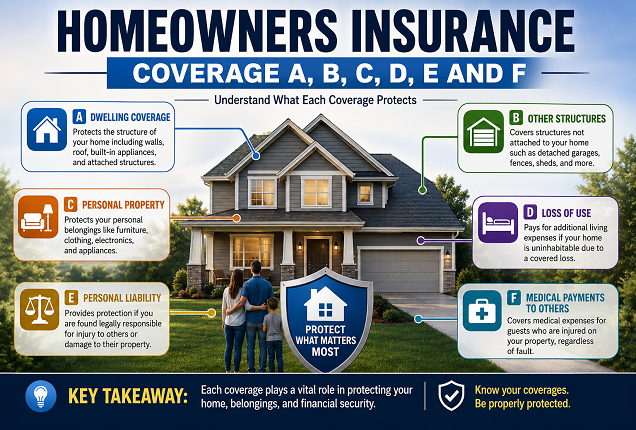
A standard homeowners policy is organized into six lettered coverages. Coverage A is the dwelling, Coverage B other structures, Coverage C personal property, Coverage D loss of use, Coverage E personal liability, and Coverage F medical payments to others. The first four pay for damage to your own property. The last two respond when someone else is injured or their property is damaged. Each carries its own separate limit, printed on your declarations page.

This article explains how a policy is organized. It is educational information, not financial, insurance or legal advice. For a question about your own coverage, speak to a licensed agent or your state Department of Insurance.

The letters are not a ranking and they are not sizes of the same thing. They are six different promises, and the reason they look like a list is that they are printed as one. If you have not found where they sit on your paperwork, how to read an insurance declarations page covers the layout.

The six letters, in one table

Three state insurance regulators publish plain-language descriptions of these coverages. The wording below is theirs.

Letter Name What it covers Usual relationship to Coverage A
A Dwelling The house itself and attached structures The base figure everything else is set from
B Other structures Structures on the premises not attached to the dwelling Normally 10 percent of Coverage A
C Personal property The contents of the home and personal belongings Typically 50 percent of Coverage A
D Loss of use Additional living expenses when the home cannot be lived in Normally 20 percent of Coverage A
E Personal liability Injury to others for which you are legally responsible Set as its own limit, not a percentage
F Medical payments to others Medical expenses of people accidentally injured on your property Set as its own limit, not a percentage

The North Carolina Department of Insurance publishes the 10 percent, 50 percent and 20 percent relationships. The California Department of Insurance, in its residential insurance guide issued as Form 401 and revised January 2026, gives the same figure for Coverage B and states that Coverage D is "normally limited to 20 percent of Coverage A."

The most useful thing to understand about that column is covered further down: those are defaults, not rules.

Section I and Section II: two contracts on one page

The six letters do not form a single scale. They divide in two, and the divide is the most important structural fact on the page.

Coverages A, B, C and D answer one question: my own property was damaged or made unusable, what does the policy pay. The North Carolina Department of Insurance describes Coverage A as protection for "your house and attached structures if it is damaged by a covered loss," and Coverage D as "additional living expenses if your home is damaged by a peril insured against to the extent that you cannot live in your home."

Coverages E and F answer a different question: someone other than me suffered a loss connected to my household. NC DOI describes Coverage E as coverage "in the event you or a resident of your household are legally responsible for injury to others," and Coverage F as "reasonable medical expenses for persons accidentally injured on your property."

That is why a reader cannot compare the limits down the column and conclude anything. A Coverage E limit and a Coverage C limit are not larger and smaller versions of the same protection. They are two unrelated promises that happen to be printed under one heading.

Coverage A: the dwelling, and why every other number depends on it

Coverage A is the anchor. The Iowa Insurance Division, in a consumer guide published April 4, 2024, calls it "the cornerstone of your homeowners policy, protecting the physical structure of your home against perils or causes of loss such as fire, windstorms, hail, lightning, and vandalism." The California Department of Insurance describes it as the "major property coverage that protects your house and attached structures."

Two practical consequences follow from that position.

The first is arithmetic. Because B, C and D are commonly written as a percentage of A, the Coverage A limit is not only the dwelling limit. It is the input that generates three other limits on the same page. A household that revises Coverage A and does not look further down the page has changed four numbers, not one.

The second is that Coverage A is a rebuilding figure rather than a market figure. The North Carolina Department of Insurance frames adequacy in terms of replacement cost rather than sale price. What a property would sell for includes land and location, and neither of those burns. The distinction between valuation bases, and where it is recorded on your own page, is set out in actual cash value vs replacement cost.

Coverages B, C and D: the three that are usually a percentage of A

Coverage B, other structures. NC DOI describes it as protection "to other structures on the residence premises that are not attached to the dwelling," and puts the default at 10 percent of Coverage A. The Iowa Insurance Division gives examples: "detached garages, sheds, fences, or guest houses." Whether a given structure is attached is a question about the structure, not about how it is used.

Coverage C, personal property. NC DOI describes it as protection "for the contents of your home and other personal belongings owned by you or family members," typically at 50 percent of Coverage A. Iowa lists "furniture, clothing, electronics, and appliances."

Coverage D, loss of use. NC DOI puts this at 20 percent of Coverage A and adds a procedural point most summaries skip: it is paid on documentation. Iowa's phrasing is that when a home "becomes uninhabitable due to a covered loss, loss of use coverage helps cover additional living expenses."

Now the correction. These percentages are published defaults, not the shape of every policy. They are the settings a policy commonly starts from, and what governs your coverage is the dollar limit printed beside each letter on your own declarations page. If your Coverage B limit is not 10 percent of your Coverage A limit, your policy is not wrong. It is simply not on the default, and the page is the authority.

That is also why the standard advice to "check your Coverage B" is not a matter of doing the multiplication. The multiplication tells you whether you are on the default. It tells you nothing about whether the default suits a property with a detached workshop on it, and that second question is one for a licensed agent looking at the actual property.

Coverage C is where the sub-limits live

Coverage C has a feature the other five do not, and it is the most common source of surprise on the page.

The overall Coverage C limit is not the maximum payable for every category of belonging. The North Carolina Department of Insurance states that the coverage carries limited coverage on categories including cash, jewelry, furs, manuscripts and collections. The California Department of Insurance likewise notes that personal property is subject to special limits on categories such as jewelry, firearms and fine arts.

In other words, a household can hold a large Coverage C limit and still find a category capped at a small figure well below it. The category caps are set inside the policy form rather than on the summary page, and the amounts vary by policy, so the only reliable figures are the ones in your own form.

What that means for reading the page: the Coverage C number tells you the ceiling for personal property as a whole. It does not tell you the ceiling for any one category, and the two are separate questions.

Coverage E and Coverage F have different triggers

These two sit side by side, are both about other people, and are commonly read as one large version and one small version of the same thing. They are not.

Coverage E responds to legal responsibility. NC DOI describes it as applying where you or a household resident "are legally responsible for injury to others," and notes that intentional acts are excluded.

Coverage F responds without it. The Iowa Insurance Division states that medical payments coverage "focuses specifically on covering medical expenses for guests injured on your property, regardless of fault."

That phrase is the whole distinction. Coverage F is a small, no-fault payment for a guest's medical expenses. Coverage E is the coverage that engages when responsibility is actually at issue. They can apply to the same incident, they can apply to different incidents, and neither one is a fraction of the other.

Coverage F also has boundaries worth knowing while the page is open. NC DOI states that it does not cover injuries to members of the household, and does not cover business activities. Injuries to the people who live in the house are not what this line is for.

What the letters do not tell you

The six letters describe what a policy is organized to cover. Four things are decided elsewhere in the contract, and none of them appears in the letter itself.

  • Whether a given cause of damage is covered at all. That is the perils section, and it depends on whether the coverage is written on a named peril or an open peril basis. See named perils vs open perils.
  • What is carved out regardless. That is the exclusions section, and it is separate from the perils section. See what a standard home policy never covers.
  • How a covered loss is valued. That is the valuation basis, set per coverage.
  • What is subtracted before payment, and what the ceiling is. That is the deductible and the limit, and the relationship between those numbers is set out in premium, deductible, limit, out-of-pocket.

A reader who knows the six letters can navigate the page. A reader who knows the letters, the perils basis, the exclusions and the deductible can read the policy.

How to read your own six lines

  1. Find the coverage table on the declarations page and write down the letter, the name and the dollar limit for each of the six.
  2. Check whether B, C and D sit on the published defaults of 10, 50 and 20 percent of Coverage A. Being off the default is information, not an error.
  3. Note which limits are property and which are liability. A through D on one side, E and F on the other, and do not compare across the line.
  4. Look for the special limits on Coverage C, which will be in the policy form rather than on the declarations page. Ask your insurer for the form by number if it is not in hand.
  5. Read the valuation word next to each property coverage separately, since it can differ between the dwelling and the contents.

For questions past that point, a licensed insurance agent can explain what a given limit does and what changing it would mean. Your insurer's service line can confirm what is on file. Your state Department of Insurance publishes consumer material on exactly this structure and handles complaints about how a company administers a policy, and the National Association of Insurance Commissioners maintains the directory of those state departments.

This site explains documents. It does not tell anyone what limits to carry, because that depends on the property, the household and the assets involved, and no article can see any of them. How sources are chosen here is set out in our editorial policy.

Frequently asked questions

Does every homeowners policy use these six letters?
The lettered structure is the common convention in the United States and is what North Carolina, California and Iowa regulators all describe. Layout and wording vary between insurers and between policy forms, and some pages list the coverages by name rather than by letter. Your own declarations page is the authority for your policy.

Is Coverage B always 10 percent of Coverage A?
No. Ten percent is the default that the North Carolina Department of Insurance publishes, and the California Department of Insurance gives the same figure. It is a common starting point, not a rule. The dollar limit printed on your declarations page is what applies.

What is the difference between Coverage E and Coverage F?
The trigger. Coverage E applies where you or a household resident are legally responsible for injury to others, in NC DOI's wording. Coverage F pays reasonable medical expenses for people accidentally injured on your property, and the Iowa Insurance Division states it applies regardless of fault.

Why is my jewelry capped below my Coverage C limit?
Because personal property coverage carries separate special limits on certain categories. The North Carolina Department of Insurance names cash, jewelry, furs, manuscripts and collections among them, and California names jewelry, firearms and fine arts. Those caps live in the policy form, and the amounts vary, so the form is where to read yours.


Sources: North Carolina Department of Insurance, "Basic Homeowners Insurance" (no date shown on the page). California Department of Insurance, "Residential Insurance: Homeowners and Renters," Form 401, revised January 2026. Iowa Insurance Division, "Consumer Connection: Understanding your Homeowners Policy," published April 4, 2024. All accessed August 6, 2026.