



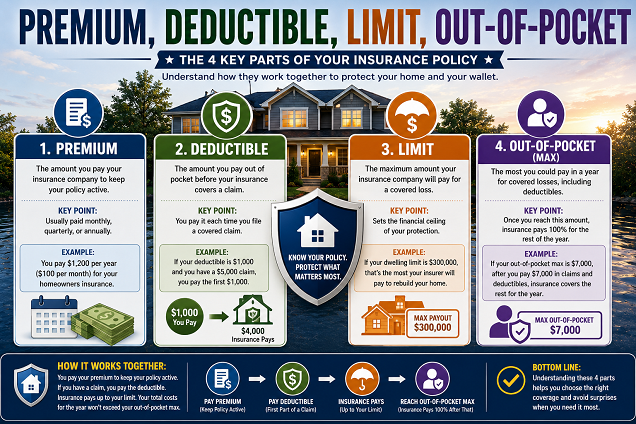
Premium is what you pay to hold the policy. Deductible is what is subtracted from a covered loss before the insurer pays. Limit is the most the insurer will pay for that coverage. Out-of-pocket is what ends up coming from you, which is the deductible plus anything above the limit or outside the coverage. Three of the four are printed on your declarations page. The fourth is arithmetic.
This article explains how policy terms work. It is educational information, not financial, insurance or legal advice. For a question about your own policy, speak to a licensed agent or your state Department of Insurance.
These four words are the vocabulary the rest of a policy is written in, and they are the four most commonly mixed up. Part of the reason is that the same words are used by health plans to mean something meaningfully different, and search results for them are dominated by the health-plan version. This page covers the property and casualty version first, on a homeowners, renters or auto policy, and then says exactly where the health-plan meanings diverge. If you want the page-by-page tour of the document these numbers sit on, start with how to read an insurance declarations page.
Premium: the price of the contract, and what it does not buy
The premium is the amount you pay the insurer to keep the policy in force for the policy period. It is billed monthly, quarterly, semiannually or annually, and on a home with a mortgage it is often paid out of an escrow account rather than by you directly.
Two things follow that people frequently expect and that are not true.
The premium does not accumulate. Paying premium for ten claim-free years does not build a balance, reduce a future deductible, or entitle you to anything at renewal. A property and casualty policy is a term contract for a defined period, and when the period ends the contract ends.
The premium is not part of your loss arithmetic. When a covered loss happens, the deductible and the limit decide what is paid. Premium paid does not enter that calculation in any way.
What the premium does reflect is the rest of the page. A lower deductible or a higher limit generally costs more premium, and the declarations page usually shows the discounts applied to arrive at the final figure. Which combination is right for a given household is a question for a licensed agent who can see the whole picture, not something a general article can answer.
Deductible: the amount subtracted, and how often it comes back
The deductible is the amount removed from a covered loss before the insurer pays anything. If a covered loss is smaller than the deductible, the policy pays nothing, which is the ordinary and intended result rather than a failure of the coverage.
The timing is the part that surprises people. The Insurance Information Institute states that deductibles apply each time you file a claim, with the exception that in Florida and Louisiana hurricane deductibles are applied once per season rather than for each storm. So a property deductible is not an annual allowance you work through. It resets to full for every separate covered loss.
A single policy also frequently carries more than one deductible. A homeowners policy commonly has one figure for most covered losses and a separate, larger one for wind, hail, hurricane or named storm, and the second is often written as a percentage rather than a dollar amount. That structure is the subject of its own page here: flat vs percentage deductibles.
One more boundary worth knowing. The Institute notes that deductibles generally apply to property damage rather than to the liability portion of a homeowners or auto policy. The liability coverages usually have no deductible at all.
Limit: the ceiling, and why a policy has several
The limit is the maximum the insurer will pay under a given coverage for a covered loss. Anything above it is yours.
The important structural point is the plural. A property policy does not have "a limit." It has one for each coverage. The Iowa Insurance Division, in a consumer guide published on April 4, 2024, sets out the standard homeowners coverages as Coverage A dwelling, Coverage B other structures, Coverage C personal property, Coverage D loss of use, Coverage E personal liability, and Coverage F medical payments to others. Each of those carries its own limit, and they are not interchangeable. Money left unused under Coverage A does not become available under Coverage C.
Beneath those headline limits sit sub-limits, which cap particular categories inside a coverage. Jewelry, cash, firearms and business property are the usual examples: they are covered under personal property, but only up to a smaller figure of their own.
Auto policies express limits differently, often as a pair or a trio of numbers for liability, with separate limits for collision, comprehensive and the various medical and uninsured motorist coverages. Same principle, different notation.
Out-of-pocket: the word that means two different things
On a property or auto policy, "out of pocket" is not a defined term with a line on your declarations page. It is a description of the total you end up paying, and it is made of three parts: the deductible, anything above the applicable limit, and anything the policy does not cover at all.
That total has no ceiling. A homeowners policy has no out-of-pocket maximum, because the concept does not exist in the property forms. If a loss exceeds the limit, the excess is simply yours.
This is exactly where the health-plan version of the vocabulary diverges, and where most of the confusion comes from. On a health plan, "out-of-pocket maximum" is a defined term with a specific figure, and it functions as a genuine annual ceiling on covered, in-network costs. On a homeowners policy there is no such number, and looking for one is looking for something the contract does not contain.
The four numbers working together in one covered loss
The numbers below are chosen because they divide cleanly. They are not presented as typical, and no figure here is a statement about what any policy costs or should be set at.
Say a policy carries a personal property limit of 100,000 dollars and a deductible of 1,000 dollars, and a covered loss damages property with a settled value of 12,000 dollars.
| Step | Figure | Where it comes from |
|---|---|---|
| Settled value of the covered loss | 12,000 | the claim settlement |
| Less the deductible | 1,000 | the deductible column on the declarations page |
| Insurer pays | 11,000 | arithmetic, provided the limit is not reached |
| Applicable limit | 100,000 | the limit column for that coverage |
| Your out-of-pocket | 1,000 | the deductible only, in this case |
Change one thing and the shape changes. If the settled value were 140,000 dollars against the same 100,000 dollar limit, the insurer would pay 100,000 minus the deductible, and your out-of-pocket would be the deductible plus the 40,000 above the limit. Change it again: if the loss is a peril the policy excludes, none of these numbers apply, because the deductible and the limit only operate on covered losses.
That last line is the one worth carrying away. The four numbers describe how much. Whether a loss is covered at all is decided by the policy form, not by any of them.
Where the health-plan version diverges
Health plans use three of these four words and add several of their own. The same word does a different job in each system.
| Term | On a homeowners, renters or auto policy | On a health plan |
|---|---|---|
| Premium | Price of the policy for the term. Not part of loss arithmetic | Price of the plan, usually monthly. Generally does not count toward the out-of-pocket maximum |
| Deductible | Subtracted per claim. Resets for every separate covered loss | An annual amount, met across the plan year |
| Limit | Many limits, one per coverage, plus sub-limits inside them | Coverage limits exist but the more prominent ceiling is the out-of-pocket maximum |
| Out-of-pocket | A description, not a defined term. No maximum exists | A defined term with a stated maximum on covered in-network costs |
| Coinsurance | Uncommon on a standard homeowners policy | Central: a percentage share after the deductible |
| Copay | Does not appear | A flat fee per service |
For the health-plan versions, the authoritative starting points are HealthCare.gov, which publishes a federal glossary of these terms, and your own plan's Summary of Benefits and Coverage, which is the standardized document every plan must provide. This site does not restate their definitions secondhand.
Where to check your own four numbers
All three of the printed numbers appear on your declarations page. The premium is usually at the bottom or in its own block. The limits and deductibles appear in the coverage table, side by side, one row per coverage. Read each row across rather than reading a column down, because a limit and a deductible only mean something as a pair.
Two further items on that page change what the numbers are worth. One is whether a coverage is written on a replacement cost or actual cash value basis, which is covered here in actual cash value vs replacement cost. The other is the list of form and endorsement numbers, which is where the definitions and exclusions live.
For a question about your own limits or deductibles, a licensed insurance agent can explain what your page says and what changing it would do. Your insurer's service line can confirm what is on file and send you the policy forms by number. Your state Department of Insurance is the neutral party, publishes consumer guides, and handles complaints about how a company is administering a policy. Have your declarations page and policy number in front of you for any of the three. Our disclaimer sets out what this site does and does not do.
Frequently asked questions
Does paying my deductible on one claim mean I do not pay it again that year?
On a property policy, no. The Insurance Information Institute states that deductibles apply each time you file a claim. The exception it names is that Florida and Louisiana apply hurricane deductibles once per season rather than per storm. A health plan works the opposite way, with an annual deductible met once across the plan year.
Why does my policy list several different limits?
Because a homeowners policy is several coverages in one contract. The Iowa Insurance Division lists Coverage A through Coverage F, each protecting something different, and each carries its own limit. Unused limit under one coverage is not available under another.
Is there a maximum I can be out of pocket on a homeowners claim?
No. There is no out-of-pocket maximum in a standard homeowners policy. That term belongs to health plans. On a property policy your exposure is the deductible plus anything above the limit plus anything the policy does not cover.
Does a lower deductible always cost more premium?
Generally the two move in opposite directions, which is why they are shown together on the declarations page. What that trade-off is worth depends on facts about your own situation, and a licensed agent looking at your actual policy is the right person to price it.
Sources: Insurance Information Institute, "Understanding your insurance deductibles" (no publication date shown on the page). Iowa Insurance Division, "Consumer Connection: Understanding your Homeowners Policy," published April 4, 2024. Maryland Insurance Administration, consumer material on understanding your declarations page. All accessed August 5, 2026.
